
Ever feel like the battle between a good habit and a bad habit isn't about willpower? You're right. It's about brain chemistry. Every single habit you have, whether it’s good for you or not, runs on a simple neurological loop: a cue sparks a routine, which gives you a reward. Getting a handle on this cycle is the secret to finally breaking free from destructive patterns and building ones that actually serve you.
Understanding The Science of How Habits Work
Have you ever wondered why ditching a bad habit, like smoking or vaping, feels like such an impossible climb? The reason is hardwired into our brains. Habits are basically shortcuts your brain creates to save mental energy. Once you do something enough times, it gets filed away as an automatic program, needing almost zero conscious thought to run.
This entire process is driven by a simple but powerful mechanism called the habit loop. It’s a three-part framework that’s behind almost everything we do on autopilot.
The Three Parts of The Habit Loop
The habit loop is made up of a few distinct parts that work together to cement a behaviour. Spotting these parts in your own life is the first real step towards making a change that sticks.
- The Cue: This is the trigger. It’s the thing that tells your brain to switch to automatic and run a specific habit. A cue can be anything – a time of day, a place, an emotion, or even just being around certain people.
- The Routine: This is the action itself, whether it’s physical, mental, or emotional. For someone who smokes, the routine is the whole ritual: reaching for the pack, lighting up, and taking that first drag.
- The Reward: This is the payoff. It’s what tells your brain, "Hey, that was good, let's remember this for next time." The reward could be the chemical hit from nicotine, a moment of stress relief, or even just fitting in socially.
Think about the classic morning coffee and cigarette. For so many, the smell of coffee brewing (the cue) instantly triggers reaching for a vape or cigarette (the routine). That combined rush of caffeine and nicotine delivers a powerful sense of satisfaction (the reward), soldering that connection even tighter for tomorrow.
Here’s the thing: your brain can’t tell the difference between a good habit and a bad habit; it just chases the reward. This is exactly why trying to 'just stop' through sheer force almost never works. The craving for that reward is still there, loud and clear.
Why 'Just Stopping' Is So Difficult
Because habits are so deeply ingrained, trying to just erase a bad one creates a vacuum. Your brain still gets the cue and desperately anticipates the reward, which is what causes those intense cravings. The trick isn’t to fight the habit, but to outsmart it by overwriting it.
When you understand your cues and the real reward you're chasing, you can consciously design a new, healthier routine to slot into that loop. Instead of fighting your brain’s natural wiring, you learn to work with it. This is the whole foundation for replacing a destructive habit like smoking with a mindful ritual using AuraFlow. You get to keep the cue, swap out the routine, and still give your brain a satisfying reward, without all the harm.
How to Pinpoint Your Habit Triggers

If you really want to replace a bad habit with a good one, you first have to become a bit of a detective in your own life. Every single habit—especially one as deeply rooted as smoking or vaping—is kicked into motion by a trigger. Think of it as a cue. Understanding what sparks that familiar routine is the absolute key to dismantling it.
So many of these triggers operate just beneath the surface of our conscious thought. They’re the subtle little nudges that send us on autopilot, reaching for a vape without even thinking. Once you become aware of them, you suddenly have the power to step in and make a different choice.
For the next week, your only job is to observe. Don't try to change a thing just yet; simply notice. Keep a small notebook or a note on your phone and jot down the answers to a few key questions every time you feel the urge to smoke or vape.
The Four Questions to Ask Yourself
This isn't meant to be homework. Think of it as a quick, two-minute data-gathering mission to uncover the patterns that have been quietly running your life. For each craving, just make a quick note of the following:
- Where are you? In the car? At your desk? Slumped on the sofa after work, or outside the pub with mates? Your environment is a massive cue.
- What time is it? Do you always reach for a vape at 10 AM with your coffee, or is it that 3 PM energy slump that gets you?
- How are you feeling? Are you stressed, bored, anxious, lonely, or maybe even happy and celebrating? Be honest with yourself about your emotional state.
- Who are you with? Are you alone? With that one colleague who also smokes? Or in a particular social group?
After just a few days of this, you’ll start to see clear patterns jumping out from your notes. You might realise your biggest trigger isn't just "stress," but the specific stress you feel right after a difficult meeting. Or maybe it’s not simply "boredom," but the unstructured downtime you have while waiting for the train.
This table can help you connect the dots between the cue and what you really need in that moment.
Decoding Smoking Triggers and Their True Needs
| Common Trigger (Cue) | Associated Routine | Potential Underlying Need | Healthy Replacement Idea |
|---|---|---|---|
| Morning Coffee | The first smoke of the day | A moment of quiet ritual to start the day | A few mindful breaths with AuraFlow, stretching |
| Driving in the Car | Vaping on the commute | A way to manage boredom or traffic stress | Listening to a podcast, mindful breathing |
| After a Meal | A "digestive" cigarette | A signal that the meal is finished, a pause | A short walk, sipping herbal tea |
| Feeling Stressed at Work | Stepping out for a smoke break | A mental break, stress relief, a change of scenery | A 5-minute walk, using AuraFlow at your desk |
| Socialising at a Pub | Smoking with friends | A sense of belonging, social ritual | Stepping out with friends but using a healthy alternative |
| Feeling Bored | Mindless vaping | A need for stimulation or distraction | A quick puzzle on your phone, a creative doodle |
Seeing your triggers laid out like this makes them far less powerful.
By identifying the specific circumstances that lead to your craving, you are no longer a victim of a mysterious urge. You now have a precise moment in your day where you can consciously choose to introduce a new, healthier routine instead.
This awareness is your launchpad. For instance, many people find their habit is deeply connected to a physical sensation—the simple act of bringing something to their mouth. This is often called an oral fixation, and it’s a powerful driver. If this rings true for you, understanding it helps you choose a replacement that truly satisfies that underlying need, making the new habit far more likely to stick.
Designing a Better Habit Replacement Plan
Right, you’ve pinpointed the triggers that fire up your old habits. Now for the clever part: building a new, better routine to take its place.
The goal isn’t to fight your brain’s wiring—that’s a battle you’ll rarely win. Instead, we’re going to hijack the old habit loop. You keep the cue, satisfy that deep-down craving for a reward, but consciously swap out the harmful routine for something that actually serves you. This is where we move from thinking to doing.
The most effective way to build a good habit is to make it obvious, attractive, easy, and satisfying. To break a bad habit, you simply flip that on its head: make it invisible, unattractive, difficult, and unsatisfying.
Let’s get practical and make your new routine impossible to ignore and genuinely enjoyable.
Making Your New Habit Obvious and Attractive
First things first, you need to design your environment for success. If you want to replace that morning cigarette with a few mindful breaths, don’t leave your AuraFlow tucked away in a drawer. The night before, place it right next to your coffee machine. This simple act makes the new choice the most obvious one when that morning coffee cue hits.
Next, you have to want to do it. Making the new routine attractive is key. A vague goal like "I should meditate" isn't going to cut it when a real craving strikes. You need to frame it as something you look forward to. Think of it as your "five-minute mental reset" or your "personal calm-down ritual."
Try thinking in terms of simple swaps:
- Instead of a smoke break: Call it a "fresh air break." Walk around the block and listen to one of your favourite songs.
- Instead of vaping out of boredom: Frame it as a "five-minute puzzle challenge" on your phone.
The key is to make the new habit feel like a treat, not a chore. A recent YouGov study found that healthy eating is the top positive habit among UK adults, with 52% of people doing it. Why? Because the benefits feel good. By framing your new habit as an act of self-care, you tap into that same powerful motivation.
Making It Easy and Satisfying
Friction is the enemy of any new habit. If it’s even a little bit difficult to start, you’ll probably find an excuse not to. Your replacement routine needs to be incredibly easy.
Think of the "two-minute rule." If your big goal is to start running, the first step is just putting on your running shoes. For replacing smoking, the action is as simple as picking up your AuraFlow. Make it so easy you can’t say no.
The final piece of the puzzle is to make the new routine immediately satisfying. Your brain needs a quick win to prove the new loop is worth remembering.
A reward doesn’t have to be a big deal. It can be the refreshing taste of an AuraFlow flavour, the simple satisfaction of ticking a box on a habit tracker, or just taking a quiet moment to tell yourself, "I did it." This immediate feedback is what convinces your brain to repeat the action next time.
This is especially crucial if you’re trying to break away from digital distractions like mindless scrolling. For anyone looking for targeted strategies to tackle digital habits, exploring resources can provide practical phone addiction help. Combining an easy, physical ritual with a solid plan to reduce digital temptations can be an incredibly powerful strategy for real change.
Your First 30 Days of Habit Change
Trying to swap a lifelong bad habit for a good one feels like a mountain to climb. But when you break it down into a 30-day plan, it suddenly becomes a series of manageable hills. Think of this as a roadmap, not a rigid set of rules. We’re aiming for progress, not perfection.
The first month is all about laying a solid foundation. You'll move from just watching your own behaviour to taking consistent action, turning a huge challenge into small, weekly wins.
Week One: Focus on Awareness
This week, your only job is to be a detective. Seriously. Don't even think about quitting yet—that pressure doesn't help anyone. Your mission is to gather intelligence on your own habit. Keep tracking those triggers we talked about, noting exactly when and why the urge to smoke or vape pops up.
By the end of the week, you should have a pretty clear map of your habit's cues. You’ll start to see the patterns: the specific times, places, and feelings that make you reach for your vape on autopilot. This awareness is the most powerful weapon in your arsenal.
Week Two: Introduce The Replacement
Right, now it’s time to bring in your new routine. Start small. Pick a low-stress situation where you feel completely in control. For example, if you know you always vape after dinner at home, that's the perfect place to begin.
- The Cue: Finishing your meal.
- The Old Routine: Reaching for a vape.
- The New Routine: Pick up your AuraFlow and take a few slow, mindful breaths.
Forget about tackling your biggest triggers for now—like that Friday night with friends or a stressful work deadline. Just focus on racking up small, consistent wins in these easy scenarios. And celebrate every single time you make the swap. That little hit of self-praise is more important than you think.
"The first mistake is never the one that ruins you. It is the spiral of repeated mistakes that follows. Missing once is an accident. Missing twice is the start of a new habit."
This quote is a great reminder that one slip-up means nothing. It’s not a failure. The real goal is to just get back on track with the very next opportunity. Consistency will always beat perfection.
This is where understanding how habits are formed really helps. This simple visual breaks it down into four key steps.
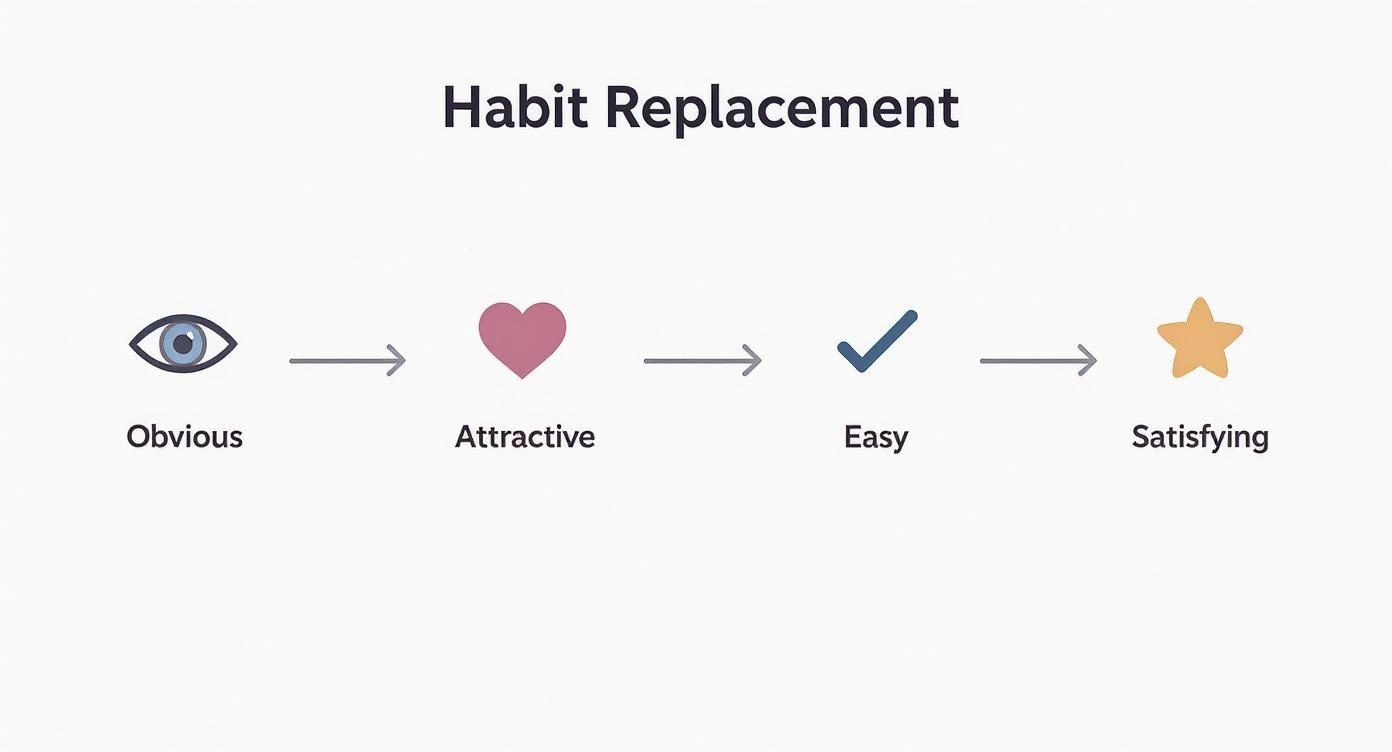
As you can see, making a new habit obvious, attractive, easy, and satisfying is the secret sauce to making it stick.
Week Three: Build Consistency
You’ve got a week of practice under your belt. Time to turn up the heat just a little. Start using your replacement habit in slightly more challenging situations. If work stress is a major cue, this is the week to consciously grab your AuraFlow instead of stepping outside for a smoke.
This is also a good time to double down on other coping strategies. For example, you can explore powerful deep breathing techniques for relaxation that pair perfectly with your new mindful ritual. Having more than one tool in your toolkit gives you more ways to handle those tough cravings when they hit hard. Expect this week to test you, but remember: every successful replacement is strengthening that new pathway in your brain.
Week Four: Reinforce and Plan Ahead
By week four, this new routine should be starting to feel a bit more natural. The automatic pull of the old habit will hopefully be fading. Use this week to look back at your progress. Which situations are still a bit tricky? Where do you feel most confident?
Take a moment to acknowledge how far you've come. This final week is all about cementing the new behaviour and thinking about what comes next. You’ve navigated the first 30 days and proved to yourself that you can do this. You now have a solid foundation to build on for good.
How to Recover from Setbacks and Stay Motivated
Let’s be honest. When you’re swapping a long-term bad habit for a good habit, slip-ups aren't just possible; they’re pretty much guaranteed. A setback is a normal part of the process, not a sign that you’ve failed. The real trap isn’t the mistake itself, but the toxic ‘all-or-nothing’ mindset that can creep in afterwards.
You miss one day, have one cigarette, and your brain immediately jumps to, "Well, that's it. You've ruined it. Might as well give up." That kind of thinking is the true enemy of long-term change.
The secret to getting back on track is a simple but powerful rule: never miss twice. One slip-up is an accident. Two in a row is the start of a new, unwanted habit. So if you stumble today, your only job is to get back to your new routine tomorrow. That's it.
Practising Self-Compassion After a Slip
Beating yourself up after a mistake only piles on stress and shame—two massive triggers for falling right back into old patterns. Instead of harsh self-criticism, try a little self-compassion. Acknowledge that it was a tough moment, that you’re only human, and that you're still committed to trying again.
Treat yourself with the same kindness you’d offer a friend. This doesn't just feel better; it's genuinely more effective. By managing the negative feelings that follow a setback, you stop them from becoming the next trigger. For a bit more support here, you can explore some effective and healthy coping mechanisms for stress to help strengthen your resolve.
Keeping Your 'Why' in Clear Sight
Motivation can feel like it comes and goes, which is why you can't rely on it alone. You need to constantly reconnect with your core reason for making this change in the first place. Why did you even start this journey?
- Was it for your health? Write down exactly how much better you'll feel.
- For your finances? Calculate the actual money you're saving each week.
- For your freedom? Picture a life that isn't controlled by cravings.
Visual reminders are incredibly powerful. Stick a Post-it note on your mirror or set a daily reminder on your phone with your "why." Seeing it every day keeps your long-term goals front and centre, especially on those days when your short-term willpower is running low.
This focus on tangible goals is something we see in wider wellness trends. A recent HSBC UK survey found that half of UK adults are actively budgeting and trying to build good financial habits. Despite this, one in three still struggle with regular saving, which just goes to show that even with the best intentions, consistency is the real mountain to climb.
Procrastination is another huge barrier that can kill your momentum and motivation. Learning some powerful techniques to overcome procrastination will help keep you moving forward. Remember, this journey is a marathon, not a sprint. Every single step forward, no matter how small, is a win.
Common Questions on the Path to Change
Stepping away from an old habit and building a new one always brings up questions. It's completely normal. Getting a straight answer can be the difference between pushing through a tough moment and falling back into old patterns. Here are a few things people often ask when they start this journey.
How Long Does It Really Take to Build a New Habit?
Let's get one thing straight: the whole "21 days" thing is a myth. It came from a misread study decades ago and has stuck around ever since, causing a lot of unnecessary frustration.
The truth is, modern research shows it can take anywhere from 18 to 254 days for a new behaviour to feel automatic. The real timeline depends on you, your life, and the habit itself. Something simple like drinking a glass of water first thing in the morning might click in a few weeks. But replacing a deeply wired habit like smoking? That's going to take more time and patience. The key is consistency, not speed.
Don't get discouraged if your new routine doesn't feel natural after three weeks. You're not failing. You're in the middle of a complex but worthwhile process of rewiring your brain. Be kind to yourself.
What If My New Habit Doesn't Feel Rewarding?
This is a big one. A bad habit, like vaping, gives your brain an instant chemical hit it’s learned to crave. Healthier habits often have a delayed payoff, which can feel a bit flat at first.
So, in the beginning, you have to create the reward yourself.
- Acknowledge the Win: Seriously, take a moment and tell yourself, "Good job. I made the right choice for myself." It sounds simple, but it helps.
- Track Your Progress: There's something deeply satisfying about putting a tick on a calendar or in an app. It's a visual reminder that you're succeeding.
- Habit Pairing: Link your new, healthy action to something you already love. For example, use your AuraFlow for five minutes while listening to your favourite podcast.
Soon enough, the real benefits—like breathing easier, feeling more in control, and saving money—will become powerful rewards in their own right.
How Do I Stick to My Goals Around Unsupportive People?
This is tough, no doubt about it. Your social circle has a massive impact on your behaviour. When friends or family carry on with the very habit you’re trying to kick, it can feel isolating and make it incredibly tempting to slip.
Clear, calm communication is your best friend here. You don’t need to give a lecture, but you can explain what you're doing. A simple, "I'm not smoking at the moment, just trying to get a bit healthier," is usually all it takes.
If you can, try suggesting a change of scenery for social plans. Maybe meet for a walk or a coffee instead of gathering in the usual spot where the old habit was front and centre. Your real friends will respect your choice, even if they don't quite get it yet.
Ready to build a better ritual? The AuraFlow Starter Kit is designed to replace the physical act of smoking with a mindful, nicotine-free alternative, making it easier to build a good habit that lasts. Discover the difference at https://aura-flow.co.uk.