
Mindful meditation for beginners is simply the skill of paying attention to right now, on purpose, without judging yourself for it. It's a common myth that you need to empty your mind. The real goal is to notice your thoughts and feelings as they float by, like clouds in the sky.
Think of it as a workout for your brain, building up your muscles of focus and calm.
What Is Mindful Meditation Really About
Let's cut through all the noise. It’s easy to get lost in images of silent retreats or complicated philosophies, but the truth is, mindfulness is much more down-to-earth than that.
At its heart, mindfulness is about grounding yourself in the here and now. Instead of getting carried away by worries about what’s next or regrets about what’s already happened, you learn to gently pull your focus back to your current experience. This could be the simple feeling of your breath, the rich taste of your morning coffee, or the sound of rain against the window.
The practice isn’t about chasing some perfect, blissful state. It’s about building a better, kinder relationship with your own mind. Best of all? It requires no special equipment—just a bit of willingness to try.
Unpacking the Core Idea
Here’s the secret most beginners miss: the most important part of the practice isn't keeping a perfect focus. It’s what you do the moment you realise you’ve lost it. Your mind will wander. That’s a guarantee. The real “work” of meditation happens in that gentle, non-judgemental moment you notice you've been distracted and guide your attention back.
This simple act of noticing and returning, repeated over and over, is what strengthens your "mindfulness muscle." It teaches you to observe your thoughts without getting tangled up in them, giving you a powerful new way to handle daily stress.
It's a practice that's really taking hold. In the UK, it's estimated that around 8.3 million adults—about 15% of the adult population—have tried some form of mindfulness or meditation. You can dig deeper into these meditation uptake statistics and figures.
Mindfulness vs Misconceptions A Quick Overview for Beginners
To help clear things up, let's quickly tackle some of the most common misunderstandings people have when they first start out.
| What Mindfulness Is | What Mindfulness Is Not |
|---|---|
| Noticing your thoughts and feelings. | Forcing your mind to be empty or blank. |
| Being present in the current moment. | Escaping from reality or your problems. |
| A skill you can train with practice. | A quick fix for all of life's issues. |
| Gently guiding your attention back. | Being perfect or never getting distracted. |
| An act of kindness towards yourself. | Another thing to judge yourself for. |
Seeing the difference can be a real lightbulb moment. It’s not about fighting your mind, but learning to work with it.
Mindfulness in Everyday Life
This skill isn't something you only use when you're sitting on a cushion. It seeps into every part of your life, turning mundane activities into moments of genuine presence. The core ideas are so universal they can even be adapted for all ages; you can explore how younger beginners benefit from specific approaches like guided meditation for children.
Here are a few simple ways mindfulness can show up in your day-to-day:
- Mindful Eating: Actually tasting each bite of your meal instead of just getting through it on autopilot.
- Mindful Walking: Paying attention to the feeling of your feet on the ground with each step you take.
- Mindful Listening: Giving someone your full attention in a conversation, without just planning what you're going to say next.
Ultimately, mindful meditation for beginners is about cultivating more awareness, kindness, and presence in your life, one moment at a time.
The Real-World Benefits of a Mindful Practice

It’s fair to wonder if sitting quietly for a few minutes each day can really make a difference. The truth is, the benefits of mindful meditation aren't just vague, feel-good ideas. They're tangible changes you can see in your daily life, from feeling calmer during a hectic workday to finally getting a better night's sleep.
This isn’t magic. It all stems from the simple practice of training your attention, which has a direct impact on how your brain and body respond to stress.
Imagine you're in a tense meeting. Your heart starts racing, your thoughts spiral, and that familiar feeling of being overwhelmed creeps in. Mindfulness hands you a tool to interrupt that automatic reaction.
By bringing your focus back to your breath, you activate your body’s parasympathetic nervous system—its natural “rest and digest” mode. This simple act can slow your heart rate and bring a wave of calm, even when the pressure is on. It's a practical skill you can pull out of your back pocket anywhere, anytime.
Tangible Improvements to Your Wellbeing
The positive effects of mindfulness are well-documented and show up in very real ways. Consistently practising, even for short bursts, can lead to significant shifts in how you feel and function day-to-day.
By learning to observe your thoughts without getting swept away by them, you create a small but powerful space between a trigger—like a critical email—and your reaction. This space gives you the freedom to choose a more measured response instead of a knee-jerk one.
Research from a UK-based trial highlights just how effective this can be. Participants using a mindfulness app for just 10 minutes daily saw measurable mental health benefits after only 30 days. The study found a 19.2% reduction in depression symptoms and a 12.6% drop in anxiety compared to those who didn't practice.
From Better Sleep to Sharper Focus
Beyond just managing stress, a regular mindful practice brings a whole host of other practical benefits that can genuinely improve your quality of life.
- Improved Sleep Quality: By calming a racing mind, mindfulness helps you detach from the day's worries, making it easier to fall asleep and stay asleep.
- Enhanced Focus and Concentration: Just like lifting weights builds muscle, regularly bringing your attention back to your breath strengthens your ability to concentrate on tasks.
- Greater Emotional Regulation: Mindfulness helps you recognise and acknowledge your feelings without being controlled by them, leading to less emotional reactivity.
- Increased Self-Awareness: You start to understand your own mental patterns and habits much more clearly, which is always the first step toward making positive changes.
Much of this is connected to the simple act of conscious breathing, which is a cornerstone of the practice. Digging into the benefits of deep breathing exercises can give you even more insight into how this process works. At the end of the day, this isn't about becoming a different person—it's about becoming more skilfully and calmly yourself.
How to Prepare for Your First Meditation
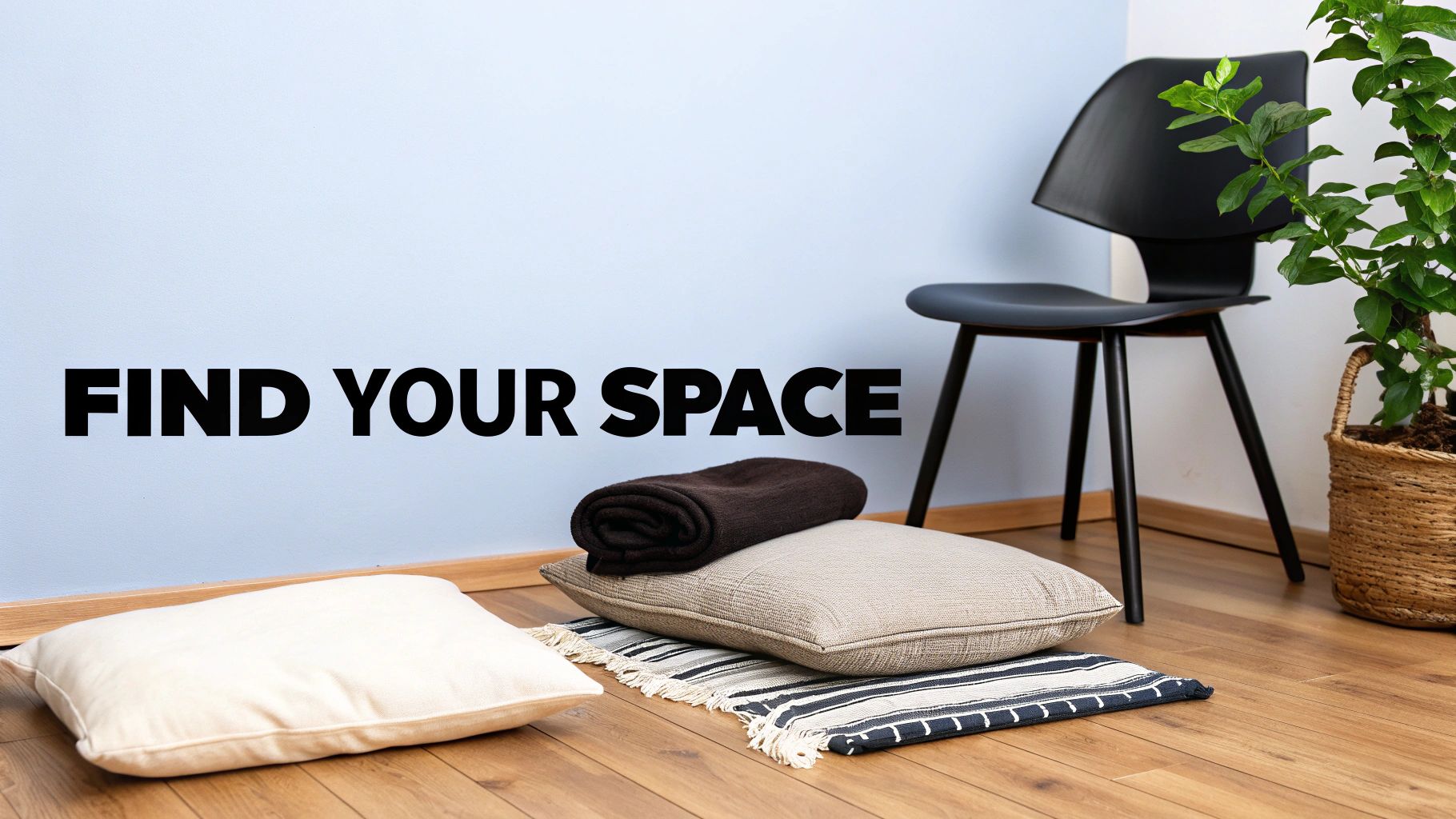
Jumping into mindful meditation isn't about following a strict rulebook. It's more like creating a gentle invitation for your mind to settle down for a few minutes. You don’t need a special room or any expensive gear—you just need to set the scene for a bit of quiet.
The very first step is deciding where you’ll practise. This doesn't have to be some permanent, dedicated shrine. It could be your favourite armchair, a quiet corner of the bedroom, or even a spot on the sofa before anyone else wakes up. The main thing is to pick a place where you feel comfortable and are unlikely to be interrupted.
Finding a Comfortable Posture
One of the biggest myths I hear about meditation is that you have to sit on the floor in a complicated cross-legged pose. The truth is, your posture is there to support your practice, not get in the way of it. The real key is to find a position that feels both alert and relaxed.
Here are a few simple options that work really well for beginners:
- Sitting in a chair: This is probably the easiest way to start. Sit with your back straight but not rigid—try moving away from the back of the chair. Let your feet rest flat on the floor and place your hands gently on your thighs or in your lap.
- Sitting on a cushion: If you'd rather be on the floor, a cushion can lift your hips slightly above your knees. This simple trick takes the strain off your back and helps your spine stay naturally upright without any effort.
- Lying down: This is super comfortable, but it does come with a risk: you might just fall asleep. If you choose to lie down, keep your legs uncrossed and let your arms rest by your sides with your palms facing up. Bending your knees slightly can also give your lower back some extra support.
Whichever position you land on, the goal is to create a sense of stability and ease. You're trying to send your body a signal that it’s time to be still, but not quite time for a nap.
Your body is your primary tool for meditation. By finding a posture that feels dignified and comfortable, you create a physical foundation that allows your mind to feel more grounded and at ease.
Setting the Scene and Your Intention
Once you have your spot and you're sitting comfortably, think about the environment. You don't need total silence. In fact, learning to meditate with a bit of background noise is a really useful skill. Just try to get rid of the obvious distractions. Put your phone on silent and, even better, place it out of arm's reach. If you live with others, just let them know you'd like a few minutes to yourself.
With digital tools making meditation more accessible than ever, it's no surprise the industry is growing. The UK’s meditation and yoga services market is forecast to be worth $12.3 billion by 2025, driven largely by apps. You can discover more insights into the booming UK digital meditation market if you're curious.
Right before you begin, set a simple intention. This isn't a goal you have to nail, but more of a gentle guide for your session. It could be something like, “For the next five minutes, I’m just going to be curious about my breath,” or “I’ll be kind to myself when my mind wanders.” It’s a small step, but it helps frame your practice with purpose.
Finally, pick an anchor for your focus. Think of this as a home base for your attention—a neutral spot you can return to whenever you notice your mind has drifted off. For most people starting out, the breath is the most natural anchor. You could focus on the feeling of the air as it enters your nostrils, or maybe the gentle rise and fall of your belly. Other easy anchors include the sensation of your hands in your lap or your feet on the floor.
With your space, posture, and anchor chosen, you're not just ready to start—you're already doing it. You've just mindfully prepared for your first session.
Your First Week Meditation Plan
Getting started is often the hardest part, so I've put together a simple, progressive plan to help you build a consistent habit this week without feeling overwhelmed. Think of it as a gentle ramp-up.
| Day | Duration | Focus Point | Tip for the Day |
|---|---|---|---|
| Day 1 | 3 minutes | The feeling of your feet on the floor. | Don't worry about "doing it right." Just sit and notice. |
| Day 2 | 3 minutes | The rise and fall of your abdomen. | When your mind wanders (it will!), gently guide it back. |
| Day 3 | 5 minutes | The sensation of air at your nostrils. | Try meditating at the same time you did yesterday. |
| Day 4 | 5 minutes | The weight of your hands in your lap. | Acknowledge any feelings of restlessness without judgment. |
| Day 5 | 7 minutes | Your choice of breath or body sensation. | Congratulate yourself for showing up for five days straight! |
| Day 6 | 7 minutes | Sounds around you, near and far. | Notice sounds without labelling them as "good" or "bad." |
| Day 7 | 10 minutes | A full body scan, from toes to head. | You did it! Reflect for a moment on how you feel after a full week. |
This plan is just a suggestion. The most important thing is to be kind to yourself and celebrate the fact that you're taking this time for your well-being.
Beginner-Friendly Mindfulness Techniques
Right, you’ve found your spot and you’re ready to begin. So, what now?
It’s time to explore a few simple yet incredibly powerful techniques. When people hear "mindful meditation," they often think it’s all about focusing on the breath. While that's a fantastic starting point, it’s not the only way. There are several different doorways into the same room of present-moment awareness.
Think of it this way: some days, one door will feel easier to open than another. The goal here isn't to master a specific technique overnight. It's about approaching this with a bit of gentle curiosity and seeing what clicks for you.
Ultimately, the best technique is the one you’ll actually do. Let’s look at a couple of popular and effective methods that are perfect when you're just starting out.
The Body Scan Meditation
The body scan is a brilliant way to ground yourself, especially when your mind feels like it's racing in a hundred different directions. Instead of trying to pin your focus on one single point like the breath, you gently guide your attention through your entire body, piece by piece. It's a fantastic practice for reconnecting your mind and body.
Here’s how you can give it a go:
- Settle In: Start by lying down comfortably on your back, if you can. Let your arms rest by your sides. If sitting is better for you, that’s perfectly fine too. Gently close your eyes.
- Start with Your Toes: Bring your full attention to the toes of your left foot. Just notice any sensations you find there—maybe warmth, a bit of coolness, a tingling feeling, or perhaps nothing at all. There’s no need to judge or change a thing; just observe.
- Move Upwards, Slowly: After a few moments, guide your awareness up to the sole of your foot, then your heel, your ankle, and continue slowly up your leg. Spend a little time with each part before moving on, simply noticing whatever sensations are present.
- Continue Through the Body: Work your way through your other leg, your hips, torso, arms, hands, and finally up to your neck and head. The whole point is to be methodical and gentle with yourself.
This practice helps you notice physical sensations without getting tangled up in the stories your mind might create about them. You’re simply observing what’s already there.
Mindful Listening Practice
What happens when your environment is noisy? This is where mindful listening comes in. It cleverly turns a potential distraction into the very anchor for your meditation. It's a wonderful technique for cultivating awareness in the middle of a busy day, whether you’re at home with the family or in a bustling office.
Instead of fighting to block out sounds, you intentionally open your awareness to them. You learn to treat sounds as neutral events, like waves appearing and disappearing in your mind. Notice the pitch, volume, and length of each sound without slapping a label on it like "good" (birdsong) or "bad" (traffic).
A key insight for beginners is realising you don't need a silent monastery to practise mindfulness. By using the sounds around you as your focus, you learn to find calm and presence right in the middle of your real life.
This technique is a game-changer for anyone who feels their mind is constantly on the go. Exploring other mindfulness strategies for a busy mind can arm you with even more tools for those moments.
Each of these practices, from body scans to listening, helps build the same core skill of awareness. If you want to dive deeper into the foundational element of so many meditation practices, our guide to mindful breathing techniques is a great next step.
What to Do When Meditation Feels Hard
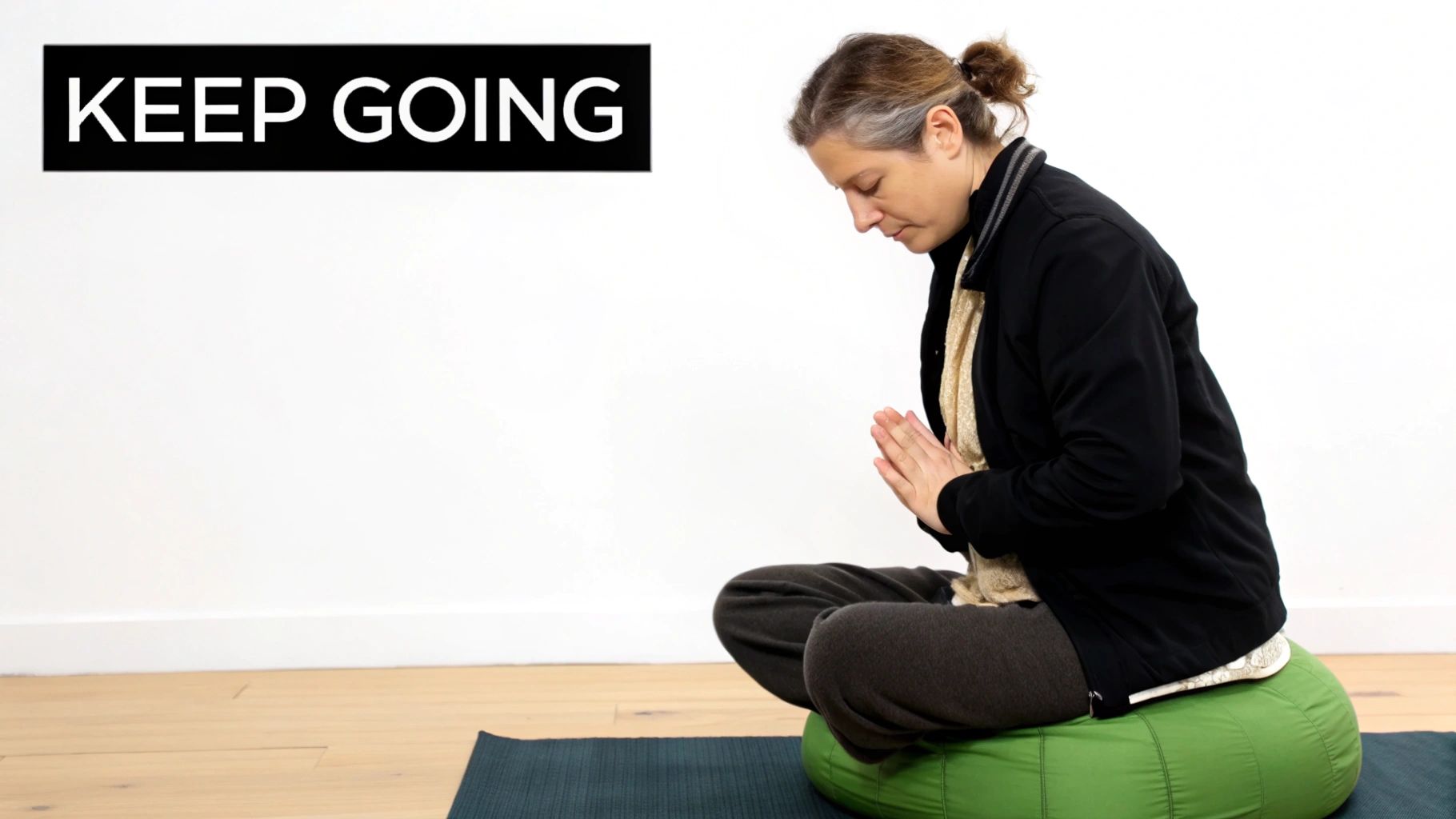
Let's be completely honest. Meditation isn’t always the blissful, serene escape it's made out to be. Some days, just sitting down to practise will feel like a genuine struggle, and that’s perfectly normal.
In fact, it’s often in these challenging sessions that you make the most progress.
Many beginners get tripped up by the idea they're "failing" when their mind refuses to quieten down. You sit, ready for calm, and are immediately ambushed by to-do lists, old conversations, or a hundred random worries. Welcome to the famous "monkey mind." Meeting it isn't a sign you're doing anything wrong.
It’s the opposite. The moment you notice your mind has wandered is the entire point. That brief, gentle "oh, there my thoughts go again" is the rep that builds your mindfulness muscle.
Taming the Monkey Mind
The goal isn't to somehow force your thoughts into silence—that's an impossible task. The real aim is to change your relationship with them. Instead of getting swept away by the current of your thinking, you're learning to sit on the riverbank and just watch the thoughts float by.
Each time you notice your mind has drifted and you gently guide your attention back to your breath, you are succeeding. This act of returning, again and again, is the entire practice in a nutshell.
This is an incredibly useful skill for managing overwhelming feelings. If you're looking for more ways to apply this, exploring specific mindfulness exercises for anxiety can give you practical tools for those really stressful moments. It’s all about learning to observe feelings without letting them take over.
Dealing with Drowsiness and Restlessness
Beyond a busy mind, the other common hurdles are feeling sleepy or incredibly fidgety. These can feel just as frustrating as mental chatter, but there are simple, practical adjustments you can make.
If you find yourself nodding off:
- Check Your Posture: Gently straighten your spine. A slightly more alert, upright posture sends a signal to your body and mind to stay awake.
- Open Your Eyes: You don't have to close them. Try meditating with a soft, unfocused gaze directed towards the floor a few feet in front of you.
- Change Your Timing: If you always practise right before bed, you might simply be too tired. Experiment with a morning or mid-day session instead.
If restlessness is the problem:
- Acknowledge It: Instead of fighting the urge to move, bring your attention to the feeling of restlessness itself. Where is it in your body? What does it feel like?
- Try a Walking Meditation: Sometimes, the body just needs to move. A slow, mindful walk where you focus on the sensation of your feet on the ground can be a powerful alternative.
- Shorten Your Sessions: It's far better to have a focused three-minute session than a restless and frustrating ten-minute one.
Remember, every single person who meditates runs into these challenges. By meeting them with curiosity instead of frustration, you turn them from obstacles into opportunities for a deeper, more honest practice.
Common Questions from Beginners
As you start exploring mindful meditation, it's completely normal for a few practical questions to bubble up. Feeling a bit of uncertainty is just part of the process for everyone starting out. Let's tackle some of the most common queries beginners have, giving you clear, straightforward answers to help you practise with more confidence.
How Long Should I Meditate for When Starting Out?
When you're new to this, consistency beats duration. Every single time.
Start with a length that feels genuinely achievable, not like another chore you have to tick off a list. A short session of three to five minutes a day is a perfect place to begin.
It might not sound like much, but committing to this small window is how you build the all-important habit. Once you feel comfortable sitting for that long every day for a week or two, you can think about gradually increasing the time to ten minutes. The real goal is to choose a duration you can stick with.
Do I Need to Sit on the Floor with My Legs Crossed?
Absolutely not. This is probably one of the biggest and most unhelpful myths about meditation. The most important thing—the only important thing—is finding a posture that is comfortable, stable, and helps you stay alert.
Sitting upright in a chair with your feet flat on the floor and your back straight (but not rigid) is a brilliant way to meditate. You can also use cushions for support on the floor, or even lie down if that works for you, though be warned it can sometimes make you a bit sleepy.
Just choose whatever position feels right for your body and helps you feel grounded.
The "right" posture is simply the one that supports your practice, not one that causes you pain or distraction. Your comfort is key to allowing your mind to settle.
What if I Cannot Clear My Mind of Thoughts?
Welcome to being human! The goal of mindful meditation, especially for beginners, isn't to stop your thoughts or force your mind into some kind of blank void. That's an impossible task that only leads to frustration.
The real practice is much more subtle: it's about learning to change your relationship with your thoughts.
You’re training yourself to notice when thoughts pop up, without getting carried away by them. When you realise your mind has wandered off, you just gently acknowledge it and guide your attention back to your anchor, like the feeling of your breath. Every single time you do this, you are successfully meditating. A busy mind isn't a sign you're failing; it’s the very training ground for your practice.
Should I Use a Guided App or Meditate in Silence?
For most people starting out, guided meditation apps can be a massive help. They give you a bit of structure, clear instructions, and a gentle voice to bring you back when your attention inevitably drifts. This can make staying focused a lot easier at the beginning.
There are loads of excellent apps and free online resources that are perfect for getting started.
As you get more experienced, you might find you prefer the quiet space of meditating in silence. There's no right or wrong answer here, and many seasoned meditators switch between both. Feel free to experiment and see what works best for you right now.
At AuraFlow, we believe in the power of mindful rituals to create calm and break unwanted habits. Our nicotine-free inhalation alternative is designed to replace cravings with moments of clarity and natural flavour, supporting your journey one gentle breath at a time. Discover a new way to find your centre at https://aura-flow.co.uk.