
Old Jamaica Sweet Tobacco wasn't actually tobacco at all. It was a clever British sweet made from shredded coconut, but it came wrapped in red waxed paper designed to look just like a tobacco pouch. For kids, it was a way to playfully copy the grown-ups without any of the harm. The real magic of this nostalgic treat was all tied up in the sensory ritual of its unique packaging and texture.
What Was Old Jamaica Sweet Tobacco?

For whole generations of British kids, the name "Old Jamaica Sweet Tobacco" conjures up vivid memories of corner shops and pocket money. But despite the name, it contained no tobacco or nicotine whatsoever.
It was actually a unique sweet made from fine shreds of coconut, sometimes with a little hint of ginger or other warm spices. A dusting of cocoa powder gave it that brownish, tobacco-like look, completing the illusion.
But the real genius was in its presentation. The sweet was ingeniously packaged to mimic a pouch of chewing tobacco, turning a simple coconut treat into a playful imitation of an adult habit. It tapped right into a child's imagination.
This clever packaging transformed a simple sweet into an entire experience. For many, the ritual of opening it was just as important as the flavour inside.
To give you a quick overview, here’s a simple breakdown of what made this sweet so memorable.
Old Jamaica Sweet Tobacco At a Glance
| Characteristic | Description |
|---|---|
| Main Ingredient | Shredded coconut, dusted with cocoa powder. |
| Flavour Profile | Sweet coconut, often with hints of ginger or other gentle spices. |
| Tobacco/Nicotine Content | Absolutely zero. It was a 100% tobacco-free confectionery. |
| Packaging | Red waxed paper, folded to look like a traditional tobacco pouch. |
| Primary Appeal | Nostalgic, playful mimicry of adult habits and a unique sensory ritual. |
As you can see, the product was all about the experience, creating a lasting memory for anyone who grew up with it.
The Sensory Experience
The appeal of Old Jamaica went way beyond its taste. It tapped into the power of sensory rituals—a concept that anyone who has tried to break a habit like smoking will know all too well. The whole experience involved:
- The Sound: That distinct, satisfying crinkle of the waxed paper as you unfolded it.
- The Sight: The reveal of the dark, fibrous strands that looked surprisingly like real loose-leaf tobacco.
- The Touch: The unique, slightly sticky feel of the shredded coconut between your fingers.
- The Motion: The hand-to-mouth action of pinching a bit of the "tobacco" and popping it in your mouth.
These simple actions mirrored the adult world in a completely safe, innocent way. For kids, it was a form of play; for the manufacturers, it was a brilliant bit of marketing that created a lasting cultural icon.
This deep connection between a physical ritual and a feeling of satisfaction is an incredibly powerful force. It’s the same force that makes quitting smoking so hard, and it’s why finding a modern herbal tobacco substitute that addresses this need can be so effective. More often than not, it's those satisfying physical actions that people miss the most.
To really get why Old Jamaica Sweet Tobacco became such a fixture, you have to picture the Britain it was born into. It wasn’t just a random sweet that caught on; it was the perfect product for its time, slotting neatly into the nation’s two biggest habits: a booming sugar obsession and a deeply ingrained tobacco culture.
Before the 20th century, sugar was something you’d only find in the pantries of the rich. But as global trade opened up and production ramped up, the price plummeted. This didn't just change diets; it changed British society, turning the country into what some historians have called the "sweetshop of Europe."
The numbers are pretty staggering. By 1801, the average person was getting through 30.6 pounds (that's nearly 14 kilograms) of sugar a year. It went from a rare luxury to a daily staple in almost every home. You can actually read more about this incredible shift and the massive impact it had. This new national sweet tooth created a huge appetite for new treats, giving confectioners a blank canvas to get creative.
A Harmless Nod to the Grown-Up World
At the very same time, tobacco was everywhere. Smoking wasn’t a niche habit; it was a normal part of daily life for adults from all walks of life. Whether in the pub, at work, or at home, the ritual of handling a pipe, cigar, or cigarette was just what grown-ups did.
This is where the quiet genius of Old Jamaica Sweet Tobacco comes in. It wasn't just coconut and sugar; it was a prop for a child's imagination, cleverly mirroring the adult world in a way that felt both exciting and completely safe.
By looking and feeling so much like real rolling tobacco, the sweet gave kids a way to play-act a familiar adult ritual without any of the harm. It perfectly bridged the gap between childhood fun and the culture they saw all around them.
This wasn't just about selling a product; it was about selling an experience. The little ritual of opening the pouch and pinching out the dark, stringy coconut strands created a sensory memory that a simple boiled sweet could never match.
Why It Stuck in Our Minds
When you combine these two massive trends—cheap, plentiful sugar and a society where tobacco was the norm—you get the perfect storm for a sweet like Old Jamaica to not just succeed, but to become an icon. It hit the mark by satisfying the nation's craving for sugar while tapping into the powerful childhood need to mimic and belong.
This is why it holds such a special place in so many people’s memories. It was never just about the taste; it was about the whole experience:
- A Sense of Connection: It was a playful, harmless way for kids to feel a part of the adult world.
- The Power of Ritual: Opening the pouch and sharing the "tobacco" became a childhood ceremony in itself.
- A True Original: In a world of chocolates and hard-boiled sweets, its unique form and concept really stood out.
All these pieces came together to make Old Jamaica Sweet Tobacco more than just a forgotten candy. It became a genuine cultural touchstone, born out of a very specific time and place in British history.
The Power of Ritual, Nostalgia, and Habit

The enduring fondness for Old Jamaica Sweet Tobacco gives us a fascinating window into our own psychology, particularly the comforting power of ritual. For a kid, it was never just about the taste of the coconut. It was the whole experience.
Think back: the distinctive crinkle of the waxed paper, the unique texture of the shreds between your fingers, and that specific hand-to-mouth motion. It was a complete sensory package.
This chain of small actions created a powerful, satisfying loop in our minds. The brain quickly learns to connect these physical cues with a pleasant reward – in this case, a sweet treat. Fast forward a few decades, and it’s this very same mechanism that makes quitting smoking or vaping so unbelievably tough for millions of people.
It’s a huge misconception that breaking the habit is only about beating a chemical addiction to nicotine. While the nicotine is undeniably part of the puzzle, the behavioural patterns built around it are often the bigger, more stubborn mountain to climb.
The Science of Our Sensory Rituals
Our brains are hardwired to find shortcuts. When we repeat an action and get a positive result, our brain carves out a strong neural pathway. Picture a path across a field; the more you use it, the deeper and easier it gets to follow. Smoking embeds this process into the very fabric of daily life.
The ritual isn't a single act but a sequence of tiny, interconnected habits that offer a predictable sense of comfort. It almost always follows the same pattern:
- The Trigger: It could be finishing a meal, seeing a stressful email pop up, or pouring that first coffee of the day.
- The Action: Reaching for the packet, tapping out a cigarette, the familiar click of a lighter.
- The Sensation: The feel of the cigarette in your hand, the warmth of the smoke, the repeated hand-to-mouth movement.
- The Reward: A brief feeling of relief or satisfaction, which your brain links to the entire sequence, not just the nicotine hit.
This cycle becomes so deeply ingrained that the actions themselves start to feel calming, completely separate from any chemical effect. This is precisely why so many people who try to quit find themselves missing the physical act of smoking just as much, if not more, than the nicotine itself.
The real challenge in quitting isn't just giving something up. It's learning how to dismantle a deeply comforting, automated loop that has become a core part of your daily routine.
Understanding this connection is the first step toward finding a way to quit that actually works. Instead of just gritting your teeth through cravings, the goal should be to consciously replace the old, harmful ritual with a new, healthier one.
You can learn more about this hidden struggle in our guide exploring what happens beyond nicotine when quitting smoking. By addressing the deep-seated psychological need for ritual, you tackle the habit at its source. This transforms the journey from a constant battle into a mindful, manageable transition.
The Real Cost of Today's Tobacco Habits
That sweet memory of Old Jamaica tobacco is a harmless trip down memory lane, but let's be honest—the reality of modern tobacco and nicotine habits is anything but sweet. The playful ritual of the past has morphed into a genuinely dangerous dependency, one that hits us hard in our health and our wallets.
It’s time to leave nostalgia behind and face the stark facts. Smoking is the UK's single biggest preventable killer, responsible for around 76,000 deaths every single year. It’s the direct cause of over 50 serious illnesses, from various cancers and heart disease to strokes and chronic obstructive pulmonary disease (COPD).
And the damage isn't just limited to cigarettes. The rise of vaping has brought a whole new set of worries, with researchers still scrambling to understand the long-term effects of inhaling heated chemical cocktails. What we do know for sure is that these habits put an enormous strain on our bodies.
The Financial Drain of Smoking
Beyond the alarming health stats lies a cost you can feel every single day. The financial burden of keeping a smoking habit going in the UK is genuinely staggering when you actually stop and do the maths.
Let's break it down. With the average price of a 20-pack of cigarettes now sitting at around £15.66, someone smoking just 10 a day is spending nearly £8. Every. Single. Day. That seemingly small amount quickly spirals.
Over a year, this habit adds up to a shocking £2,850. That’s enough for a luxury holiday, a hefty chunk towards a house deposit, or a serious investment in your future.
And that calculation doesn't even touch on the hidden costs—the extra dental work, higher insurance premiums, and other expenses that creep in. When you look at the numbers, you're not just buying cigarettes; you're literally burning a huge portion of your income.
More Than Just Money
But the cost isn't just about pounds and pence, or even physical health. There’s an emotional and psychological toll, too. Think about the constant cycle of cravings, the low-level anxiety of running out, and the social stigma that can hang over you. It all adds up to a significant mental load.
This toxic combination of health risks and financial strain creates a powerful reason to find a better way forward. Acknowledging the true cost is the first, most crucial step toward reclaiming your health, your finances, and your freedom from a habit that takes far more than it ever gives back.
AuraFlow: A Modern Answer to an Old Ritual
Let’s be honest, anyone who has ever tried to quit smoking or vaping knows it’s about so much more than just nicotine. It’s the ritual. It’s that familiar hand-to-mouth motion, the little pause it gives you in a hectic day, the whole routine that frames your moments of stress and relaxation. In a strange way, it brings back memories of things like Old Jamaica Sweet Tobacco—a harmless way for kids to mimic a grown-up habit. AuraFlow is built on that same idea, offering a modern, genuinely healthy way for adults to reclaim that ritual.
But this isn't another complicated gadget you have to fuss with. AuraFlow was designed with an elegant simplicity in mind, built to satisfy the physical and sensory habits left behind when you put down the cigarettes or vape for good. There are no batteries to charge, no buttons to learn, and zero confusing e-liquids to mix. It’s just a pure, mindful tool for a calmer you.
So how does it work? It simply replicates the physical actions you’ve come to rely on. The gentle draw, the subtle flavour, the simple comfort of holding it—these all come together to create a moment of intentional calm, turning what was once a destructive habit into a positive, mindful one.
Reclaiming the Ritual Without the Harm
The real magic of AuraFlow lies in its focus on natural, sensory satisfaction. Instead of flooding your system with harmful chemicals, it uses carefully chosen flavours from essential oils to create a pleasant, grounding experience. This lets you get right to the heart of the behavioural loop that keeps you hooked.
By satisfying that deep-seated need for a physical ritual, you can finally separate the comforting action from the harmful substance. Suddenly, the journey away from nicotine feels less like a loss and more like a positive replacement.
This approach understands that becoming smoke-free is as much a psychological game as it is a physical one. By giving your hands and mind a familiar task, AuraFlow helps quiet the anxiety and restlessness that so often send people reaching for another cigarette.
The image below breaks down the two main ways a tobacco habit really costs you.
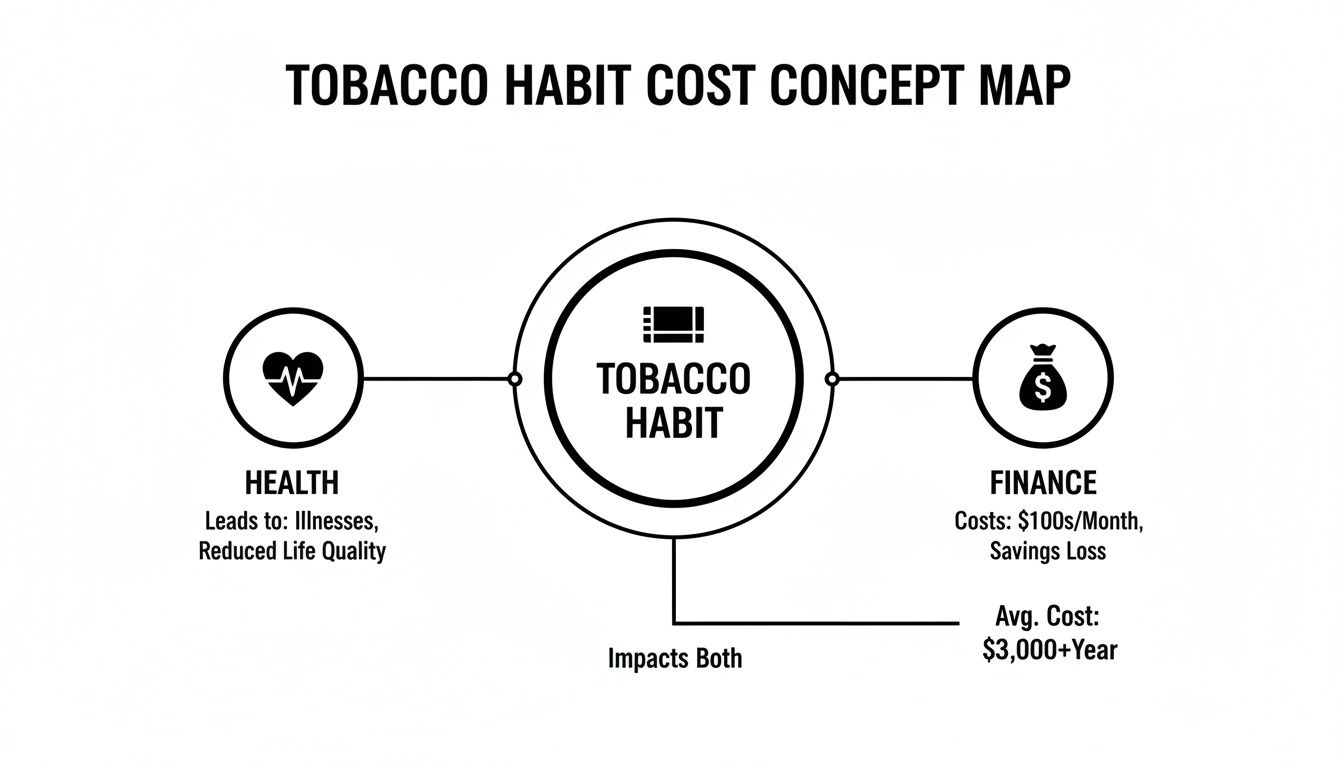
As you can see, the price you pay isn't just in pounds and pence; it's a heavy tax on your long-term health and wellbeing.
The table below offers a clear comparison, showing how AuraFlow directly addresses the sensory rituals of smoking with a healthier, more mindful alternative.
Comparing Rituals: Smoking vs. AuraFlow
| Aspect of Ritual | Traditional Smoking/Vaping | AuraFlow Experience |
|---|---|---|
| Hand-to-Mouth Action | Automatic, often mindless habit driven by craving. | Conscious, deliberate action to find a moment of calm. |
| Oral Sensation | Harsh smoke or chemical vapour. | Gentle draw with a subtle, natural flavour. |
| Breathing Pattern | Shallow, often anxious inhales. | Encourages slow, deep, and mindful breathing. |
| The "Pause" | A break associated with nicotine and chemicals. | A mindful pause for stress relief, without dependence. |
| Sensory Feedback | Taste and smell of burning tobacco or artificial e-liquids. | Pleasant, natural taste from essential oil-based Flavour Cores. |
| Health Impact | Negative. Introduces harmful toxins and carcinogens. | Positive. Promotes mindfulness and calm with no harmful intake. |
By shifting the focus from a chemical fix to a sensory one, AuraFlow helps you retrain your brain to find comfort in a new, healthier way.
A Flavour for Every Moment
AuraFlow gives you the power to consciously replace an old craving with a new, enjoyable sensation. The whole experience centres around its unique Flavour Cores, which offer a variety of natural tastes to match your mood.
- Refreshing Mint: Brilliant for a moment of sharp clarity and focus.
- Sweet Strawberry: A light, fruity option for when a sweet craving hits.
- Warm Cinnamon: A comforting, cosy choice for winding down in the evening.
By focusing on these pleasant, natural tastes, you can start building new, positive associations with your daily rituals. Feel free to explore our full range and learn more about our essential oil flavours to see how each one can support you. This simple switch allows you to keep the ritual you find calming but completely redefine it on your own healthy terms—one gentle breath at a time.
How to Begin Your Nicotine-Free Journey
Taking that first step towards a nicotine-free life is a huge decision. It's powerful, but let's be honest, it can feel overwhelming. The secret is to stop thinking about it as 'giving something up'. Instead, see it as a positive, manageable transition towards a better you.
It all starts with getting to know your own habits on a deeper level.
Think of yourself as a detective investigating your own routine. Your mission is to pinpoint the exact moments—your triggers—that make you automatically reach for a cigarette or vape. Is it that first coffee in the morning? The stress of a looming deadline? That quiet moment after dinner?
Once you know what your triggers are, you can start building a new ritual to put in its place. This is where a sensory tool like AuraFlow can be a game-changer.
Creating a New, Healthier Ritual
Instead of just fighting an urge with willpower alone, you actively replace it with something better. It’s a far more sustainable approach and much kinder to yourself. Here’s a simple, practical plan to get you started:
- Identify Your Top 3 Triggers: Actually write them down. Is it driving? Finishing a meal? Having a drink with friends? Get specific.
- Prepare Your Replacement: Keep your AuraFlow device close by, especially during those trigger moments you've identified. Make it just as easy to reach for as your old habit was.
- Be Mindful in the Moment: When the craving hits, just pause. Acknowledge the feeling without judging it, then take a few slow, deliberate breaths with your AuraFlow. Really focus on the pleasant, gentle flavour.
- Track Your Wins: Every time you successfully swap the old habit for this new one, make a mental or physical note of it. These small victories are huge—they build the momentum and confidence you need to keep going.
A massive part of any successful journey away from nicotine involves understanding the importance of effective coping strategies versus avoidance for emotional health, which helps you face challenges head-on rather than running from them.
Reinforce Your Motivation with Financial Wins
Remember the numbers we talked about earlier? Quitting gives you a tangible reward you can see almost immediately in your bank account. That daily saving of nearly £8 for a 10-a-day smoker adds up incredibly fast.
By the end of your first month, you could have an extra £240 sitting in your account. That’s not just a number; it's a real, concrete reward for your effort. It’s proof that this new path is already paying you back.
This journey is about reclaiming your control, one mindful breath at a time. It’s a path back to better health, financial freedom, and a life where you are in charge of your rituals—not the other way around.
Your Questions, Answered
Deciding to go nicotine-free is a huge step, but it's natural to have questions pop up along the way. We've put together some honest, straightforward answers to help you feel clear and confident as you start this journey.
How Long Does It Really Take to Break a Habit?
The honest answer? It’s different for everyone. You might have heard the old “21 days” myth, but modern research shows it can take anywhere from 18 to 254 days for a new behaviour to feel automatic.
The secret isn’t speed; it’s consistency. Every time you consciously replace an old ritual—like smoking after a meal—with a new one, like taking a few mindful breaths with your AuraFlow, you’re slowly but surely rewiring those deep-seated habits. Think of it as building a new path, one small step at a time.
What If I Still Get Really Strong Cravings?
First off, cravings are completely normal, especially at the start. They’re just signals from your brain, which has gotten used to a certain routine. Instead of seeing them as a sign you're failing, try to see them for what they are: a sign that your body is healing and adjusting.
The best way to deal with a craving is to acknowledge it without giving in. Just pause, take a deep breath, and engage your senses with a healthier alternative. This simple act interrupts that automatic response and puts you right back in the driver's seat.
Will Using a Sensory Aid Genuinely Help Me?
Absolutely. A massive part of any smoking or vaping habit is tied to the physical ritual—the hand-to-mouth movement, the feeling of the inhale, and the simple pause it creates in your day. Just getting rid of nicotine doesn't do anything to address this powerful behavioural loop.
A sensory tool like AuraFlow is designed to satisfy that deep-seated need for a physical ritual. It gives you that familiar motion and sensory feedback your brain is looking for, but without any of the harmful stuff. It helps you dismantle the old habit from the inside out.
Ready to reclaim your ritual and start a healthier, smoke-free chapter? Check out the AuraFlow Starter Kit and find the support you need for your journey. Visit https://aura-flow.co.uk to get started today.