
From the moment you put out your last cigarette, your body gets to work on an incredible recovery mission. The timeline of what happens when you quit smoking starts almost instantly, with real, measurable changes happening within minutes of that final puff. It kicks off a chain reaction of health benefits that unfolds over the next 48 hours and long beyond.
The First 48 Hours: Your Body's Remarkable Recovery
Quitting smoking isn’t just about long-term goals; it’s about immediate wins. The first two days are a powerful reminder of just how resilient your body is. Think of it like a factory that’s been running on dirty fuel for years suddenly switching to a clean power source—the whole system immediately starts clearing out the gunk and repairing the machinery.
This initial period is so important for building motivation. When you see and feel these rapid improvements, it gives you a real, tangible reason to push through the early challenges of nicotine withdrawal. Every hour that passes brings a new, positive development.
The First Day: A Cascade of Positive Change
The good stuff kicks in faster than most people think. Within the first 24 hours, your body begins to undo the immediate stress that smoking puts on your heart and circulation.
- 20 Minutes: Your heart rate and blood pressure, which are kept artificially high by nicotine, start to drop back towards normal. You might even notice your hands and feet warming up as your circulation improves.
- 8 to 12 Hours: The carbon monoxide level in your blood—a toxic gas from smoke that robs your body of oxygen—falls dramatically. This allows oxygen levels to bounce back to normal, meaning your cells and tissues finally start getting the proper nourishment they need to work properly.
There's a reason this immediate timeline is a cornerstone of UK public health advice. As the NHS points out, the body’s ability to normalise blood pressure and clear out carbon monoxide so quickly offers powerful, science-backed motivation for anyone starting their smoke-free journey. You can read more about these positive changes documented by UK health campaigns.
This timeline shows just how fast your body begins to heal in those first few hours.
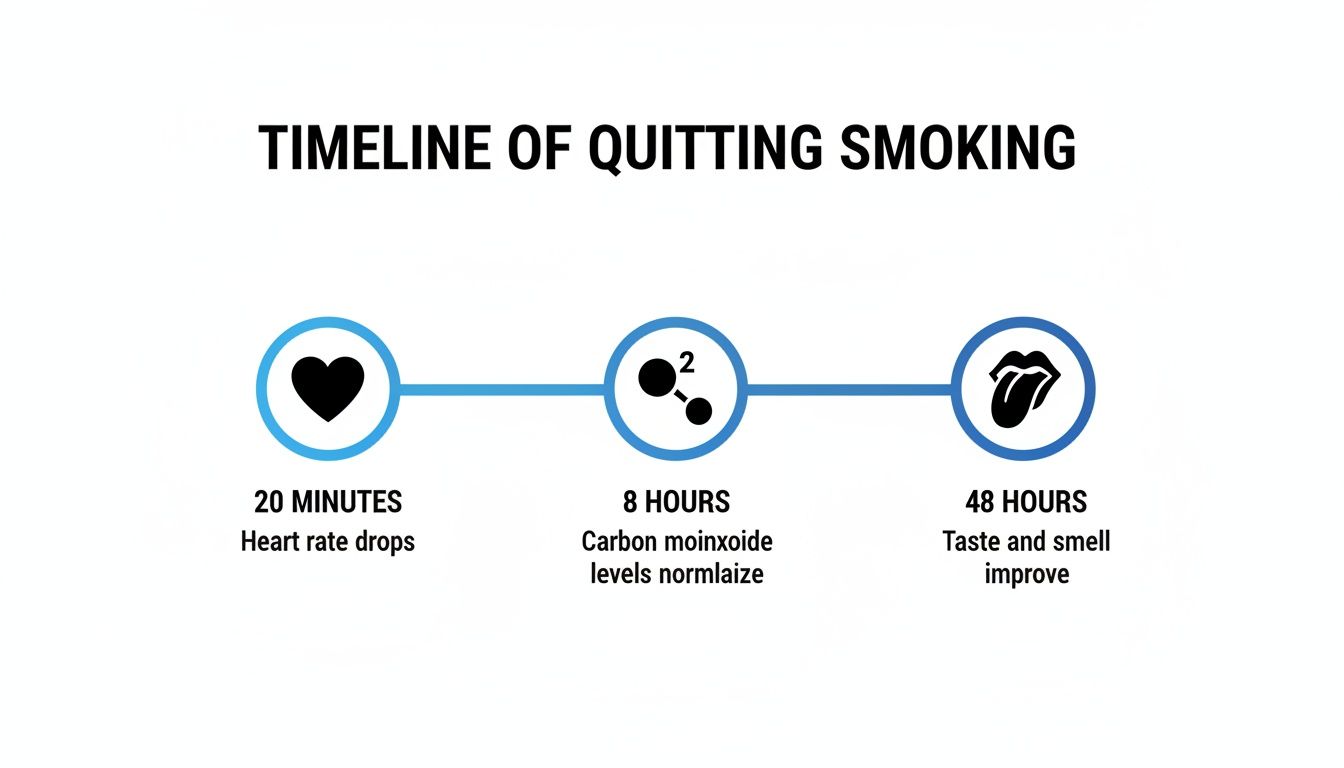
It’s a clear illustration that your body doesn't wait around to start healing; recovery begins the minute you stop.
Day Two: Awakening Your Senses
As you roll into your second smoke-free day, the benefits become even more noticeable, moving beyond your internal systems to your senses. This is often when the rewards of quitting start to feel personal and much more real.
The 48-hour mark is a huge milestone: your body has flushed out most of the leftover nicotine. This is a clear signal that the physical dependency is starting to break.
Your sense of taste and smell, which were dulled by smoking, start to reawaken. Food begins to taste more vibrant and flavours become sharper, turning a simple meal into a genuinely enjoyable experience again.
This sensory revival happens because your nerve endings are finally healing. It’s one of the most encouraging early signs that your body isn’t just recovering—it's actively regenerating.
Here’s a quick summary of what you can look forward to in these first couple of days.
Your Immediate Health Recovery Timeline
| Time After Quitting | What Happens in Your Body |
|---|---|
| 20 Minutes | Your heart rate and blood pressure start to return to normal levels. |
| 8-12 Hours | Carbon monoxide levels in your blood drop significantly, boosting your oxygen levels. |
| 24 Hours | Your risk of a heart attack begins to decrease. |
| 48 Hours | Nerve endings start to regrow, and your senses of taste and smell begin to improve. |
While the first 48 hours can bring challenges like cravings and irritability, they also deliver profound and encouraging proof that your decision to quit is already paying off in incredible ways.
Gaining Momentum: Navigating The Fog of The First Month
If the first couple of days are a sprint, the first month is the beginning of the marathon. This is where your body’s initial recovery starts to build on itself, but it’s also when the real psychological battle gets underway. You're no longer just dealing with nicotine leaving your system; you're now faced with the task of actively rewiring years of deeply ingrained habits.
Think of this period like walking out of a thick fog. The path forward isn't always crystal clear, and you’ll definitely run into obstacles like mood swings, sharp cravings, and irritability. But with every step you take, the skies get a little clearer, and the benefits you start to feel become powerful motivators to keep going.
Your Body Continues Its Remarkable Repair Work
While the mental game can feel all-consuming, your body is working tirelessly in the background. Within two weeks to three months, your circulation improves dramatically, and your lung function begins its incredible comeback. This isn't just some abstract health benefit; you'll actually feel it in your day-to-day life.
That flight of stairs that used to leave you gasping for air might suddenly feel manageable. A brisk walk with the dog becomes a genuine pleasure instead of a chore. This is your body physically thanking you, giving you tangible proof that all this hard work is paying off. These physical wins are so important for building the momentum you need to push through the tougher mental moments.
The Mental and Emotional Fog
As your body heals, your brain is doing its best to play catch-up. Nicotine withdrawal symptoms usually peak around day three and then start to ease off, but the mental grip of addiction can hang around for a while longer. It's common to experience what many call 'smoker's flu', as your body adjusts to the absence of thousands of chemicals.
This period is about so much more than just fighting cravings. It’s about learning brand new ways to cope with stress, boredom, and social situations. Your brain has to unlearn the powerful association it built between triggers—like your morning coffee or finishing a meal—and the chemical reward of nicotine.
It’s also worth being aware of Post Acute Withdrawal Syndrome (PAWS), which can pop up during this time with persistent symptoms like anxiety or low moods. Simply recognising that these feelings are a normal part of the healing process can help you manage them without feeling like you’re failing.
The Power of The 28-Day Milestone
In the UK, making it to the four-week mark is seen as a massive turning point. There’s a good reason why public health campaigns like Stoptober are built around this milestone. The evidence is clear: if you can stay smoke-free for 28 days, you are about five times more likely to quit for good.
That statistic is incredibly empowering. It reframes the huge, scary goal of "quitting forever" into a much more manageable, short-term target. In fact, government communications highlight that a staggering 95% of ex-smokers report noticing positive changes within just two weeks.
Practical Strategies for Navigating The First Month
Getting through this period and coming out stronger on the other side requires a solid plan. This isn't about raw willpower; it's about having the right tools and support in your corner.
- Identify Your Triggers: Write down the situations, feelings, or times of day that make you crave a cigarette. Once you know what they are, you can make a plan to either avoid them for a while or handle them differently.
- Lean on UK Support Systems: You absolutely do not have to do this alone. NHS Stop Smoking Services offer free, expert advice and support, including behavioural coaching and help accessing aids like Nicotine Replacement Therapy (NRT).
- Reframe Your Mindset: Instead of seeing a craving as a sign of weakness, see it for what it truly is—a sign that your brain is healing and your body is winning the fight. They feel intense, but they are temporary. They will pass.
The first month is less about deprivation and more about rediscovery. You're rediscovering how food tastes, how fresh air feels in recovering lungs, and how to manage your emotions without relying on a chemical crutch.
Understanding how long do cravings last can also be a massive relief. Cravings are powerful but typically short-lived, usually lasting only a few minutes. Knowing this simple fact helps you ride out the wave without giving in.
Ultimately, this first month lays the foundation for your entire smoke-free future. By celebrating the small wins, using the resources available to you, and trusting the healing process, you can turn this challenging phase into your first major victory.
One Year Smoke-Free: A Major Turning Point For Your Health
Making it to the one-year mark is a monumental achievement. Seriously, take a moment to let that sink in. It’s 365 days of pure commitment, of pushing through the tough moments and reclaiming your health. This isn't just another day on the calendar; it’s a massive turning point where the rewards of your persistence become incredibly clear.
Think back to how your circulatory system felt a year ago. If you were a smoker, it was like a city centre during rush hour—congested, sluggish, and constantly under stress. Today, it’s more like a free-flowing motorway, with everything moving smoothly and efficiently. This isn't just a nice thought; it’s your new physiological reality.
The most profound change at this stage is the dramatic leap forward in your cardiovascular health.
After one year without smoking, your excess risk of having a heart attack has dropped by a staggering 50%. This single statistic is one of the most powerful motivators in the entire quitting journey.
This incredible reduction happens because your heart and blood vessels are no longer being bombarded by the hundreds of toxic chemicals found in cigarette smoke. The healing process that began just minutes after your last cigarette has now resulted in substantial, life-altering improvements.
Visible and Tangible Health Transformations
Beyond the amazing things happening on the inside, the one-year mark often brings changes you can actually see in the mirror and feel in your day-to-day life. The benefits are no longer just about avoiding future illness; they're about experiencing a more vibrant and energetic you, right now. Many people report a noticeable "glow-up" in their appearance and overall well-being.
Take your skin, for example. It's had a full year to recover from the constant damage. With improved blood flow, more oxygen and nutrients are finally reaching the surface, which can lead to:
- A clearer, more even complexion: That sallow, greyish tint often associated with smoking starts to fade, replaced by a much healthier, more natural skin tone.
- Reduced premature wrinkles: Your skin’s ability to produce collagen and elastin gets a boost, helping to slow down the accelerated ageing process caused by smoking.
- A healthier glow: Better circulation simply brings more life and radiance to your appearance.
This isn’t about vanity; it’s a visible sign that your entire body is working better from the inside out.
Breathing Easier and Living Fuller
Your lungs have also been on a remarkable journey of repair. A year ago, the tiny, hair-like cilia that line your airways were damaged and basically paralysed. These little guys are crucial for sweeping out mucus and debris, and when they don't work, you get that persistent "smoker's cough."
After 12 months, these cilia have had time to regrow and are back on the job. This means you’ll likely experience far less coughing and shortness of breath. That renewed lung capacity opens up a world of possibilities, from enjoying a brisk walk without wheezing to easily keeping up with your kids or grandkids. It’s about getting your freedom back.
By exploring the full spectrum of the health benefits of quitting smoking, you can see just how deep this recovery process goes. This one-year milestone is definitive proof that all those difficult early days were a worthwhile investment in a healthier, more energetic future. The rewards you're reaping now are just the beginning. Your body hasn't just healed; it has transformed.
The Long Game: Reclaiming Your Future Health
Passing the one-year mark feels like crossing a finish line, but really, it’s the start of an even more rewarding race. This is the long game. It's where the real magic happens, as the benefits of quitting start to compound, paying you back with years of reclaimed health and energy.
If the first year was about reversing the immediate damage, the years that follow are about fundamentally rewriting your future. Think of it like a garden that was once neglected. The first twelve months were spent clearing out the weeds and turning over the soil. Now, the strong, healthy roots are taking hold, promising long-term growth and resilience.
The changes from here are less about the day-to-day sensations and more about huge, life-altering reductions in your risk for major diseases. This long-term view is where the true power of your decision to quit becomes crystal clear.
The Five-Year Milestone: A Health Reset
Reaching five years without a single cigarette is a landmark achievement for your body’s internal defence systems. Your risk of having a stroke is dramatically reduced, and for many, it starts to get close to that of a lifelong non-smoker. This is a direct result of your circulatory system healing from the constant inflammation and strain caused by smoking.
Your risk for several types of cancer also takes a significant dive.
- Mouth, throat, and oesophagus cancers: Your risk is cut in half compared to when you were smoking.
- Bladder cancer: This risk also falls by 50%, a powerful reminder that quitting benefits your entire body, not just your lungs.
The five-year mark is a profound turning point. Your body hasn't just healed from the constant assault of toxins; it has substantially rebuilt its defences, putting you on a much safer and healthier path.
It’s an incredible testament to your body's capacity for repair. You’ve officially shifted from damage control to active, long-term health protection—a crucial part of the what happens when you quit smoking timeline.
Ten To Fifteen Years: Returning To Baseline
As you move into your second smoke-free decade, the most astonishing transformations take place. Your body continues its quiet, persistent work of erasing the damage, bringing your health risks remarkably close to those of someone who has never smoked.
The ten-year mark is particularly momentous. Your risk of dying from lung cancer is now about half that of a person still smoking. This isn’t a small reduction; it’s a life-saving shift that shows just how profoundly your lungs have healed. The precancerous cells that were once present have been gradually replaced by healthy ones.
By 15 years, the healing is even more complete. Your risk of coronary heart disease drops to a level similar to that of a non-smoker. The damage to your heart and blood vessels has been so thoroughly repaired that it's as if you’ve been given a second chance at cardiovascular health.
This long-term progress is a personal victory with a wider impact. In the UK, widespread quitting has led to a noticeable drop in smoking rates, reducing the strain on our health service. For instance, smoking prevalence among young adults aged 18-24 has plummeted in the last decade. You can explore more about these positive UK-wide trends and see the full picture of our collective success.
Finding The Right Tools For Your Quitting Journey
Understanding what your body goes through when you quit smoking is a massive motivator, but knowing you've got the right support in your corner can make all the difference. You don't have to go on this journey alone. In fact, building a personal toolkit of support systems and aids is one of the best things you can do to boost your chances of success.
Think of it like preparing for a big expedition. You wouldn't set off without a map, the right gear, and a support crew, would you? Quitting smoking is no different. Luckily, the UK has a fantastic menu of options designed to fit all sorts of different needs and preferences, so you can find a strategy that feels right for you.
Tapping Into Professional UK Support
For many people in the UK, the NHS is the cornerstone of support. Their services are free, backed by solid evidence, and designed to give you both practical tools and behavioural coaching to help you get there.
- NHS Stop Smoking Services: These local services offer one-to-one or group sessions with trained advisors. They're brilliant for helping you create a personal quit plan, navigate the tricky spots, and give you a boost of encouragement right when you need it.
- Prescription Aids: Your GP or a stop smoking advisor can talk you through prescription options like Varenicline (Champix) or Bupropion (Zyban). These medications work by dialling down cravings and withdrawal symptoms, which can make those first few weeks feel much more manageable.
For really thorough, ongoing support, many people find success by consulting an online primary care provider as part of their plan. It's a convenient way to get professional guidance that’s tailored to your specific situation.
Nicotine Replacement Therapy Explained
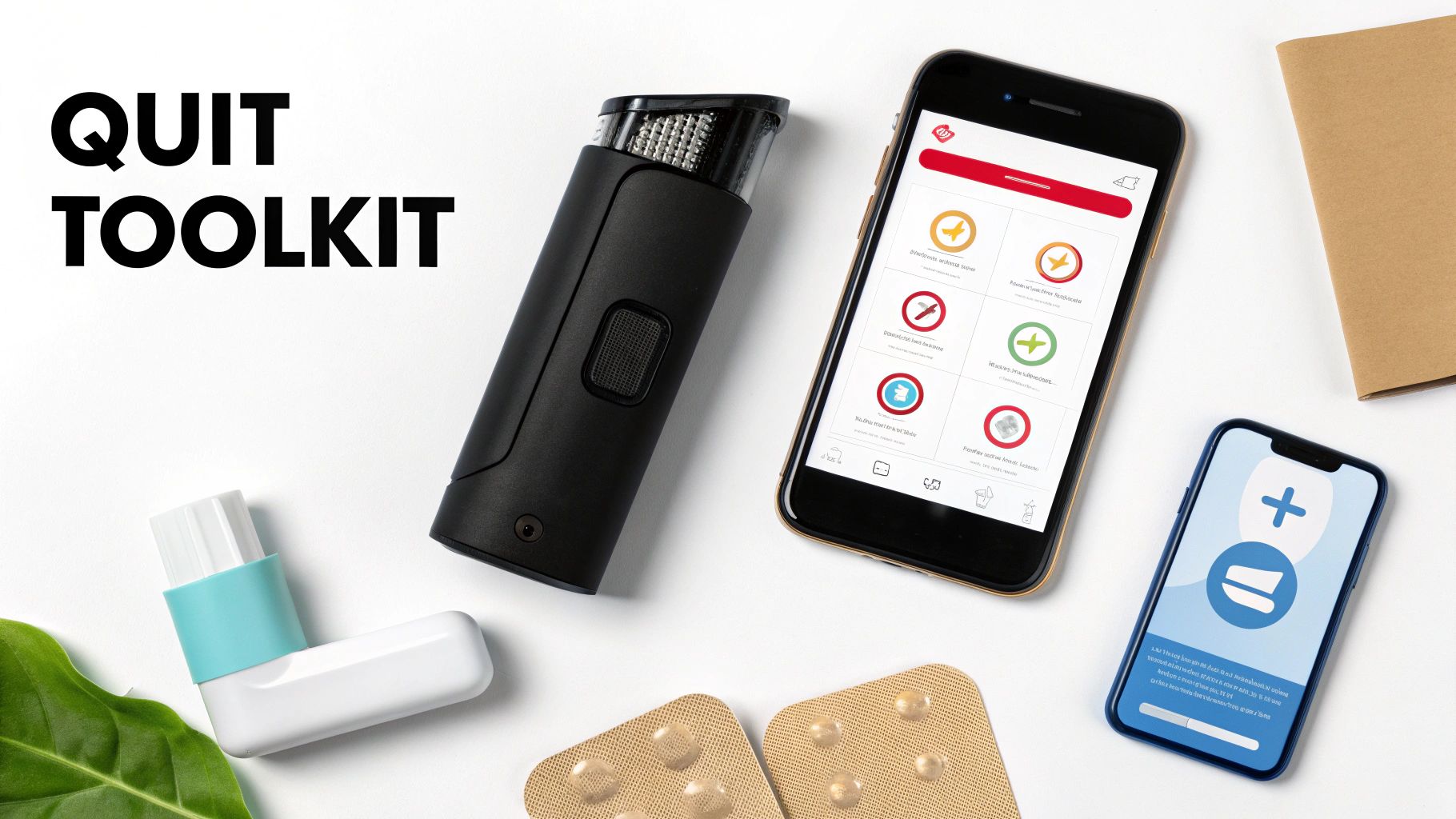
Nicotine Replacement Therapy (NRT) is a popular and effective tool for a reason. The idea is simple: give your body the nicotine it's craving without the thousands of other harmful chemicals packed into cigarette smoke. This helps to take the edge off the physical withdrawal symptoms, freeing you up to focus on breaking the psychological habits first.
NRT comes in a bunch of different forms, so you can mix and match to figure out what works for you:
- Patches: These give you a slow, steady release of nicotine throughout the day.
- Gum & Lozenges: Perfect for tackling those sudden, intense cravings when they hit.
- Inhalators & Sprays: These mimic the hand-to-mouth action of smoking, which can be a huge help for the behavioural side of the habit.
Modern Aids and Alternative Approaches
The world of quitting aids has grown a lot, giving you more choice than ever. Here in England, e-cigarettes (vapes) have become a really common tool for smokers looking to make a change.
In fact, large-scale surveys show that vaping is the most common aid people use, involved in about 40.2% of quit attempts. These studies also found that using e-cigarettes was linked to a better chance of successfully quitting compared to just going cold turkey.
But while vaping can be a great bridge away from tobacco for some, others want to break free from nicotine altogether or just don't like the fuss of electronic devices. This is where nicotine-free alternatives come into their own.
A nicotine-free inhalation alternative offers a totally different approach. It focuses squarely on the behavioural part of the addiction—that hand-to-mouth ritual, the deep breath, the simple act of taking a pause—without any nicotine, tobacco, or vapour. For so many people, this ritual is just as hard to break as the chemical dependency.
Using a simple, flavourful inhaler can satisfy that muscle memory, making it a powerful stop smoking aid for managing cravings in a much more natural way. By replacing the habit with a calming, mindful action, you can start to uncouple your triggers from the need for nicotine, smoothing out those tougher moments on your quitting timeline.
Your Quitting Questions, Answered
As you navigate the timeline of quitting, you're bound to run into some practical, in-the-moment questions. Getting clear, straightforward answers is the key to feeling confident and staying on track. Let's tackle some of the most common worries people have, with simple explanations to help you push through.
Will I Gain Weight If I Quit Smoking?
This is a huge worry for many, and it’s not completely unfounded. Nicotine acts as an appetite suppressant while also giving your metabolism a slight boost. When you take it away, your metabolism settles back to its normal pace and your appetite can roar back to life, making it easy to reach for extra snacks.
But weight gain is not inevitable. The trick is to be aware of it and have a plan. Try swapping out crisps and biscuits for healthy options like fruit and veg, drink plenty of water to stay hydrated, and weave a bit more movement into your day—even a brisk walk makes a difference. These small, mindful changes are your best defence while your body finds its new normal.
How Do I Beat a Sudden Intense Craving?
Cravings can feel like they come out of nowhere and hit you like a ton of bricks. The good news? They’re almost always temporary, usually peaking and fading within just a few minutes. Your best defence is having a few go-to tricks up your sleeve to distract your brain until the wave passes.
Here are a few quick techniques that work anywhere:
- Delay: Promise yourself you’ll wait just 10 more minutes. By the time the 10 minutes are up, the craving has often completely vanished.
- Deep Breathe: Take a few slow, deep breaths. This is a brilliant way to calm your nervous system and pull your focus away from the panic of the craving.
- Drink Water: Sipping a glass of cold water keeps your hands and mouth busy, satisfying that physical part of the smoking ritual.
- Distract Yourself: Get up and change your scenery. Walk into another room, put on your favourite song, or fire off a quick text to a friend.
Is It Ever Too Late to Quit?
Absolutely not. It is never too late to stop smoking. Your body has an incredible ability to heal itself, and the benefits start the second you put out your last cigarette, no matter your age or how many years you’ve smoked.
Of course, quitting earlier in life gives you the biggest health wins, but stopping at any age still adds years to your life and dramatically improves your quality of living. Someone who quits later in life can still see incredible reductions in their risk for heart attack, stroke, and cancer. Your body is ready to start repairing the damage right now.
Quitting smoking is the single best thing you can do for your health at any stage of life. The timeline for recovery starts immediately, proving that positive change is always possible.
Can I Have Just One Cigarette After I Quit?
It’s such a tempting thought, especially when you’re having a rough day. "Just one won't hurt, right?" Unfortunately, it's an incredibly risky move. Nicotine is powerfully addictive, and the pathways it carved in your brain don't just vanish overnight. Having "just one" is often all it takes to reawaken that dependency.
Think of it like this: your addiction is a sleeping giant. One cigarette can be enough to wake it up, and before you know it, you're right back where you started. The science of addiction is clear—that single act can quickly unravel all your hard work and lead straight to a full relapse.
It’s far safer to treat every single cigarette as off-limits. Remind yourself how far you've come and use your coping skills to ride out the craving. Your smoke-free future is worth protecting.
Breaking that hand-to-mouth habit is often one of the biggest challenges people face. If you're looking for a simple, nicotine-free way to manage cravings and satisfy that physical ritual, AuraFlow can help. Our flavourful inhalation alternative provides a calming, mindful pause without any nicotine, tobacco, or vapour. Discover how AuraFlow can support your smoke-free journey.