
It’s a terrifying feeling, isn't it? That sudden, gut-wrenching sensation that you just can’t get enough air. The feeling that you can "breathe no air" is deeply unsettling, and it often comes from a strange disconnect between what your body needs and what your mind is telling you.
For many, this is triggered by anxiety or the incredibly challenging process of quitting smoking. If this sounds familiar, you're in the right place. Let's break down what's really going on and find a clear path forward.
What It Means to Feel Like You Can't Breathe
When that feeling of suffocation hits, it's easy to panic. But here’s the thing: most of the time, your body isn't actually being deprived of oxygen. The sensation, known medically as dyspnoea, is often your body's internal alarm system going into overdrive.
Think of it like a smoke detector that's become a little too sensitive. It's designed to protect you, but right now, it's blaring at the slightest hint of a threat, even when there's no real fire.
This is especially common during nicotine withdrawal. As your body starts the incredible process of healing, your lungs begin the tough job of clearing out all the mucus and tar that have built up. This can cause some temporary tightness, coughing, and a feeling of breathlessness that's completely normal, but still very scary.
The Mind-Body Connection
At the same time, quitting smoking can send your anxiety levels through the roof. Your brain, suddenly without the nicotine it has come to rely on for a sense of calm, can start misinterpreting completely normal bodily sensations as signs of danger.
This creates a vicious cycle: the anxiety makes you feel breathless, and the feeling of breathlessness makes you even more anxious. Just understanding that this loop exists is the very first step to breaking free from it.
So, what can set it off?
- Anxiety and Panic: Your 'fight or flight' response kicks in, causing that classic rapid, shallow breathing.
- Nicotine Withdrawal: Your body and brain are recalibrating, and it's a bumpy ride.
- Intense Physical Activity: Sometimes, you just push your body a little further than it’s ready for.
- Environmental Factors: Things like poor air quality or sudden changes in temperature can make anyone feel a bit tight-chested.
Exploring what influences that ‘breathe no air’ sensation can be helpful, and it’s worth thinking about how different settings affect us. For example, some people find that controlled environments can make breathing feel easier, which gives us clues for understanding the ease of breathing in different environments versus more challenging conditions.
The most important thing to realise is that this sensation is incredibly common, especially when you’re making a huge lifestyle change like quitting smoking. When you learn what's happening inside your body and mind, you can start to replace that fear with knowledge and get back in the driver's seat. Our goal is to give you real, actionable strategies for a calmer future.
Why Quitting Smoking Can Make You Feel Breathless
It sounds completely backwards, doesn't it? You've quit smoking to finally get your breath back, but instead, you're left feeling winded and tight-chested. It’s confusing, and honestly, a little alarming. But this experience is surprisingly common. While you’re on the path to major long-term lung improvements, the first steps can feel like you’re going in the wrong direction.
Think of it like this: your body has spent years dealing with a constant stream of pollution. When you finally stop, a massive clean-up operation begins. Just like a major road repair, the initial work is disruptive. It kicks up dust and causes temporary chaos before things get better. Your body is doing the same thing—a deep, restorative healing project that can cause some temporary discomfort.
The Great Lung Clear-Out
The moment you quit, your lungs get to work. Tiny, hair-like structures in your airways called cilia, which were paralysed by the smoke, wake up and start moving again. Their job is to sweep out all the tar, mucus, and gunk that has been clogging things up for years.
This intense cleaning process is what triggers the infamous "smoker's cough" many people get after they quit. It can also create a feeling of tightness in your chest or make it feel like you just can't take a full, deep breath. As unsettling as it is, this is a powerful sign that your respiratory system is actively repairing itself. You can find a detailed breakdown of these changes in our guide to what happens when you quit smoking timeline.
This phase of healing is temporary but absolutely essential. Your body is working hard to expel years of toxic build-up. Seeing it as a positive step—a sign of recovery, not a setback—can make all the difference in how you handle the discomfort.
Nicotine Withdrawal and Anxiety
It’s not just a physical thing. While your lungs are busy clearing house, your brain is going through a massive adjustment of its own. Nicotine withdrawal is notorious for sending anxiety and stress levels through the roof, and this spike in anxiety is a major trigger for that terrifying feeling that you can breathe no air.
Your nervous system, so used to the calming hit of nicotine, can go into overdrive. It might start misinterpreting normal body signals as threats, kicking off a 'fight or flight' response. This leads directly to shallow, rapid breathing and a sense of panic. It's the perfect storm for breathlessness: your body is physically healing while your mind is in a state of high alert.
The good news is, you're not alone on this journey. Millions have walked this path. In England, the number of people choosing to quit is rising every year. Adult smoking prevalence recently dropped to just 10.4%, a massive decrease from 19.8% in 2011, which shows a huge national shift towards better health. If you want to dig into the numbers, you can explore the official smoking profile statistical commentary on GOV.UK. This data proves just how many people successfully navigate this challenging but incredibly rewarding process.
How to Tell Panic From a Physical Emergency
When that terrifying feeling hits—like you can breathe no air—your mind instantly spirals to the worst-case scenario. It’s a primal, deep-seated fear.
The most critical question in that moment is this: Is this a wave of panic, or is it a genuine physical crisis that needs immediate medical attention? It’s incredibly difficult to tell the difference when you’re in the thick of it, but it is possible.
A panic attack often feels like it comes out of nowhere, hitting you with an intense force that peaks within about 10 minutes. That breathlessness is usually joined by a whole cascade of other symptoms: a racing heart, trembling, sweating, and an overwhelming feeling of doom. Your thoughts can start to spiral, creating a feedback loop that makes the physical sensations even stronger.
This whole process is often driven by your brain’s limbic system, which is essentially its emotional alarm bell. Getting to know the neurological roots of panic can be a game-changer; for a deeper look, you can learn more about limbic system retraining for emotional balance.
Key Distinguishing Signs
Learning to spot the patterns of a panic attack versus a true medical emergency can give you the power to respond more calmly. One of the biggest clues is the onset and duration. A panic attack is typically a rapid, intense, but relatively short episode. On the other hand, the symptoms of a physical emergency might develop differently and stick around.
A medical emergency often comes with more specific, localised symptoms. For example, the chest pain might feel like a crushing pressure rather than the sharp, stabbing sensation sometimes associated with panic.
The context also matters. If you’re just resting and these symptoms suddenly hit you without any history of anxiety, it’s a sign to take it more seriously. For those using tools to manage their breathing, it's vital to ensure you are using them correctly; our guide offers an inhaler technique video that demonstrates proper usage for similar devices.
To help you get a clearer picture, here’s a breakdown of how the signs can differ.
Panic Attack vs Medical Emergency Signs
| Symptom | Common in Panic Attacks | Potential Medical Red Flag (Seek Help) |
|---|---|---|
| Chest Pain | Often sharp, stabbing, and localised in the centre of the chest. | Feels like pressure, squeezing, or crushing. May radiate outwards. |
| Onset | Can be triggered by stress but often feels sudden and random. | Can occur suddenly, especially during physical exertion or stress. |
| Duration | Symptoms peak within 10 minutes and then gradually fade. | Pain or discomfort is persistent and may worsen over time. |
| Other Sensations | Tingling in hands/feet, dizziness, feeling of unreality, intense fear. | Pain spreading to the arm, jaw, or back; nausea; cold sweat. |
| Breathing | Feels like you can't get enough air, hyperventilating. | Genuine difficulty breathing, accompanied by wheezing or coughing. |
Remember, this table is a guide, not a diagnostic tool. The lines can sometimes blur, which is why it's crucial to know when to stop guessing and get help.
When to Seek Immediate Help
While understanding the signs of panic is incredibly helpful, some symptoms should never be ignored. Your safety always, always comes first.
- Radiating Pain: If chest pain spreads to your arm, jaw, neck, or back.
- Loss of Consciousness: If you faint or feel like you are about to.
- Physical Changes: Look for a bluish colour on your lips or skin, which indicates a lack of oxygen.
- Sudden Confusion: Any abrupt change in your mental state or severe dizziness.
This visual guide shows the two common paths breathlessness can take when you're quitting smoking or vaping.
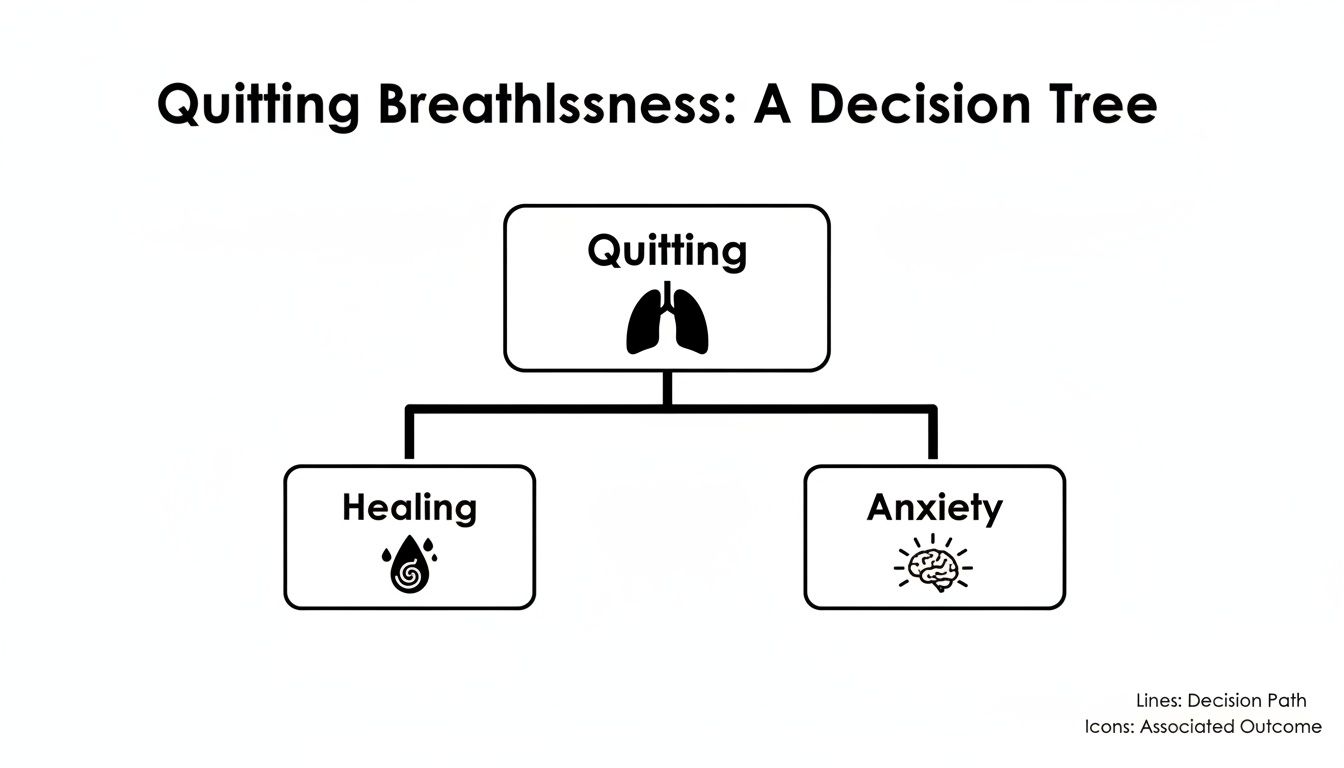
As the infographic shows, while one path involves your body's physical healing, the other is driven by anxiety. This really highlights how important it is to look after both your mind and body during this journey.
Important Takeaway: This information is for guidance, not diagnosis. If you are ever in doubt about the cause of your breathlessness, the safest course of action is always to seek immediate medical help. It is far better to be cautious and get checked out than to dismiss a potentially serious symptom.
Practical Techniques to Reclaim Your Breath
In the middle of that breathless moment, when it feels like you can breathe no air, rational thought can seem a million miles away. Your body's alarm system is blaring, and what you need is a reliable toolkit to quiet the noise. The techniques that follow are simple, proven, and designed to gently calm your nervous system right when it matters most.
These strategies work by giving your mind something else to focus on, interrupting the panic cycle before it can fully take hold. They shift your attention away from that frightening internal sensation and reconnect you with the physical world, helping you feel in control of your body and mind again.
Master Box Breathing
One of the most powerful and surprisingly simple methods for managing stress is Box Breathing. It's a technique used by everyone from navy SEALs needing to stay calm under pressure to yoga practitioners seeking focus. It works by deliberately slowing your breathing to a steady, predictable rhythm, which sends a clear signal to your brain that the danger has passed.
Just imagine your breath tracing the four equal sides of a square. It’s that easy.
- Inhale: Breathe in slowly and gently through your nose for a count of four.
- Hold: Hold your breath comfortably for a count of four.
- Exhale: Breathe out slowly through your mouth for a count of four.
- Hold: Pause and hold your breath again for a final count of four before starting over.
Keep this cycle going for a few minutes until you feel your heart rate begin to slow and a sense of calm returns. This simple, rhythmic pattern is incredibly effective for grounding yourself. If you're looking for more ways to manage these feelings, our guide on breathing exercises for anxiety offers a few more techniques.
Use the 5-4-3-2-1 Grounding Technique
When panic takes over, your focus turns inward, which only amplifies the fear. The 5-4-3-2-1 technique is designed to forcefully pull your attention back to your immediate surroundings, using your five senses to anchor you firmly in the present moment. It’s a practical way to tell your brain, "I am safe right now."
Think of this method as a mental reset button. By engaging with real, tangible things, you break the loop of anxious thoughts and remind your nervous system that there's no immediate threat to fight or flee from.
Here’s the simple, step-by-step process you can follow absolutely anywhere:
- 5 Things You Can See: Look around and acknowledge five distinct objects. Don't just glance; really notice their colour, shape, and details. "I see the green leaves on that plant, the blue ink in my pen, the light reflecting off my phone screen..."
- 4 Things You Can Feel: Bring your awareness to physical sensations. Notice four things you can touch, like the soft texture of your jumper, the cool surface of the table, or the solid feeling of your feet flat on the floor.
- 3 Things You Can Hear: Listen carefully and pick out three distinct sounds. It could be the distant hum of traffic, the ticking of a clock, or even the sound of your own breathing starting to steady.
- 2 Things You Can Smell: Focus on what you can smell right now. Perhaps it’s the faint scent of coffee from this morning, or the clean smell of the air after rain.
- 1 Thing You Can Taste: Finally, acknowledge one thing you can taste. It might be the lingering taste of your last cup of tea or simply the natural taste inside your mouth.
Practising these techniques when you aren't feeling anxious can make them second nature. That way, they’ll be ready and much more effective when you truly need them to reclaim your breath.
Building a New Ritual for Lasting Calm
Breaking a habit like smoking is about so much more than just fighting a chemical dependency. It’s about rewriting the deeply ingrained rituals that shape your day, from that first-morning cigarette to the one you grab on your break. That familiar hand-to-mouth motion becomes a comforting, automatic response to stress, boredom, or cravings.

To really succeed, you need to find a new, healthier ritual to put in its place. This is where a nicotine-free sensory tool like AuraFlow can become such a powerful ally. It lets you keep the familiar hand-to-mouth action but completely transforms its purpose—from satisfying an addiction to practising a moment of mindful breathing.
Rewriting Your Daily Script
Imagine swapping that harmful habit for a moment of genuine calm. Instead of reaching for a cigarette when you feel anxious, you could perform a similar action—a slow, deliberate inhale—that delivers a hint of natural Mint or Blueberry flavour without any of the harmful chemicals.
This isn’t about finding a simple substitute; it’s about building a supportive new practice. Think of it as a pattern interrupt, a psychological tool that snaps the automatic link between a trigger (like stress) and your old response (smoking).
By consciously choosing a new action, you begin to weaken the old neural pathways and build new, healthier ones. Each time you opt for a mindful breath instead of a cigarette, you are actively retraining your brain for a calmer response.
This approach is making a real difference. In a recent period, England's local stop smoking services saw 238,000 people make a quit attempt, a huge 21% jump from the previous period. Out of those, an impressive 128,000 individuals successfully quit, showing that with the right support and strategies, lasting change is more than possible. You can explore more on these success stories in ASH's latest press release.
How a New Ritual Helps
Creating a new routine gives you something stable and predictable to lean on when your old one is gone. It offers a structured, positive way to handle those difficult moments. Here’s how it works:
- It satisfies the physical habit: The hand-to-mouth motion is a core part of the smoking ritual. A sensory tool directly addresses this physical urge, so it doesn't feel like something is missing.
- It creates a moment of mindfulness: The act of inhaling slowly encourages you to take deeper, more deliberate breaths, which naturally calms your nervous system and lowers stress.
- It offers a sensory reward: A pleasant, natural flavour provides a small but immediate positive experience, replacing the one you used to get from nicotine.
This simple, affordable practice can become your go-to strategy for managing cravings and anxiety, empowering you on your journey to finally breathe freely and easily.
Your Path to Breathing Freely and Confidently
Let's bring this all together. That terrifying, overwhelming feeling that you can breathe no air is a real and difficult experience, but it’s absolutely one you can learn to manage and move past.
Throughout this guide, we've unpacked the 'why' behind this frightening sensation. We've armed you with practical, in-the-moment coping strategies and introduced new, supportive rituals to help you reach your goal of a smoke-free life. The most important thing to take away from all this is that you are in control.
Taking Back Your Breath
By getting to know your unique triggers—whether they stem from anxiety or withdrawal—and consistently practising grounding techniques, you can completely change your relationship with your breath. It’s about shifting from a cycle of fear to a state of calm control. This journey isn't about one giant leap; it's built on small, consistent, confident steps forward.
The path to breathing freely is a process of reclaiming your own power. Every time you use a coping skill or choose a new ritual, you're retraining your body and mind for peace and resilience.
You now have the knowledge and the tools to move past the fear. Remember to be patient with yourself during this process. Each deep, steady breath is a victory, and every calm moment is a testament to your own strength. You are more than capable of navigating this journey and coming out the other side, breathing freely and with total confidence.
Got Questions? Let's Get Them Answered
Taking the leap to quit smoking or vaping can stir up a lot of questions, especially when you run into strange physical feelings like breathlessness. Getting clear, straight-up answers can make all the difference, helping you feel more in control as your body begins to heal. Here are some of the most common queries we hear.
How Long Does This Breathlessness From Quitting Last?
For most people, the purely physical side of breathlessness gets much better within the first couple of weeks. This is prime time for your lungs as they work overtime to clear out old mucus and start repairing themselves. As things settle down, that feeling of tightness usually eases up.
What can stick around a bit longer, though, is the anxiety that comes with nicotine withdrawal. If you're hit with that intense feeling that you can breathe no air, and it gets worse or hangs around for more than a month, it's really important to chat with your doctor. They can help rule out any other causes and give you some much-needed peace of mind.
Can a Nicotine-Free Inhaler Actually Help Me Quit?
Absolutely. It can be one of the most powerful tools in your quitting arsenal. When you successfully quit, you're not just beating one thing; you're breaking two very different dependencies: the chemical addiction to nicotine, and the deep-seated behavioural habit of the hand-to-mouth ritual.
A nicotine-free inhaler is designed to tackle that behavioural habit head-on. It lets you satisfy the psychological urge with a completely harmless, mindful action, giving you a way to handle triggers without feeding the chemical addiction.
This is how you break the cycle for good. You're not just resisting; you're actively rewriting your brain's response to cravings.
When Should I Be Worried and See a Doctor?
Always trust your gut—if something just doesn't feel right, it’s always best to get it checked out by a professional. While anxiety is a master of disguise and can mimic serious symptoms, there are a few red flags you should never, ever ignore.
Seek immediate medical help if your breathlessness is:
- Sudden and severe: An abrupt, intense feeling that completely overwhelms you.
- Comes with chest pain: Especially if the pain feels like a heavy pressure or spreads to your arm or jaw.
- Paired with fainting: If you actually lose consciousness or feel extremely dizzy and light-headed.
- Joined by swelling: If you notice any new or unusual swelling in your legs or ankles.
It is always, always better to be safe than sorry. Your health is the number one priority, and getting a proper medical opinion is the only way to manage it with real confidence.
Ready to build a new, calming ritual to support your smoke-free life? AuraFlow offers a simple, nicotine-free sensory experience to help you ride out cravings and find your moment of peace. Discover the starter kit and begin your path to breathing freely today at https://aura-flow.co.uk.