
So, you want to quit smoking for good, but the thought of giving up the ritual feels just as daunting as kicking the nicotine? You're not alone.
Fake cigarettes are designed to tackle exactly that problem. They act as powerful behavioural aids, satisfying the familiar hand-to-mouth habit without any of the harmful tobacco or addictive nicotine. Think of them as a clever way to keep your hands busy and your mind calm, allowing you to go through the motions of smoking while your body gets on with detoxing from the chemical dependency. It’s a unique and surprisingly effective ally on your journey to becoming smoke-free.
Why Fake Cigarettes Can Be Your Secret Weapon
Quitting often feels like fighting a war on two fronts. On one side, you have the intense, physical craving for nicotine—a powerful substance that keeps you hooked. But on the other, you're battling the deep-seated comfort of the ritual itself. It’s the familiar motion of lighting up with your morning coffee, the cigarette break at work, or the one you reach for when you’re stressed.
For so many people, breaking that ritual is actually harder than beating the chemical addiction. This is precisely where fake cigarettes come in. They aren’t just a gimmick; they're a strategic tool designed to help you win the psychological side of the fight.
Taming the Habitual Beast
These non-nicotine aids—from simple props to more advanced inhalers like AuraFlow—work by satisfying that ingrained physical habit. They give your hands something to do and replicate that familiar hand-to-mouth action, providing a psychological cushion while you navigate the tricky withdrawal period. It’s a way to gently uncouple the action of smoking from the chemical hit of nicotine.
By tackling the behavioural part first, you can focus on letting your body detox without the added stress of ditching all your routines at once. You’re systematically dismantling the habit, piece by piece, making the whole process feel much less overwhelming.
Think of it like this: You're retraining your brain, teaching it that the comfort of the ritual can exist without the harm of tobacco. This separation is often the key to lasting success.
Your Roadmap to a Smoke-Free Life
Understanding how these tools can support you is the first step. This guide will give you a clear roadmap to navigate your quitting journey with confidence. We’ll dive into:
- The Psychology of Habit: How fake cigarettes help you finally break the powerful link between your daily routines and reaching for a smoke.
- A Clear Comparison: An honest look at how these behavioural aids stack up against other popular UK methods like vaping and Nicotine Replacement Therapy (NRT).
- A Practical Plan: Real, actionable steps to weave a nicotine-free alternative into your life and break free from smoking for good.
This approach empowers you to tackle both the physical and psychological sides of the addiction, giving you a more complete and sustainable strategy. By focusing on the ritual, you make the entire process feel more manageable and far less scary.
Breaking the Habit, Not Just the Addiction
When we talk about quitting smoking, the conversation almost always lands on nicotine. We frame it as a chemical battle, a fight to break free from a substance. And while that’s a huge part of the story, it’s not the whole picture. There's an equally powerful force at play: the habit itself.
This is the intricate web of rituals you’ve woven into your daily life, often without even thinking. Is it that first cigarette with your morning coffee? The one you instinctively reach for during a stressful phone call? The smoke break that perfectly splits up your workday? These aren't just random cravings; they're deeply ingrained psychological triggers.
Each time you light up in one of these moments, you're reinforcing a mental pathway. The action of lifting the cigarette, the inhale, the exhale—it all becomes automatic. It’s a physical routine that signals comfort and structure, completely separate from the nicotine hit.
Untangling the Wires in Your Brain
This is where the line between addiction and habit becomes so important. Addiction is your body screaming for a chemical. Habit, on the other hand, is your mind craving a familiar routine. Fake cigarettes are designed to go straight for the habit.
Think of them as a safe detour on that well-worn mental path. They let you go through your day—the coffee break, the after-dinner moment—and perform the physical actions your brain is expecting. You can still hold something, bring it to your lips, and mimic the act of inhaling. It’s a simple thing, but it provides a powerful psychological cushion, easing the sheer panic that comes from abruptly shattering a long-standing pattern.
By satisfying these physical urges, you give yourself the mental breathing room to deal with the chemical withdrawal. You’re untangling the two problems and tackling them one by one.
The Power of a Healthier Replacement
This strategy is all about habit replacement, and it's one of the most effective tools for making any real, lasting change. Instead of trying to erase a habit with brute force and willpower—which usually just leaves you feeling deprived—you swap it out for a better alternative.
By performing the smoking ritual without the nicotine, you begin to systematically weaken the habit's power over you. Each time you use a fake cigarette instead of a real one, you're telling your brain, "I can go through this motion and feel okay without the chemical hit."
This gradual decoupling process is essential. You’re dismantling the addiction piece by piece, starting with the ingrained physical motions that feel almost impossible to just stop. It’s a gentler, more strategic approach. You aren’t just taking something away; you're actively building a new, healthier response to your old triggers. Understanding the basics of kicking habits in general shows just how crucial this replacement principle is.
This approach gets that the comfort from smoking isn't just about nicotine. It’s also about rhythm and familiarity. A fake cigarette gives you a tool to keep that sense of control while your body does the tough work of healing. You can dive deeper into these strategies in our guide on how to break bad habits.
Ultimately, using a behavioural aid is about fighting smarter, not harder. It lets you meet the psychological dependency head-on, making the road to a smoke-free life feel less like an impossibly steep climb and more like a steady, manageable journey.
Choosing Your Path: Fake Cigarettes vs Vaping vs NRT
When you decide to quit smoking, stepping into the world of cessation aids can feel like a minefield. The market is flooded with options, all promising to be the one that finally works. In the UK, the choice usually boils down to three main contenders: fake cigarettes (behavioural aids), vaping (e-cigarettes), and traditional Nicotine Replacement Therapy (NRT).
Figuring out the difference is the key to finding what will actually work for you.
Think of quitting as a two-front battle. On one side, you have the chemical craving for nicotine, the physical withdrawal. On the other, you have the psychological comfort of the smoking ritual itself—that hand-to-mouth habit that’s become second nature.
Each of these aids tackles the problem from a different angle. NRT, like patches or gum, is a purely medical approach. Its only job is to deliver nicotine into your system to quieten the physical withdrawal symptoms. It does nothing for the habit, the ritual, or the feeling of holding something.
Fake cigarettes, however, do the complete opposite. They are designed purely to satisfy those behavioural urges—the need to hold something, the motion of puffing, the comfort of a familiar routine. They contain zero nicotine, making them a fantastic tool for anyone wanting to break the physical habit first or go completely nicotine-free from day one.
The Role of Vaping as a Middle Ground
Vaping sits in a unique space right between these two extremes. An e-cigarette tackles both the chemical and behavioural sides of addiction. It delivers nicotine to manage your cravings while also mimicking the hand-to-mouth action you're used to. This dual approach is why it has become such a popular and effective tool for quitting here in the UK.
The research backs this up. E-cigarettes have been shown to be more effective than traditional NRT for helping UK smokers quit for good. A study from the University of Oxford found that vaping can help an extra 2 to 6 people per 100 quit successfully compared to using NRT alone. In England, a massive 27.2% of quit attempts last year involved vaping, easily outpacing NRT at 15.5%.
But while vaping is a powerful harm-reduction tool, it still involves nicotine. For many, the real goal is to be free from all forms of nicotine dependence. And that's where fake cigarettes offer a clear advantage.
This decision tree can help you visualise which path might suit you best, depending on what keeps you reaching for a cigarette.
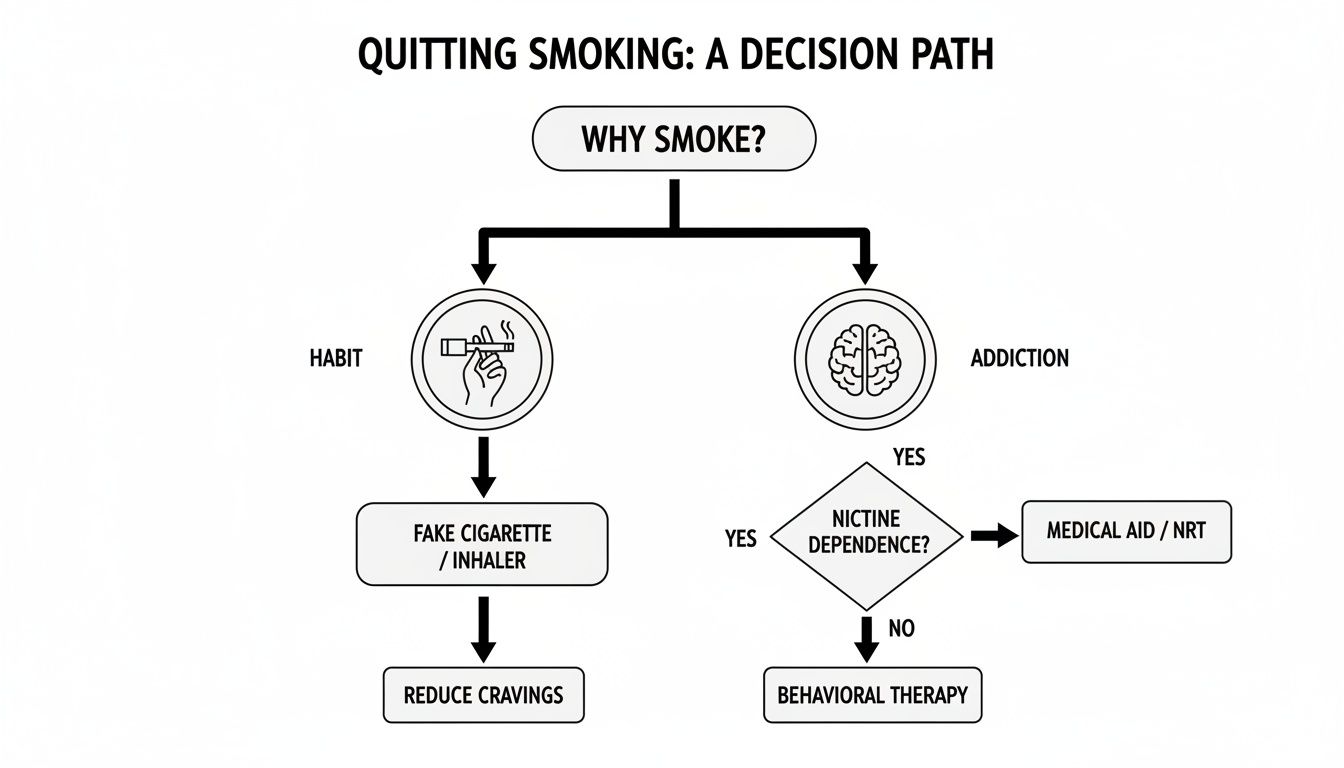
As you can see, if the physical ritual is your biggest hurdle, a behavioural aid offers a direct, powerful solution.
Making the Right Choice for Your Quit Journey
So, how do you actually choose? The best method is the one that addresses what you find hardest about quitting. Be honest with yourself: what part of smoking has the tightest grip on you?
- If you crave the ritual: Is the thought of giving up your morning coffee cigarette or that break-time routine what makes you anxious? If so, a fake cigarette is an excellent place to start. It lets you keep your routines intact while your body gets the nicotine out of its system.
- If you fear nicotine withdrawal: Are you worried about the intense physical cravings, the irritability, and the anxiety? Then vaping or NRT can supply the nicotine your body is screaming for, making the move away from tobacco far less painful.
- If you want a combined approach: There's no rule saying you can only pick one. Many people find success by mixing methods. You could use a nicotine patch (NRT) for steady, background relief while using a fake cigarette to help quit during those specific trigger moments.
The only quit plan that works is the one designed for you. Forget one-size-fits-all solutions; real success comes from understanding your personal triggers and picking a tool that directly targets them.
To make this even clearer, let's break down how each option stacks up side-by-side.
Comparing Quit Smoking Aids: Behavioural vs Vaping vs NRT
| Feature | Fake Cigarettes (Behavioural) | Vaping (E-Cigarettes) | Nicotine Replacement Therapy (NRT) |
|---|---|---|---|
| Primary Target | The physical habit and ritual | Both nicotine addiction and habit | Nicotine addiction only |
| Nicotine Content | Zero | Variable (from high to zero) | Fixed doses |
| How It Works | Mimics the hand-to-mouth action | Delivers nicotine via inhaled vapour | Delivers nicotine through skin or mouth |
| Best For | Breaking the psychological habit | Managing both cravings and habit | Tackling physical withdrawal symptoms |
| Examples | AuraFlow, herbal cigarettes | E-liquids, disposable vapes | Patches, gum, lozenges, sprays |
Each path offers a valid way forward. The key is to choose the one that feels most manageable and empowering for your specific situation.
Ultimately, the goal is to find a sustainable way to live a smoke-free life. Whether that means tackling the habit first, managing the nicotine withdrawal, or a combination of both, the choice is yours. For those looking to explore more options, you can discover a range of healthy cigarette alternatives to find the perfect fit for your new lifestyle.
Integrating Fake Cigarettes into Your Quit Plan
Knowing a tool exists is one thing. Knowing how to use it is what turns a quit attempt into a genuine success story. Bringing a fake cigarette into your plan isn't about a simple swap; it's a conscious strategy to dismantle the smoking habits you've built over the years.
Think of it as a temporary bridge to a smoke-free life, not a permanent destination. With a clear plan, you can face those old trigger moments with newfound confidence.
Setting Your Foundation for Success
The first step is to treat your quit attempt with the seriousness it deserves. This isn't just about raw willpower—it's about smart preparation.
-
Set a Quit Date: Pick a specific date within the next two weeks. This creates a clear starting line and gives you time to get mentally ready without letting procrastination creep in.
-
Identify Your Triggers: For a few days before you stop, keep a simple log. Note down every time you light up and what you’re doing or feeling. Is it the morning coffee? After a meal? A stressful moment at work? These are your personal smoking cues.
-
Prepare Your Replacement: Have your fake cigarette, like an AuraFlow inhaler, ready to go. The key is to make it more convenient to reach for your new tool than an old cigarette. Keep it in your pocket, on your desk, or in the car—wherever you’d normally keep your pack.
By mapping out your smoking patterns, you stop reacting to cravings and start proactively planning for them. You’re turning a subconscious habit into a conscious choice.
The goal is to replace the automatic reach for a cigarette with a mindful choice to use your behavioural aid. This simple act of conscious replacement is where you start to reclaim your power.
This strategy puts you back in the driver's seat, letting you face each trigger with a ready-made solution that satisfies the ritual without the harm.
Combining Strategies for a Stronger Quit
Using a fake cigarette is a powerful way to tackle the behavioural side of smoking, but you don’t have to go it alone. The most successful quit attempts often come from a combined approach that addresses both the physical and psychological sides of the addiction.
Think about pairing your behavioural aid with other proven methods. For instance, using mindfulness techniques can help you sit with a craving and watch it pass, while your fake cigarette keeps your hands busy.
It's also worth noting that combining different aids is common and often very effective. A huge survey in England of over 25,000 smokers found that e-cigarettes were the most used aid in 40.2% of quit attempts and were linked with the highest success rates. This shows how a tool that addresses both habit and, in the case of vaping, nicotine can be powerful, reinforcing the idea that a multi-faceted approach is often best. You can read the full research on cessation aids in England to see the data for yourself.
Expert support can also make a huge difference. The NHS Stop Smoking Services offer free, professional advice and can help you build a personalised quit plan that might include combining NRT with a behavioural tool like AuraFlow.
Gradually Reducing Your Reliance
Finally, remember that your fake cigarette is a tool to get you there, not a crutch for life. The ultimate goal is to be free from the habit entirely.
Once you feel stable and confident without tobacco, you can start to gradually reduce your reliance on your behavioural aid. You might start by leaving it at home when you pop to the shops, or consciously not using it during one of your old trigger moments.
Over time, you’ll find you need it less and less, until one day you realise you haven’t reached for it at all. That’s freedom.
Finding the Right Nicotine-Free Alternative for You
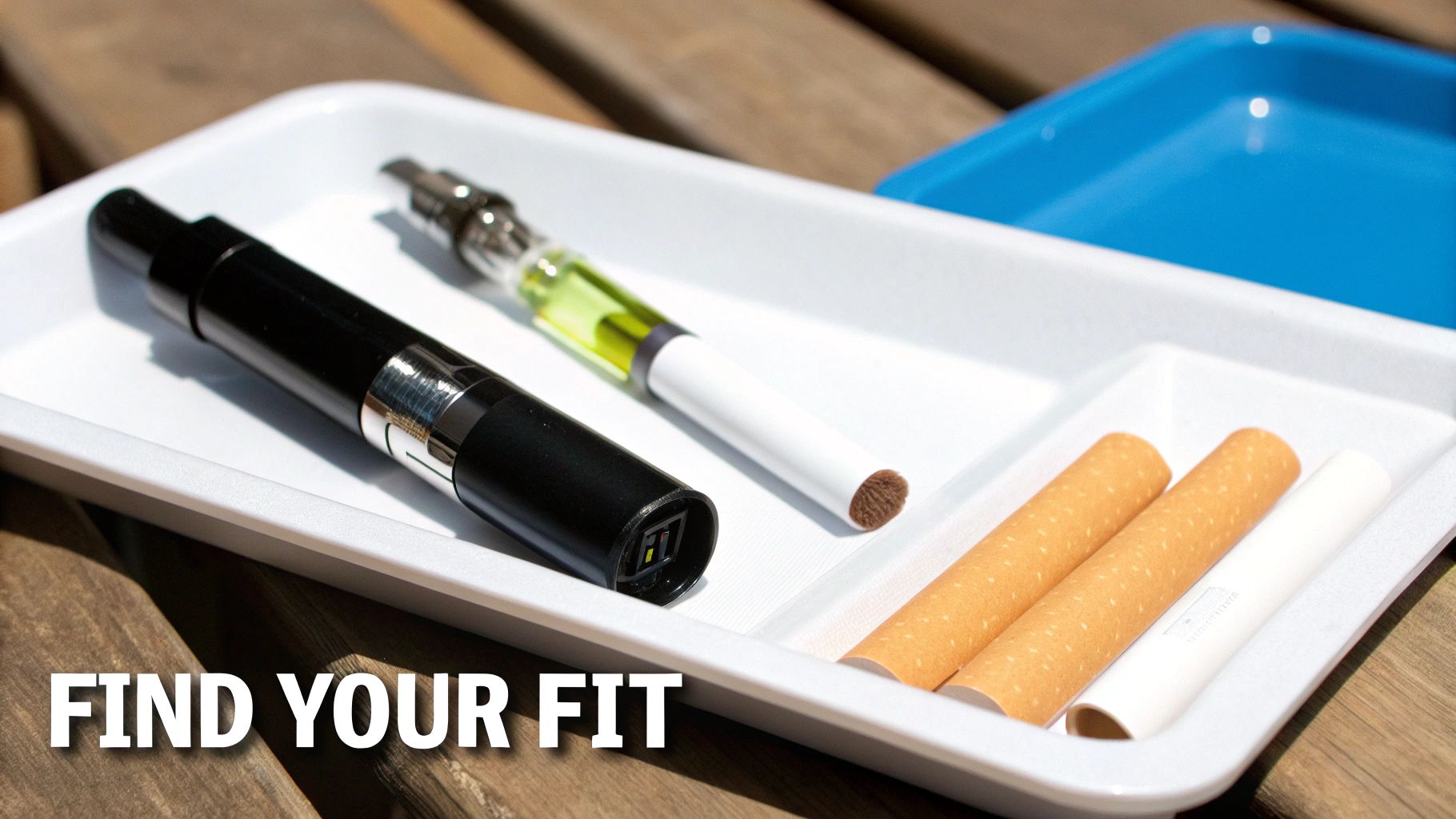
The term ‘fake cigarette’ actually covers a surprising range of products, and each one is designed to help you quit in a slightly different way. Choosing the right one isn't just a small detail—it's crucial, because it needs to match your personal triggers and the life you lead.
Let’s break down the main categories to help you find what works for you. The first step is to get honest with yourself about what you’re trying to replace. Is it mostly about keeping your hands busy? Or is it the deep-down miss of the sensation of inhaling and the flavour? Your answer is the key.
Simple Tools for Fidgety Hands
At the most basic end of the spectrum, you have simple plastic props or fidget devices. Their entire purpose is to tackle the physical, hand-to-mouth action of smoking. Nothing more. They don't offer any flavour, any vapour, or that familiar throat sensation.
Think of these as a straightforward stand-in for the cigarette itself. They're best for people whose biggest struggle is the "fidget factor"—that constant, nagging need to hold and do something with their hands. While they can work, they leave a big gap by not addressing the sensory side of the habit, which is often the biggest hurdle.
Herbal Cigarettes: A Word of Caution
Next up are herbal cigarettes. These look and feel a lot like the real thing and are often sold as a ‘natural’ way to quit. Instead of tobacco, they contain a blend of herbs, but here’s the catch: you still have to light them.
And that is their single biggest flaw. Burning any plant material, even if it’s nicotine-free, releases tar, carbon monoxide, and other nasty toxins. So while they can perfectly replicate the whole ritual, from lighting up to inhaling smoke, the health risks involved make them a poor choice for anyone serious about a healthy quit plan.
Modern Inhalators: The Sensory Solution
This brings us to the new wave of fake cigarettes to help quit: modern, thoughtfully designed inhalators. These devices are built from the ground up to replicate the sensory experience of smoking, but without any of the harm that comes from combustion or nicotine.
They offer the complete package: the physical object to hold, the familiar hand-to-mouth motion, and the all-important sensation of inhaling flavourful air. This makes them profoundly more satisfying than a simple plastic prop.
A perfect example is the AuraFlow device. It's not just about copying the act of smoking; it’s about replacing a harmful habit with a pleasant, calming one. By focusing on enjoyable flavours like Mint and Strawberry, AuraFlow helps you reframe quitting. It stops being about what you're losing and starts being about what you're gaining.
You're not just 'not smoking'—you're actively choosing a moment of calm and sensory pleasure. This mental shift is incredibly powerful and can be the secret to strengthening your resolve for good.
By understanding these different tools, you can make a choice that actually works. You can pick an alternative that targets your biggest challenges head-on, whether that’s just keeping your hands occupied or finding a truly satisfying sensory replacement. It puts you back in control.
Common Questions About Using Fake Cigarettes
Starting your quit journey naturally brings up a lot of questions. If you're thinking about using fake cigarettes to help quit, you'll want to be sure about safety, how well they work, and how they fit into your plan. Let's clear up some of the most common queries.
Are They Safe to Use Long-Term?
Most nicotine-free inhalers are designed with safety in mind, using inert materials and food-grade ingredients just for that quitting phase. They let you completely sidestep the thousands of nasty chemicals found in tobacco smoke.
The main idea is to use them as a temporary bridge—a tool to help you break that hand-to-mouth habit, not as something you’ll use forever. The goal is to eventually not need the behavioural aid, either.
It's crucial to know that some alternatives, like herbal cigarettes that you have to burn, are not a safe option. You can dig deeper into the important differences in our guide exploring if herbal cigarettes are safe and see why anything involving combustion is always the problem.
Can I Use Them with Nicotine Patches?
Absolutely, and this can be an incredibly effective strategy. When you combine a behavioural tool like a fake cigarette with Nicotine Replacement Therapy (NRT), you’re tackling the addiction from both of the angles that matter.
The NRT patch works behind the scenes, managing your physical nicotine withdrawal symptoms around the clock. Meanwhile, the fake cigarette gives you something to reach for to satisfy that immediate, psychological urge for the smoking ritual in those trigger moments.
This dual approach has been shown to seriously boost the chances of quitting for good because it addresses both the chemical dependency and the ingrained habit at the same time.
Should I Choose a Fake Cigarette or Vaping?
This really comes down to your personal struggle. If your biggest hurdle is the physical habit of smoking and you want to get away from nicotine right away, then a nicotine-free fake cigarette is a fantastic choice. It lets you focus purely on dismantling that ritual.
On the other hand, if your nicotine cravings feel completely overwhelming, vaping is a proven harm-reduction tool that deals with both the craving and the ritual. To make the right choice for your journey, think about which part of smoking has a stronger hold on you: the chemical hit, or the physical routine?
Ready to replace the habit with a calming, flavourful ritual? The AuraFlow Starter Kit provides a nicotine-free way to manage cravings and reclaim your moments. Start your smoke-free journey with AuraFlow today.