
Practising mindful meditation is simpler than it sounds. It's really just about finding a comfortable spot, setting aside a few minutes (five is perfect to start), and gently paying attention to the feeling of your breath.
The goal isn't to magically empty your mind—that's impossible. Instead, it’s about noticing your thoughts without getting tangled up in them, and guiding your attention back to your breath whenever your mind naturally wanders off. This simple rhythm of noticing and returning is the heart of the entire practice.
Your First Mindful Meditation Session
Getting started with meditation can feel a bit daunting, but your first session doesn't need any special gear or years of training. It's just about giving yourself a few moments of quiet attention.
The aim is simply to begin, to see what it feels like without any pressure or lofty expectations. Forget those images of silent monks on misty mountaintops; this is about carving out a moment of stillness right here, right now.
The whole process is incredibly straightforward: find a quiet spot, get comfortable, and turn your focus to your breath. That's it. Your mind will wander—that's what minds do. When you catch yourself thinking about your to-do list or what’s for dinner, just gently acknowledge the thought and guide your focus back to the physical sensation of breathing. Every time you do that, you're doing it right.
Finding Your Anchor
Your breath is the perfect anchor for mindfulness because it’s always with you. You can focus on the feeling of air entering your nostrils, the gentle rise and fall of your chest, or the expansion of your belly as you breathe. You don't need to change your breathing at all; just observe its natural, easy rhythm. This simple focal point gives your busy mind a place to rest.
"The real 'practice' happens in the moment you realise you've been carried away by a thought and you gently, without judgement, guide your focus back to your breath. Each time you do this, you're building mental strength."
This simple guide below breaks down the three core elements for your first session: a comfy posture, a short time commitment, and a clear point of focus.
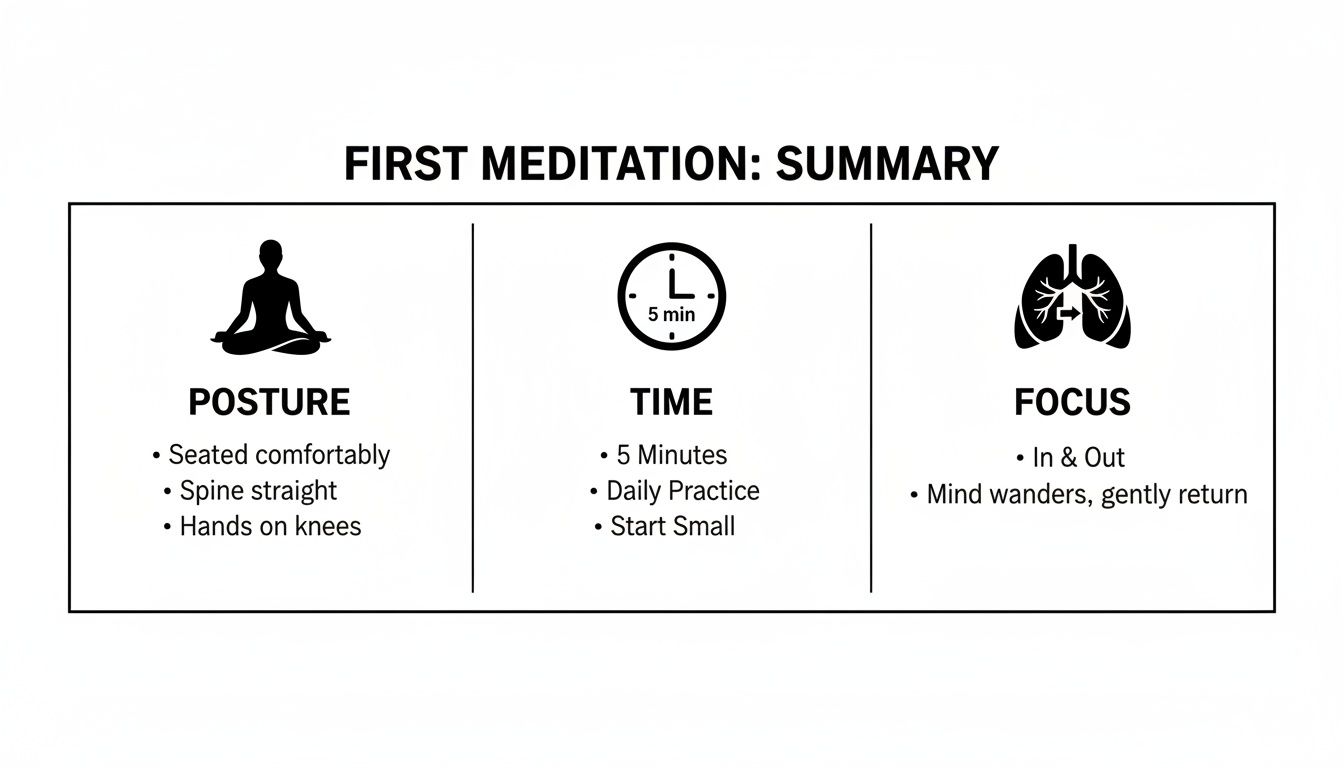
It shows just how these three simple pieces fit together to create a first meditation experience that's both easy and effective.
Posture and Comfort
Finding a posture that is both comfortable and alert is key. You can sit in a chair with your feet flat on the floor, on a cushion, or even lie down if you prefer (though be warned, this can sometimes lead to a nap!). The main idea is to keep your spine straight but not stiff.
Here are a couple of popular options to get you started, along with some simple breathing exercises.
Beginner Meditation Postures and Techniques
A summary of accessible postures and simple breathing exercises to help you begin your mindful meditation practice comfortably and effectively.
| Posture/Technique | Key Focus | Best For |
|---|---|---|
| Seated on a Chair | Feet flat on the floor, back straight. Creates a stable, grounded base. | Absolute beginners or those with limited flexibility. |
| Seated on a Cushion | Legs crossed comfortably, knees lower than hips to support the spine. | Anyone who finds sitting on the floor comfortable and wants a traditional posture. |
| Belly Breathing | Place a hand on your stomach and feel it rise and fall with each breath. | Calming the nervous system and deepening your connection to the breath. |
| 4-7-8 Breathing | Breathe in for 4, hold for 7, exhale for 8. A simple, structured count. | Moments of high stress or when your mind feels particularly busy. |
Whichever posture you choose, the goal is to feel settled and stable, so you can focus on your breath without distraction.
Even a small amount of practice can have a real impact. Recent findings from UK universities have shown that meditating for just ten minutes a day makes a difference. One study found that participants using a mindfulness app saw a 19.2% greater reduction in depression symptoms and a 12.6% decrease in anxiety compared to a control group.
If you're curious about different approaches, you can explore more in our guide on minditation techniques for beginners.
Building a Sustainable Meditation Routine
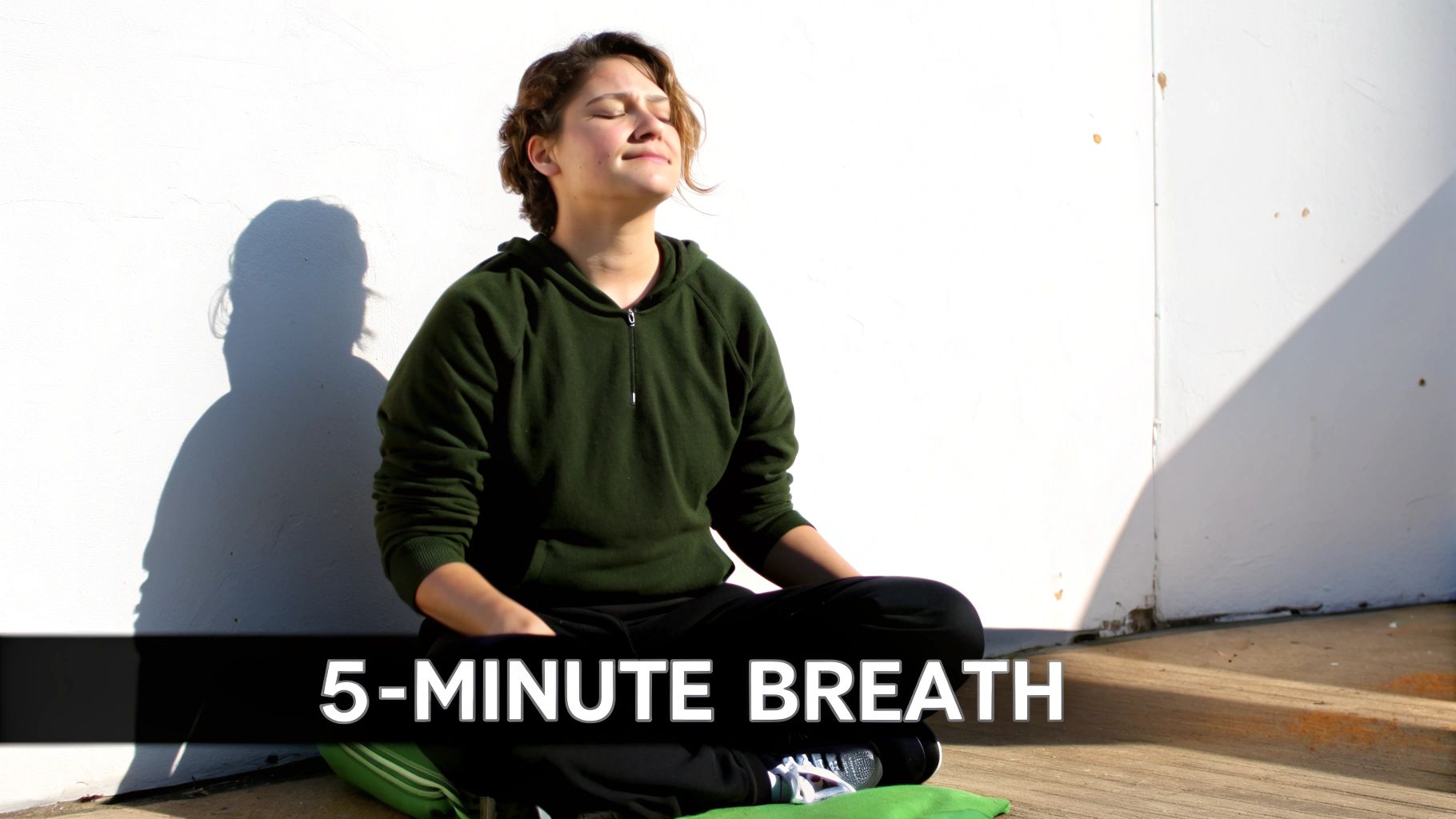
Here's a secret: the real, lasting benefits of mindful meditation don't come from perfect, hour-long sessions. They come from consistency. The goal isn’t another task to tick off your list. It's about gently weaving moments of stillness into the fabric of your life until it becomes a habit that supports you.
You don’t need a soundproofed room or fancy cushions to get it right. Simply choosing the same corner of your bedroom or even the same chair each time sends a powerful signal to your brain. It says, "Okay, it's time to switch gears and turn inward."
Making Time for Mindfulness
The trick is to slide your practice into your existing schedule, not force it into a day that’s already chaotic. The easiest way to do this is to link your meditation to something you already do without thinking. This is a powerful technique known as habit stacking.
Here are a few ideas to get you started:
- Morning Anchor: Before you even glance at your phone, sit for ten minutes with your morning coffee or tea. It sets a calm, intentional tone for the whole day.
- Lunchtime Reset: Take five minutes at your desk or find a quiet bench outside to decompress before you eat. It helps you process the morning and be more present for your break.
- Evening Wind-Down: Use a short meditation as a buffer between your work life and your home life. It’s a brilliant way to mentally clock off.
Making meditation part of your day is a cornerstone of many holistic wellness practices, and it’s a game-changer for finding balance. When you’re thoughtful about where this new habit can fit, you’re so much more likely to make it stick.
The best routine is the one you actually do. Meditating for five minutes every single day is far more powerful than a thirty-minute session once a week. Consistency is what builds the mental muscle.
Finding Support with Technology
Let's be honest, staying motivated can be tough, especially when you're just starting out. This is where your phone can actually be an ally. Guided meditation apps are brilliant for taking the guesswork out of it, giving you a gentle voice to follow when your own mind feels too noisy.
Think of these apps not as a crutch, but as a toolkit. They offer different styles and lengths of meditation to match your mood and how much time you have. Many also have gentle reminders and progress trackers, which can give you that little boost of encouragement as you build momentum.
Learning what separates a good habit from a bad one is a huge part of the journey, and using an app can help reinforce the positive routine you’re trying to build. You can read more about forming better routines in our article on understanding good and bad habits. Ultimately, the goal is to make your practice a sustainable part of your life—not just another chore.
Navigating Common Meditation Challenges
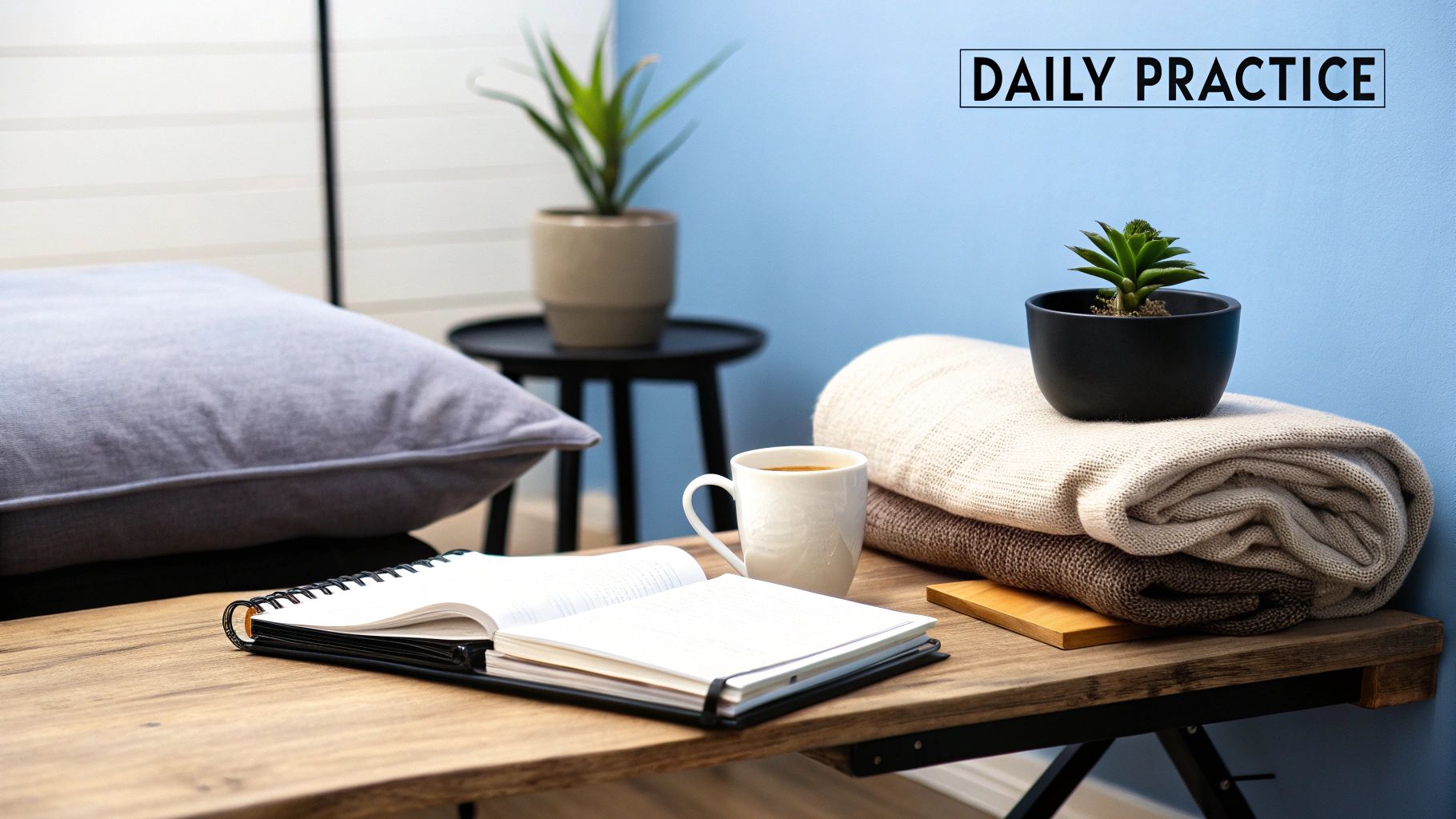
As you start to build a real meditation routine, it’s completely normal to hit a few bumps in the road. You might feel restless, find your mind racing with a million thoughts, or even start to feel a bit sleepy.
These experiences aren't signs you're doing it wrong. In fact, they’re a universal part of the process for absolutely everyone learning to practice mindful meditation.
Think of it this way: every time you notice your attention has drifted—whether to a memory, a worry, or an itch on your nose—and you gently guide it back to your breath, you're doing a rep for your mindfulness muscle. That act of returning, without judging yourself, is the practice.
Handling a Busy Mind
One of the biggest myths about meditation is that you need a perfectly clear, empty mind. In reality, the mind is a thought-generating machine. You can’t just switch it off, and intrusive or distracting thoughts are guaranteed to show up.
The key is to change your relationship with them. Instead of getting frustrated, try just acknowledging them with a neutral label like "thinking" or "planning." Imagine them as clouds drifting across the sky of your awareness—you can see them, but you don't have to get on board and fly away with them.
For many of us, these recurring thoughts are a source of stress. Specific mindfulness exercises for anxiety can be a huge help in learning to manage them with a bit more compassion.
Remember, the goal is not to stop your thoughts, but to stop your thoughts from controlling you. By observing them without getting entangled, you take back your power and find stillness amidst the mental noise.
Overcoming Restlessness and Discomfort
Sitting still can be surprisingly challenging. You might notice a powerful urge to fidget, feel a sudden ache in your back, or become overwhelmingly aware of every tiny sensation in your body. This physical restlessness is often just pent-up energy or your body adjusting to being still.
Before you immediately shift your position, try bringing a curious awareness to the sensation itself.
- Acknowledge It: Silently note, "There is an itch," or "My knee feels tight." Just state what's happening.
- Explore It: Observe the feeling without judgement. Is it sharp or dull? Does it pulse, or is it constant?
- Breathe Into It: Direct your breath towards the area of discomfort, imagining it softening with each exhale.
If the discomfort becomes too strong to ignore, it’s perfectly fine to mindfully adjust your posture. The aim is to respond with gentle intention rather than a reactive jolt.
This approach helps you learn the difference between genuine pain that needs attention and fleeting discomfort that you can simply observe and let pass. It’s an incredibly useful skill, both on and off the cushion, helping you respond to life's challenges with far more calm and presence.
Exploring Deeper Mindfulness Practices
Once you've found a comfortable rhythm of returning to your breath, you can start to explore other powerful ways to practise mindful meditation. These aren't complicated techniques that require you to learn a whole new skill. Instead, think of them as fresh ways of applying the same core principle: gentle, non-judgemental awareness.
Moving beyond a simple focus on the breath can deepen your mind-body connection in some really surprising and meaningful ways. This next step is all about expanding your mindful curiosity from just your breath to your entire being.
Introducing the Body Scan Meditation
A fantastic way to deepen your practice is with a body scan. This is a technique where you systematically guide your attention through different parts of your body, simply noticing whatever sensations you find without trying to change them.
Instead of anchoring on your breath, you might start by bringing your awareness to the toes on your left foot. You’ll just notice what’s there—warmth, coolness, a bit of tingling, pressure from your socks, or even a complete lack of sensation. After a few moments, you’ll gently shift your focus to the sole of that foot, then the heel, and so on, gradually "scanning" your way up your entire body.
The process is simple and has a nice, gentle structure:
- Start at Your Feet: Bring a curious, kind attention to your toes, one foot at a time.
- Move Up Slowly: Gradually guide your awareness up through your legs, torso, arms, and neck.
- End at Your Head: Finish by noticing the sensations in your face, scalp, and the very crown of your head.
This practice is brilliant for reconnecting with your physical self. You’ll be amazed at how it can help release hidden tension you weren't even aware you were holding onto.
The body scan isn't about fixing or relaxing anything. It's about listening. By paying kind attention to your body, you foster a sense of presence and acceptance that can be incredibly restorative.
Embracing Kindness in Your Practice
As you explore these deeper practices, a gentle and compassionate attitude becomes even more important. It's inevitable that you'll encounter physical tension, difficult emotions, or a stubbornly busy mind. When this happens, our first instinct is often to judge ourselves or get frustrated.
This is where self-compassion becomes a vital part of your meditation. As your mindfulness practice evolves, focusing on cultivating self-compassion for lasting well-being can make a huge difference to your inner peace and resilience. It’s really about learning to treat yourself with the same kindness you’d offer a good friend.
Profound Shifts in Awareness
With consistent practice, many people find that mindfulness becomes much more than just a tool for stress relief. Here in the UK, where around 15% of adults have tried mindfulness, this shift is becoming better understood.
A report from the British Psychological Society found that regular practitioners experienced a sense of 'unity'—where the self and environment seem to merge—at double the frequency of non-meditators. Remarkably, 43% of these experiences happened during meditation sessions, showing that the practice can lead to some truly profound changes in perception. You can discover more insights about these findings on the BPS Research Digest.
These moments aren't goals to strive for, but rather natural outcomes that can arise from sustained, curious attention. They reveal the potential of mindfulness to not only calm the mind but also to completely reshape how you experience yourself and the world around you.
Bringing Mindfulness into Your Digital Life
Mindfulness isn’t something you just do on a meditation cushion; its real magic happens when you bring it into the chaos of your everyday life. And let’s be honest, for most of us, that life is packed with screens, notifications, and a constant hum of digital noise.
Learning to find moments of quiet awareness in the middle of all that is a powerful antidote to the burnout we all feel sometimes.
The idea is to close the gap between your formal practice and your screen time. This doesn't mean you need to meditate for an hour every time you check your email. It’s much simpler than that. It’s about weaving tiny pockets of awareness into the digital habits you already have.
Practising Micro-Mindfulness Habits
This is where micro-mindfulness comes in. It’s all about creating tiny, intentional pauses that interrupt our automatic, reactive scrolling and clicking. These little moments inject a sliver of presence into activities that are usually completely mindless.
Here are a few simple ways you can start doing this right now:
- The Three-Breath Rule: Before you flip open your laptop or even unlock your phone, just stop. Take three conscious breaths. Feel the air come in and go out. This tiny act creates a powerful buffer between an impulse and your action.
- Mindful Transitions: When you get up to make a cup of tea, leave your phone on the desk. Seriously, just leave it. Pay full attention to the feeling of your feet on the floor, the sound of the kettle starting to boil, and the warmth of the mug in your hands.
- Notification Awareness: Instead of jumping at every ping, just notice the sound. Acknowledge the little jolt of urgency to check it, take one single breath, and then decide if it needs your attention right now. Most of the time, it can wait.
These small acts are your secret weapon against the constant pull of technology. They might feel insignificant at first, but they compound over time, helping you feel more in control and less like you're being dragged around by your devices.
"Your phone can either be a source of constant distraction or a tool for mindful awareness. The choice lies in how you decide to engage with it, one intentional moment at a time."
Using Technology to Support Your Practice
It might sound strange, but you can actually use your technology to help you stay mindful. The trick is to be intentional—to use your devices to support your practice instead of letting them drain your attention. Try setting a recurring daily reminder on your phone with a simple, gentle prompt like, "How's your breathing right now?"
The strain of being constantly connected is real. A study by Opera and the Oxford Mindfulness Foundation found a massive gap: while 70% of UK adults feel stressed out online and 97% are open to the idea of mindfulness, less than half of them actually do it regularly. You can read the full research about digital stress and mindfulness to dig deeper. This shows a huge need for practical ways to build mindful habits right into our digital lives.
By creating these small moments of pause, you start to transform your relationship with technology. You shift from being a passive consumer of information to an active, present participant in your own life—both online and off.
Common Questions About Mindful Meditation
As you start to explore mindful meditation, it's completely natural for questions to bubble up. Feeling a bit unsure is part of the process, and getting some clarity can help you stick with it when things feel tricky.
This section tackles some of the most common hurdles people face when they're just starting out. Think of it as a friendly guide to help you navigate those early days on the cushion.
How Long Should I Meditate For Each Day?
When you're new to this, consistency is everything. It's far better to meditate for five minutes every single day than for half an hour once a week. You want to build a habit that feels supportive, not like another chore on your to-do list.
Don't underestimate the power of short sessions. Research from UK universities has found that even ten minutes of daily practice can lead to real reductions in anxiety and depression. Start with a time that feels genuinely doable. You can always add a few more minutes later on, once the routine feels natural.
What If I Keep Falling Asleep During Meditation?
This happens to almost everyone, so please don't worry about it! It's usually just a sign that you're tired, especially if you’re meditating at the end of a long day or while lying down.
A few simple tweaks can make a big difference:
- Sit Upright: Try meditating in a chair with your feet flat on the floor and your back straight but not stiff. This posture naturally encourages alertness.
- Switch Up Your Timing: Experiment with meditating in the morning or during a midday break when you're likely to have more energy.
- Get Moving: If you’re still feeling sleepy, a mindful walk is a brilliant alternative. It keeps the body and mind gently engaged.
Is It Okay That I Can't Stop Thinking?
Yes, absolutely. A busy mind isn't a sign that you're failing; it's a sign that you have a perfectly normal brain. The goal of mindfulness isn't to get rid of your thoughts, but to learn how to relate to them differently.
The real 'practice' is the moment you notice you've been swept away by a thought, and you gently guide your attention back to your breath. Every single time you do that, you're building a mental muscle.
It's not about achieving a blank, empty mind. It's about noticing the mental chatter, again and again, and kindly returning to your anchor—your breath. This very act of noticing and returning is the meditation.
Do I Need Any Special Apps Or Equipment?
Honestly, you don't need anything fancy to get started. All you really need is a quiet spot where you won't be disturbed for a few minutes. Your own breath is the only tool that's truly essential.
That said, a little guidance can be a massive help, especially in the beginning. Guided meditation apps can provide structure, keep time for you, and offer a calming voice to follow along with. Many trusted UK organisations, including the NHS, even recommend app-based resources as an easy and supportive way to dip your toes into the world of mindfulness.
Ready to replace a smoking habit with a moment of mindful calm? The AuraFlow Starter Kit offers a nicotine-free alternative, using natural flavours and a simple, satisfying ritual to help you on your journey. Discover a gentler way to breathe at https://aura-flow.co.uk.