
Deciding to quit vaping cold turkey is a huge first step. You're not just vaguely trying to stop; you're making a clean break. This isn't about sheer willpower alone. It's about having a solid plan for a definitive end to nicotine, and you've chosen the most direct path there.
Why Quitting Vaping Cold Turkey Is a Powerful Choice
Going cold turkey is a genuinely empowering move. Instead of dragging out the process of weaning yourself off nicotine, you’re ripping the plaster off in one go. Psychologically, this is massive. It creates a clear, final end date and gets rid of that grey area that so often leads to "just one more puff."
This isn't an impulse decision; it's a strategic one to reclaim your health right now. You're choosing to face the challenge head-on. Sure, the first few days will be tough, but you get through the most intense withdrawal symptoms much faster. You're essentially fast-tracking your journey to feeling normal without a vape. In fact, many of the long-term health benefits of quitting smoking and vaping kick in almost immediately.
The UK Trend Is On Your Side
You're not alone in making this choice. The cultural tide in the UK is turning, and there’s more support than ever for people ready to quit. Recent research from UCL shows that after a huge spike, the number of adults vaping in the UK has completely stalled.
This levelling-off suggests fewer people are starting, and a recent dip in adult e-cigarette use is actually the first decline seen since 2012. It’s clear you're part of a growing movement away from nicotine dependency.
The benefits of quitting now are undeniable:
- A True Clean Break: No more bargaining with your addiction. When you stop, it's over.
- Faster Physical Recovery: Your body starts healing right away, and more decisively than with a gradual approach.
- Instant Financial Savings: Every single day you don't vape is money back in your pocket. It adds up incredibly fast when you stop completely.
Choosing to stop vaping cold turkey is about flipping the script. You’re not giving something up—you’re taking back control over your health, your money, and your future.
This guide is here to help you turn that powerful decision into a successful plan. It’s not just about gritting your teeth and getting through it. It's about preparing properly. With the right strategies and mindset, your choice to go cold turkey can be the best one you ever make.
How to Prepare for Your Quit Day
Let's be honest, quitting for good rarely happens on a whim. The real work, the stuff that makes it stick, begins in the days leading up to your last puff. Proper preparation transforms a vague wish into a concrete, actionable plan. It’s about methodically taking apart the habit before you even have to face down your first real craving.
Think of it like getting ready for a big life event. You wouldn't just show up and hope it all works out. You'd plan, you'd prepare, you'd get your head in the game. Your quit day deserves that same respect. This is the approach that separates a frustrating, failed attempt from a genuine, life-changing success.
Lock in a Non-Negotiable Quit Date
First things first: you need a finish line for your old habit and a starting line for your new life. Vague goals like "I'll quit sometime next week" are just too easy to push off forever. Get out your calendar and pick a specific, non-negotiable date within the next seven days. That’s close enough to keep the motivation high, but gives you just enough time to get everything in order.
Mark it down. Circle it in red. Set a reminder on your phone. Treat this date like an unbreakable appointment. A smart move is to pick a day with less built-in stress, like the start of a weekend. This lets you navigate the first tricky 48 hours without the pressure of a chaotic workday piling on.
Once it's set, tell a couple of key people. Letting a supportive partner, a close friend, or a family member in on your plan adds a powerful layer of accountability. It’s not about adding pressure; it’s about building a small team who can cheer you on when things get tough.
Do a Vape Audit and Create Your Reward
To really grasp what you’re about to gain, you need to see exactly what you've been losing. Take five minutes and do a quick 'vape audit'. Tally up what you spend on pods, liquids, and new devices each week. Then multiply it out for the month, and finally, for the year. The final number is often a genuine shock.
Write that yearly figure on a sticky note and put it somewhere you'll see it every day—the fridge, your computer monitor, your car's dashboard. This number is now your financial motivation. Start dreaming about what you’ll do with all that extra cash. A holiday? A new bike? That gadget you've been eyeing? Seeing a tangible reward makes the short-term struggle feel so much more worthwhile.
Your quit day isn't about deprivation. It's the day you start liberating yourself from a habit that costs you your health and your hard-earned money. Every pound saved is a real, concrete reward for your effort.
This simple exercise completely reframes the act of quitting. You're not losing something; you are actively gaining back control, health, and a significant amount of money.
Assemble Your Quit Kit
You wouldn't go into a storm without a raincoat, so don't face nicotine withdrawal without the right tools. Your 'quit kit' is your personal arsenal of craving-busters and distraction aids, ready to go from minute one. The whole point is to have replacements ready for when your hands and mouth start feeling that familiar, antsy void.
Everyone's kit will look a bit different, but here are some must-have items to get you started:
- Oral Fixation Fixes: Sugar-free gum, strong mints, crunchy carrot sticks, or even sunflower seeds can work wonders.
- A Hydration Hero: Keep a big, reusable water bottle with you at all times. Taking a long sip of cold water can genuinely derail a craving and helps your body flush everything out.
- Hands-On Stress Relievers: A stress ball, a fidget toy, or a simple rubber band to snap on your wrist can give your hands a much-needed job to do.
- A Nicotine-Free Inhaler: For so many of us, the hand-to-mouth ritual is the hardest part of the habit to break. A tool like an AuraFlow gives you that physical motion and satisfying flavoured air without any of the harmful stuff. It's an incredible replacement for the physical act.
Putting this kit together is a critical step. For more great ideas, check out our guide on how to build effective quit smoking kits—the same principles work perfectly for leaving vaping behind.
Map Your Triggers and Plan Your Escape Routes
Finally, get brutally honest about your personal vaping triggers. When are you most likely to reach for your device? For many, it's that first coffee in the morning, the mid-afternoon slump at work, or during the drive home.
Don't wait for the trigger to strike. Plan a new routine for each one before your quit day arrives. If you always vape with your coffee, try drinking it in a different room or switch to tea for the first week. If your work break is a trigger, plan to use that time for a brisk five-minute walk outside instead.
Having a pre-decided alternative is your secret weapon. It removes the need to make a tough decision in a moment of weakness, making it infinitely more likely you’ll stick to your new, healthier path.
Right, you’ve made it to quit day. This is it. The next three days are going to be the ultimate test of your decision to stop vaping cold turkey. This is where the physical withdrawal from nicotine hits its peak, but it’s also where your body starts doing some serious healing. Knowing what’s coming and having a plan ready to go can make all the difference.
Forget generic advice. Think of this as your hour-by-hour survival guide. Every uncomfortable feeling—the irritability, the brain fog, the sudden, intense cravings—is just a temporary signal that your body is getting back to normal. These aren't signs of failure; they're signs you're winning.
The prep work you did beforehand is what will carry you through now.
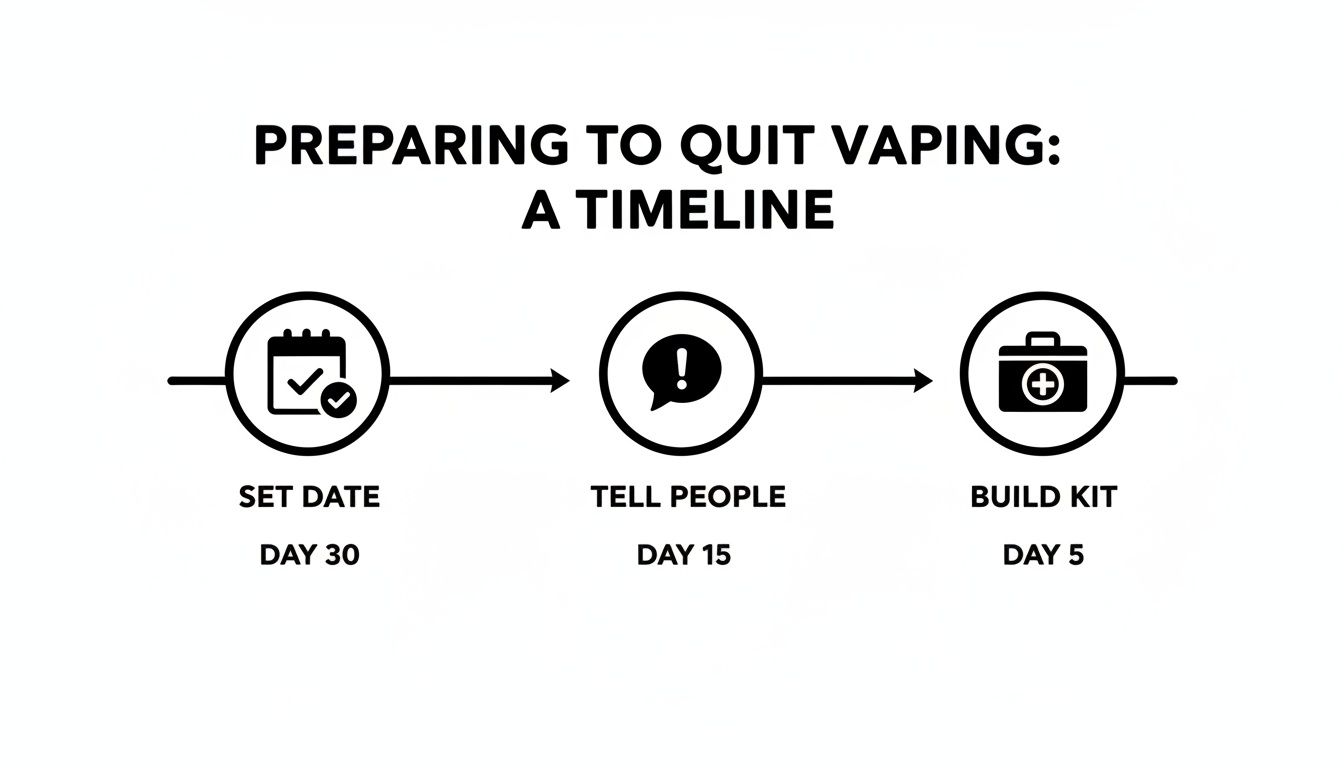
This is why setting a date, telling people, and building your quit kit were so crucial. They are your foundation for getting through these first 72 hours.
What to Expect Physically and Mentally
The physical side of nicotine withdrawal really ramps up within the first 24 to 72 hours. Your brain, which got used to a regular drip-feed of nicotine, is now protesting loudly. This can show up in a few key ways, and just being able to name them for what they are is half the battle.
Common withdrawal symptoms include:
- Intense Cravings: They can feel like they'll last forever, but in reality, they're surprisingly short, usually lasting only a few minutes.
- Irritability and Mood Swings: You might feel snappy, anxious, or just plain miserable. That's your brain chemistry rebalancing itself.
- Brain Fog: Finding it hard to concentrate or feeling like your head is full of cotton wool is completely normal. Your mind is learning to work without a stimulant.
- Headaches and Dizziness: Often caused by changes in your circulation and oxygen levels as your body starts to recover.
- Sleep Problems: You might struggle to get to sleep or have some pretty wild dreams as your sleep patterns regulate.
The withdrawal process can be really uncomfortable, but the table below breaks down what you might experience day-by-day and gives you concrete ways to push through it.
Your Cold Turkey Withdrawal Timeline: What to Expect
| Timeframe | Common Symptoms | Management Strategy |
|---|---|---|
| First 24 Hours | Peak irritability, intense but short cravings, restlessness, and possible headaches. | Stay hydrated. Use deep breathing exercises. Go for a short, brisk walk to burn off nervous energy. |
| 24-48 Hours | Brain fog and difficulty concentrating are common. Mood swings may feel unpredictable. | Keep healthy, crunchy snacks on hand (carrots, apples). Break tasks into small, manageable chunks. |
| 48-72 Hours | Physical symptoms start to ease, but psychological cravings can be strong. Fatigue might set in. | Focus on your "why." Remind yourself how far you've come. Use a nicotine-free inhaler to manage oral fixation. |
Remember, after the 72-hour mark, the worst of the physical symptoms typically begin to fade. Each hour you get through is a massive win. While this timeline is specific to vaping, the core principles are the same for any nicotine product. For a more in-depth look, our guide on the smoking cessation withdrawal timeline offers a detailed breakdown.
Your Immediate Coping Playbook
When a craving hits, it hits hard. You need an immediate, pre-planned response because in that moment, your brain will be screaming for the easy way out.
When a craving strikes, do one of these things immediately:
- Move Your Body: If you're sitting at your desk, get up and walk to the kitchen. If you're on the sofa, step outside for a minute of fresh air. A simple change of scenery can break the mental loop.
- Shock Your Senses: Down a big glass of ice-cold water. The cold shock is a powerful distraction. You could also bite into a wedge of lemon or splash cold water on your face.
- Breathe Deeply: Inhale slowly for a count of four, hold your breath for four, and then exhale slowly for a count of six. This simple exercise calms your nervous system right down.
Managing Stress and That Hand-to-Mouth Habit
A huge piece of the puzzle is the psychological link you've built between vaping and stress relief. That hand-to-mouth action has become your go-to coping mechanism. The first 72 hours can feel incredibly stressful, so it's a good time to explore some 10 gentle ways to find your calm.
This is also where your quit kit becomes your best mate. The oral fixation—that powerful, ingrained need to have something in your hand and bring it to your mouth—is a tough habit to break. Using a nicotine-free alternative like AuraFlow can be a game-changer here. It lets you go through the physical motions without any of the nicotine, satisfying that deep behavioural urge.
If you don't have a nicotine-free inhaler, try these instead:
- Chew on crunchy carrot sticks or celery.
- Sip water through a straw to mimic the action.
- Keep sugar-free mints or gum nearby for a quick burst of flavour.
Getting through these first three days is the toughest part of quitting vaping cold turkey. It really is a battle of moments. Just focus on winning the next five minutes. If you can win enough of those small moments, you'll win the war against nicotine for good. Be kind to yourself, drink plenty of water, and keep reminding yourself why you started.
Mastering Your Triggers for Long-Term Success
Once you’ve wrestled through those first few days of raw, physical withdrawal, the nature of the fight changes. That intense, body-shaking need for nicotine starts to quiet down, but something sneakier takes its place.
Now, the battle moves to your mind. It's all about the habits, the routines, and the environmental cues—the triggers—that you've hardwired into your brain over months or years.
Getting a handle on these psychological triggers is what separates a successful quit week from a truly vape-free life. It’s about knowing what makes you instinctively reach for a vape and having a rock-solid plan to do something else instead. This is where you graduate from just surviving the quit to actually building a new way of living.
The Four Ds: Your Go-To Craving Response
When a craving hits, it can feel like a tidal wave. Your brain starts screaming that the feeling is unbearable and will last forever. But here's the truth: most cravings are surprisingly brief, usually peaking within just three to five minutes. Your only job is to ride it out.
The '4 Ds' is a powerful, in-the-moment toolkit for doing just that.
-
Delay: Don't fight the craving, just bargain with it. Tell yourself you'll wait 10 minutes before even thinking about giving in. This simple act of putting it off shifts the power back to you. More often than not, by the time those 10 minutes are up, the urge has lost its teeth.
-
Distract: Immediately throw your brain a curveball. Do something that requires your full attention. Solve a puzzle on your phone, call a friend for a quick chat, or tackle a small, satisfying task like organising your desk drawer. The idea is to interrupt the craving's thought pattern before it can take hold.
-
Deep Breathe: This one mimics the physical action of vaping but turns it into a force for good. Inhale slowly through your nose for four seconds, hold your breath for four, and then exhale slowly through your mouth for six. This simple exercise is a direct line to calming your nervous system and getting you centred.
-
Drink Water: Always keep a bottle of cold water handy. When a craving strikes, take a long, slow sip. It gives your hands something to do, occupies your mouth, and helps to flush out any lingering toxins.
This isn't just theory; it's a practical action plan. Instead of feeling ambushed by a craving, you have four clear, effective tactics ready to go at a moment's notice.
Interrupting Your Old Patterns
Vaping was never just about the nicotine; it was a collection of deeply ingrained rituals. The vape with the morning coffee. The puff after lunch. The "stress relief" break at work. These are automatic behaviours, running on autopilot.
The most effective way to dismantle them is to consciously throw a spanner in the works.
Try some of these "pattern interrupts":
- Shake Up Your Morning: If your first vape always happened with your coffee, try drinking your coffee in a different room for a week. Or switch to herbal tea for a little while, just to break that powerful association.
- Reclaim Your Break Time: Instead of taking that usual vape break, use the time for a brisk walk around the block. Getting fresh air and moving your body is a fantastic way to boost your mood and kill a craving dead.
- Redesign Your Drive: If driving is a huge trigger, make a new 'car playlist' full of songs you have to sing along to. You could also keep something crunchy like carrot sticks in the car to keep your hands and mouth occupied.
The goal isn't just to stop the old habit. It's to actively and intentionally replace it with a new, better one. You're literally rewriting the script of your daily life.
This proactive approach is everything when you decide to stop vaping cold turkey. It shifts your focus from what you feel you're losing to all the new, positive things you're building.
The Power of Sensory Replacement
Let's be honest, a huge part of vaping is purely sensory. It's the hand-to-mouth motion, the ritual of the inhale and exhale, and that burst of flavour. When you quit, your brain misses these sensations almost as much as the nicotine itself.
This is where finding a smart replacement can be a total game-changer.
If it's the flavour you're missing, a nicotine-free alternative like AuraFlow's Mint or Strawberry can hit that spot without any of the harmful stuff. It delivers that satisfying sensory experience you're craving, which makes the whole process feel less like you're depriving yourself.
If it's the ritual you miss, you can reframe using a nicotine-free inhaler as a positive wellness practice. It stops being a destructive habit and becomes a moment of mindful breathing—a chance to pause, centre yourself, and take a calming breath. You're turning a trigger into an opportunity for genuine self-care.
And remember, this is an achievable goal. A massive 55% of current vapers in Great Britain are ex-smokers who successfully kicked tobacco. It's solid proof that millions have dropped nicotine for good. You can read more about these UK vaping and smoking trends and see just how many people have made the switch.
Building a Vape-Free Life and Preventing Relapse
You’ve made it through the toughest part. The initial battle with physical withdrawal is over, and now the real work begins. This is where the journey shifts from just surviving without a vape to genuinely thriving without one.
It’s all about cementing your new identity as a non-vaper. This is the phase where you build a life where relapse isn't just something you avoid, but something that feels completely undesirable. You’re no longer counting the minutes since your last puff; you’re starting to count the wins—the money saved, the deep breaths you can take, and the freedom you’ve reclaimed.
Celebrate Milestones and Reward Your Progress
Every step forward, no matter how small it seems, deserves to be acknowledged. Celebrating your progress reinforces the new behaviour and keeps your motivation sky-high.
Your first day vape-free is a massive victory. So is your first week, your first month, and that first social event where you didn't even think about vaping. These milestones are tangible proof that you're winning.
- Financial Rewards: Remember that 'vape audit' you did? It's time to cash in. After week one, take the money you would have spent and buy yourself something small—a good coffee, a new book, or a cinema ticket.
- Monthly Wins: After a full month, think bigger. That holiday fund or new gadget you were dreaming about is now a real possibility. Seeing your savings turn into something you truly value is an incredibly powerful motivator.
Self-compassion is your greatest tool now. You're unlearning a deeply ingrained habit, and that takes time, patience, and kindness. Celebrate your strength, not just the outcome.
By actively rewarding yourself, you're creating a positive feedback loop. Your brain starts to connect being vape-free not with deprivation, but with real, enjoyable rewards.
Navigating Tricky Social Situations
Let's be honest, one of the biggest hurdles is being around friends who still vape. It’s one thing to stay strong when you're alone, but social pressure can seriously test your resolve. The key is to have a game plan before you even walk out the door.
You don't need to become a hermit. You just need a few simple, polite refusal scripts ready to go. Having a pre-prepared answer removes the awkwardness and makes it so much easier to say no without feeling defensive.
Try these polite refusal scripts:
- Simple & Direct: "No thanks, I've quit." (You don't owe anyone a long explanation).
- Positive Frame: "I'm good, thanks. I'm feeling so much better since I stopped."
- Light-hearted Deflection: "Nah, I'm saving up for a holiday with all the money I'm not spending on that stuff!"
Practise saying them out loud at home. It might feel a bit silly, but it helps the words come more naturally when you actually need them. Your real friends will respect your decision.
Overcoming the 'One Won't Hurt' Fallacy
The most dangerous thought you'll have is, "Just one puff won't hurt." This is the thought that derails more quit attempts than anything else.
For someone quitting cold turkey, there is no such thing as "just one." That single puff resets the clock on your withdrawal and can instantly reignite the intense cravings you fought so hard to beat.
Building a sustainable vape-free life also means looking after your overall well-being with things like therapeutic activities for mental health. If you do have a slip-up, don't let it become a full-blown relapse. Acknowledge it, figure out the trigger, and get straight back on track. Guilt isn’t productive here; resilience is.
The good news is that cultural momentum is on your side. In the UK, adult vaping use has stabilised after years of growth, with a recent dip from 10.7% to 10.4%. Crucially, 18% of current vapers are ex-smokers, proving a clear path exists from smoking, through vaping, and on to quitting nicotine entirely. These insights from ASH show that mass exits from vaping are happening right now, and you're part of that movement.
Got Questions About Going Cold Turkey?
Even with the best plan in the world, it's totally normal to have a few nagging worries. Let's face it, quitting is a big deal. Getting clear answers to those common concerns can be the one thing that gives you the confidence to push through a tough moment and stick with it.
We're going to tackle some of the most common questions head-on, so you can feel prepared, reassured, and ready for what’s ahead.
Is It Dangerous to Stop Vaping Cold Turkey?
For most healthy adults, quitting cold turkey isn't dangerous, but it can definitely feel intense and uncomfortable. Those symptoms you're bracing for—the irritability, headaches, and powerful cravings—are just signs of nicotine withdrawal. They’re not a physical threat. Think of them as temporary signals that your body is already starting to heal.
That said, it’s always a good idea to have a quick chat with your GP before you quit. This is especially important if you have any underlying health conditions, like anxiety, depression, or heart issues. A doctor can give you personalised advice and just confirm this is the safest way forward for you.
How Long Does the Brain Fog Last?
Ah, the brain fog. That feeling like your head is full of cotton wool is a very real, and very frustrating, part of the process. Nicotine is a stimulant, so when you take it away, your brain needs a bit of time to find its own rhythm again.
The most intense brain fog usually hangs around for the first few days, maybe up to a week. You should start to feel your mind getting much clearer within about two weeks.
In the meantime, you can fight back with a few simple tricks:
- Drink More Water: Dehydration makes brain fog ten times worse. Keep a water bottle with you at all times.
- Get Moving: Seriously, even a brisk five-minute walk gets the blood flowing to your brain and can help clear the cobwebs.
- Prioritise Sleep: Your brain does most of its repair work while you're asleep. Try to get a solid, consistent night's rest.
I've Tried Cold Turkey Before and Failed. What Makes This Time Different?
First off, a previous attempt isn't a failure. It's a practice run. Think of it as gathering intel. You’ve already learned what your toughest triggers are, and that gives you a massive advantage this time around. The real difference between then and now? Preparation.
This entire guide is built around having a solid plan, not just gritting your teeth and hoping for the best. This time, you're going in armed with:
- A non-negotiable quit date you’ve committed to.
- A support system you’ve already told about your plan.
- A pre-planned strategy for handling your specific triggers.
- A physical 'quit kit' at the ready, maybe even including a nicotine-free inhaler to tackle that hand-to-mouth muscle memory.
A so-called "failed" attempt in the past doesn't define your future. It just gives you the data you need to build a smarter, stronger plan. You’re not starting from scratch; you’re starting from experience.
Will I Gain Weight if I Stop Vaping?
This is a big worry for a lot of people, and there's a grain of truth to it. Nicotine can give your metabolism a slight boost and suppress your appetite. When you quit, you might also be tempted to swap the oral fixation of vaping for snacking.
But weight gain is absolutely not a given. You can get ahead of it by planning. Stock your kitchen with healthy, crunchy snacks like carrot sticks, apple slices, or celery. Upping your water intake also helps you feel full and curbs the urge to graze.
The real game-changer is finding a non-food replacement for that hand-to-mouth habit. Chewing sugar-free gum, sipping water through a straw, or using a flavourful, nicotine-free alternative like AuraFlow can satisfy that physical urge without the calories. It makes it so much easier to stay on track while you quit for good.
Ready to replace the physical habit of vaping with a calming, nicotine-free ritual? AuraFlow offers a natural, flavour-forward alternative to help you on your journey. Discover the starter kit and find your moment of clarity at https://aura-flow.co.uk.