
Deciding to quit smoking is a massive step, and smoking inhalers are a fantastic tool to have in your corner. They're designed to make the whole process feel less like a battle by tackling the two biggest challenges at once: the physical nicotine cravings and that all-too-familiar hand-to-mouth habit.
Your Path to a Smoke-Free Life with Inhalers
Let's be honest, quitting smoking is one of the best things you can do for your health, but it’s rarely a walk in the park. The struggle is very real, and it’s usually a two-front war. You're fighting a physical addiction to nicotine while also trying to break a deeply ingrained habit you've relied on for years. This is exactly where inhalers come in, offering a unique way to fight both battles at the same time.
Think of this guide as your roadmap. We're going to break down the two main types of inhalers you'll find, so you can figure out which one fits you best.
Quick Overview of Smoking Inhaler Types
To get a clear picture right from the start, this table gives you a quick summary of the two core options.
| Feature | Nicotine Inhalator (NRT) | Nicotine-Free Inhaler |
|---|---|---|
| Primary Purpose | Manages nicotine withdrawal symptoms. | Replaces the hand-to-mouth habit and oral fixation. |
| Key Ingredient | Nicotine | Natural flavours, essential oils, or pressurised air. |
| How It Works | Delivers a controlled dose of nicotine vapour. | Mimics the sensation of smoking without any active ingredients. |
| Prescription Needed? | Usually available over-the-counter or with a prescription. | No prescription needed. |
| Best For | People with strong physical nicotine dependence. | Those looking to break the behavioural habit without nicotine. |
This table should help you quickly see the fundamental differences. Now, let's explore each of these paths in a bit more detail.
The Two Main Paths You Can Take
When you start looking into smoking inhalers, you'll find they fall into two distinct camps:
- Nicotine Replacement Therapy (NRT) Inhalators: These are medically approved devices. They give you a measured dose of nicotine to help take the edge off withdrawal symptoms, but without all the tar and toxic chemicals you get from a cigarette.
- Nicotine-Free Sensory Inhalers: These inhalers are all about tackling the psychological side of smoking. They use things like natural flavours or pressurised air to replicate the physical feeling of smoking, giving your hands and mouth something to do.
Why Structure and Support Really Matter
Quitting successfully often takes more than just sheer willpower. Having the right tools and a solid plan can make a world of difference. It's a proven fact. In England, for instance, people who use local stop smoking services are a staggering three times more likely to quit for good than those who try to go it alone.
Quitting is a process of unlearning a habit while managing a physical dependency. An inhaler acts as a direct substitute, giving you something to do with your hands and mouth the moment a craving strikes, which can be the difference between a moment of weakness and a successful day.
It's also worth remembering that stress is a massive trigger for many smokers. Alongside an inhaler, it’s smart to build a broader toolkit for managing your mental well-being. Looking into natural ways to reduce cortisol levels for lasting calm can be a game-changer during this journey. By understanding how each type of inhaler works, you can make an informed choice and build the right support system for your smoke-free future.
Understanding How Quit Smoking Inhalers Work
To really get your head around how quit smoking inhalers work, it helps to think of them as clever tools designed to dismantle the smoking habit piece by piece. They don't just stand in for a cigarette; they strategically target both the physical cravings and the psychological rituals that have kept you hooked for so long.
At their core, they offer a way to satisfy that familiar hand-to-mouth action without ever having to light up. This is a bigger deal than it sounds. Quitting isn’t just about fighting off nicotine withdrawal; it's about learning how to handle those moments when you’d automatically reach for a cigarette—with your morning coffee, on a work break, or when stress hits.
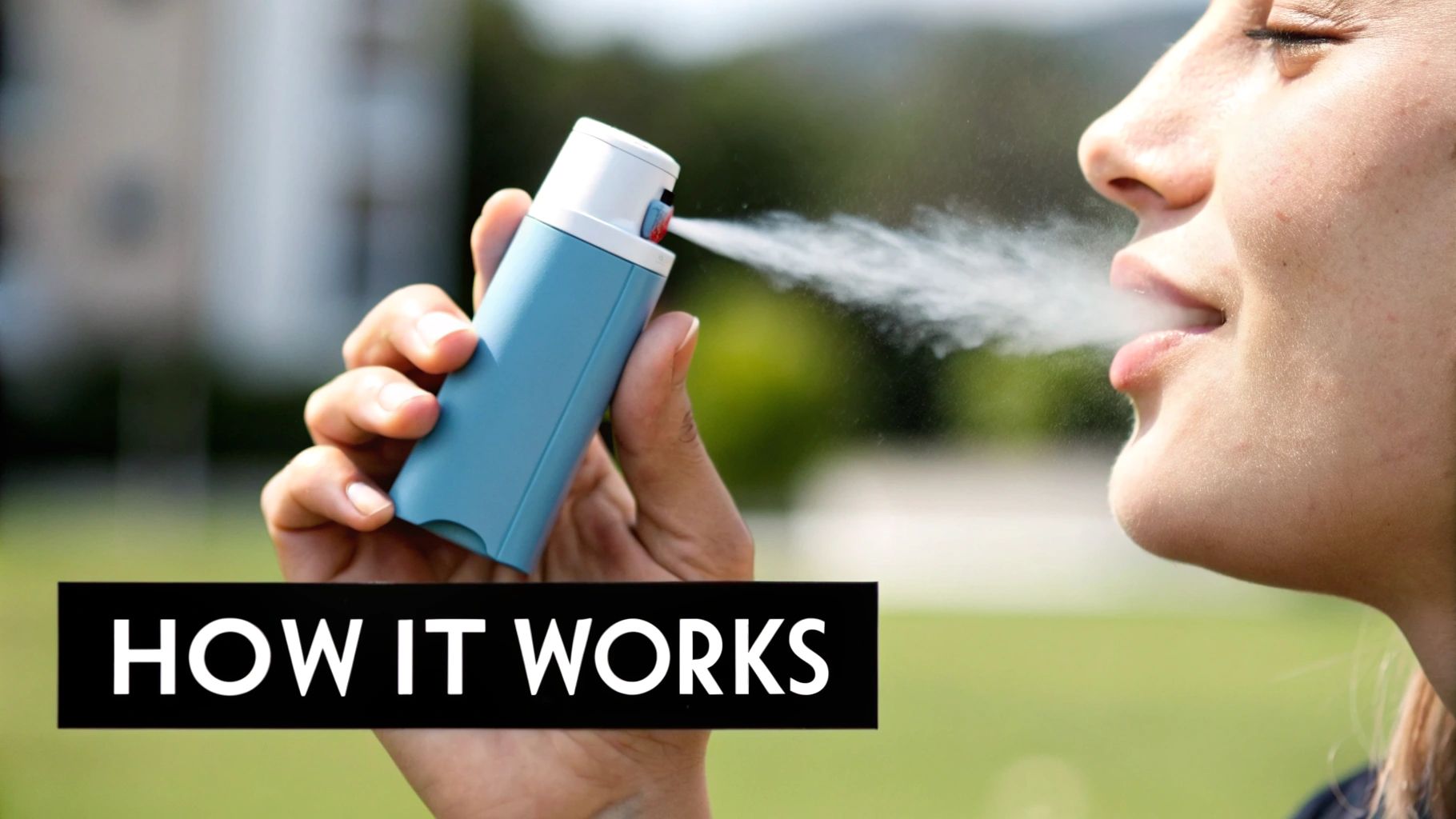
Let’s break down the two main ways these devices help you take back control.
How Nicotine Inhalators Tackle Physical Cravings
Nicotine Replacement Therapy (NRT) inhalators are built to go head-to-head with the physical side of addiction. When you take a puff, it releases a small, measured dose of nicotine vapour.
But here's the clever part: the delivery is completely different from a cigarette. The nicotine isn't inhaled deep into your lungs. Instead, it’s mostly absorbed through the lining of your mouth and throat. This means you get a much slower, more gentle release of nicotine into your bloodstream, completely avoiding the intense, rapid spike you get from smoking.
This slower system is the key. It delivers just enough nicotine to soothe those awful withdrawal symptoms—the irritability, anxiety, and nagging cravings—without giving you the powerful, addictive rush that reinforces the habit. Think of it as a dimmer switch for your cravings instead of a harsh on/off button.
An NRT inhalator essentially weans your body off high levels of nicotine. By providing a clean, controlled dose, it helps you break the cycle of sharp highs and crashing lows, all while steering clear of the thousands of toxic chemicals in cigarette smoke.
This approach lets you gradually lower your nicotine intake over time, making the physical journey to a smoke-free life feel far more manageable.
How Nicotine-Free Inhalers Address the Habit
While NRT deals with the chemical dependency, nicotine-free inhalers take on the powerful behavioural and sensory rituals of smoking. For so many people, the physical act of smoking is just as addictive as the nicotine itself.
These devices work by flawlessly mimicking the sensations your brain has come to associate with relief or pleasure.
- Hand-to-Mouth Action: They give your hands something to do and satisfy that deeply ingrained motor habit of bringing something to your lips.
- Oral Fixation: The mouthpiece provides the oral stimulation you're used to from holding a cigarette.
- The Sensation of a 'Drag': Using just pressurised air, often infused with natural flavours like mint or fruit, they replicate the feeling of taking a drag. This sensory trick can convince your brain it's satisfied, without any nicotine, vapour, or harmful chemicals.
This is all about psychological substitution. By swapping the harmful act of smoking for a similar, harmless one, you start to uncouple your daily routines and emotional triggers from the need to light up. It gives you a safe, satisfying alternative to turn to when an urge strikes, helping you tackle the habit head-on. This makes it an incredible tool if you feel the ritual is your biggest barrier to quitting for good.
Here is the rewritten section, crafted to sound completely human-written and natural, following the provided style guide.
So, What About Nicotine Inhalators?
For so many people, the physical grip of nicotine feels like the biggest mountain to climb when quitting. This is exactly where Nicotine Replacement Therapy (NRT) inhalators, often recommended by the NHS, come into the picture. Think of them as a powerful tool in your quit kit, designed to help you navigate the rockiest parts of your early journey.
These little devices work by giving you a clean, controlled dose of nicotine. This helps take the edge off the intense withdrawal symptoms that can so easily derail a quit attempt. It’s like a safety net, catching you when the craving for a cigarette feels overwhelming. By delivering just enough nicotine to soothe that familiar irritability and restlessness, they free you up to focus on the harder part: breaking the deep-seated psychological habits of smoking.
What’s Good About Using a Nicotine Inhalator?
One of the best things about an NRT inhalator is the control it puts back in your hands. A patch delivers a steady, constant stream of nicotine, but an inhalator lets you decide when and how much you need. This action closely mimics the puffing ritual of smoking, which can give you a real sense of power over your cravings.
The other huge benefit is how it tackles the hand-to-mouth habit. The device is held and used just like a cigarette, which satisfies that deep-seated behavioural urge that so many ex-smokers miss. This double-whammy—calming physical cravings while replicating a familiar action—makes it a uniquely effective choice for many.
- You’re in control: Take a puff when a craving hits for immediate, on-demand relief.
- It satisfies the ritual: The physical act of using the inhalator helps untangle the psychological link to smoking.
- It’s a much safer option: You get the nicotine your body is crying out for, but without the thousands of harmful chemicals, tar, and carbon monoxide that come with tobacco smoke.
This combination of features helps you systematically dismantle the addiction, tackling both the physical and behavioural sides at the same time.
A Fair Look at the Downsides
Of course, there’s no one-size-fits-all solution, and it’s important to be realistic about the potential downsides of using a nicotine inhalator. Knowing about these ahead of time helps you make a properly informed decision about whether it’s the right starting point for you.
For some, the nicotine vapour can cause a bit of irritation in the mouth or throat, especially at the beginning. This feeling usually fades as your body gets used to it. Another practical point is the cost; while it’s cheaper than a smoking habit, the need to keep buying replacement nicotine cartridges can add up over time.
It's crucial to remember that NRT inhalators are a temporary aid, not a permanent fix. The entire goal is to use them to gradually wean yourself off nicotine completely, until you reach a point where you don't need any support at all.
Where Do Inhalators Fit in the Grand Scheme of Things?
It’s also helpful to see how these devices stack up against other popular quitting aids. For instance, recent findings show that e-cigarettes have become a very common and effective tool for quitting in England, now being used in 40.2% of quit attempts. This points to a clear trend: people are actively looking for alternatives that replicate the smoking experience.
However, that same evidence confirms that trying to quit with nothing but willpower is tough. Unaided quit attempts have about one-third lower odds of success compared to using any kind of support. You can read the full research about these quitting trends to get a clearer picture of the landscape.
Ultimately, whether a nicotine inhalator is right for you boils down to your personal needs. If you’re a heavy smoker battling strong physical cravings, the direct nicotine replacement it offers could be the vital first step you need to manage withdrawal and start your journey towards a completely smoke-free life.
The Rise of Nicotine-Free Sensory Inhalers
What if your biggest struggle isn’t the nicotine, but the habit itself? For so many people, the chemical addiction is only one part of the puzzle. The real challenge is breaking those powerful patterns built over years—the familiar hand-to-mouth motion, the deep inhale during a stressful moment, or the simple ritual that signals the end of a meal.
This is where a different kind of tool, the nicotine-free sensory inhaler, truly shines.
These devices are designed with a single, clear goal: to tackle the behavioural side of smoking head-on. They give you a satisfying physical substitute that mimics the actions you miss, but without any nicotine, tobacco, or vapour. It’s a simple way to keep your hands busy and satisfy that oral fixation, giving you something to reach for when a trigger hits.
This approach offers a clean break from nicotine from day one, which is perfect for anyone who wants to quit without using replacement therapies. It’s also a brilliant solution for those who’ve already weaned themselves off nicotine but still find themselves fighting the ghosts of old habits.
How a Sensory Inhaler Works
The magic of a nicotine-free inhaler is in its simplicity. Instead of delivering drugs or chemicals, it focuses entirely on sensation and ritual. Think about it: you get to replicate the feeling of a 'drag' using only pressurised air and pleasant, natural flavours. That’s the entire concept.
When you draw on the inhaler, it sends a rush of flavoured air that simulates the sensory experience your brain connects with smoking. This simple act provides an immediate distraction, helping to short-circuit a craving before it can take hold. The focus is on replacing a negative ritual with a positive, harmless one.
Psychologically, this is a massive help. It helps you uncouple your daily triggers from the act of smoking.
- Morning Coffee: Instead of a cigarette, you can take a few calming puffs from a mint-flavoured inhaler.
- Stressful Work Call: Reaching for your inhaler gives your hands something to do and encourages a moment of mindful breathing.
- After Dinner: A sweet, fruit-flavoured puff can satisfy that need for a ritual without any of the harm.
By providing a direct, sensory replacement, these inhalers help you rewrite your responses to everyday triggers. It makes the behavioural side of quitting feel far less daunting.
"Breaking the psychological dependency is often the final and most difficult hurdle in quitting smoking. A sensory inhaler provides a non-addictive tool that directly addresses the hand-to-mouth ritual, empowering users to break the habit loop without nicotine."
The Power of Natural Flavours and Aromatherapy
Many nicotine-free inhalers, like AuraFlow, take this idea a step further by using natural flavours from essential oils. This adds another layer of benefit, blending the act of habit replacement with the gentle principles of aromatherapy. Different scents can evoke different feelings, helping you manage your mood as you navigate the quitting process.
For instance, a peppermint flavour can feel invigorating and refreshing, helping to clear your head and sharpen your focus. A lavender or chamomile scent might bring a sense of calm during moments of anxiety or stress. You can even learn more about how an inhaler with essential oils can support your well-being journey.
This sensory engagement makes the quitting process feel less like you’re taking something away, and more like you’re adding an act of self-care to your day.
Ultimately, nicotine-free inhalers offer a path that centres on mindfulness and behavioural change. They acknowledge that quitting is more than just a chemical battle; it's about reclaiming your rituals and building new, healthier habits for good.
Choosing the Right Inhaler for Your Journey
Deciding between a nicotine inhalator and a nicotine-free sensory alternative is probably the most important choice you'll make when you start this process. This isn't just about reading a list of features; it’s about getting really honest with yourself about your own smoking habits and what you truly need to succeed.
Let's dig a little deeper than the basic definitions. Every smoker's habit has its own unique fingerprint—the specific triggers, the intensity of the cravings, and the little rituals that have become second nature. The right inhaler will feel like it was made for that fingerprint, giving you the exact support you need, right when you need it most.
Taking an Honest Look at Your Dependence
First things first: you need to have a frank conversation with yourself about your relationship with nicotine. Is it a powerful physical dependency you’re up against, or is your habit more about the psychological comfort and the routine of it all? The answer is your signpost, pointing you toward the best tool for the job.
If you're a long-term, heavy smoker—the kind who gets irritable, anxious, or can't focus without a cigarette—your body is likely physically dependent on nicotine. In that situation, starting with a Nicotine Replacement Therapy (NRT) inhalator can be a game-changer. It delivers a controlled dose of nicotine to take the edge off those savage withdrawal pangs. This lets you focus on breaking the behavioural side of the habit without being totally overwhelmed by physical cravings, allowing you to gently wean yourself off nicotine at a pace that works for you.
On the other hand, maybe you’re more of a situational smoker. You light up with your morning coffee, on your work break, or when you’re out with friends. If your cravings feel more like a nagging urge tied to an activity rather than a constant, physical demand, a nicotine-free inhaler might be the perfect fit. These are designed to satisfy that hand-to-mouth action and oral fixation, giving you a harmless substitute that helps you navigate your daily routines and social triggers without any nicotine at all.
Making the Decision: Habit or Nicotine?
This simple decision tree can help you visualise which path might be better for you based on what you’re struggling with the most.
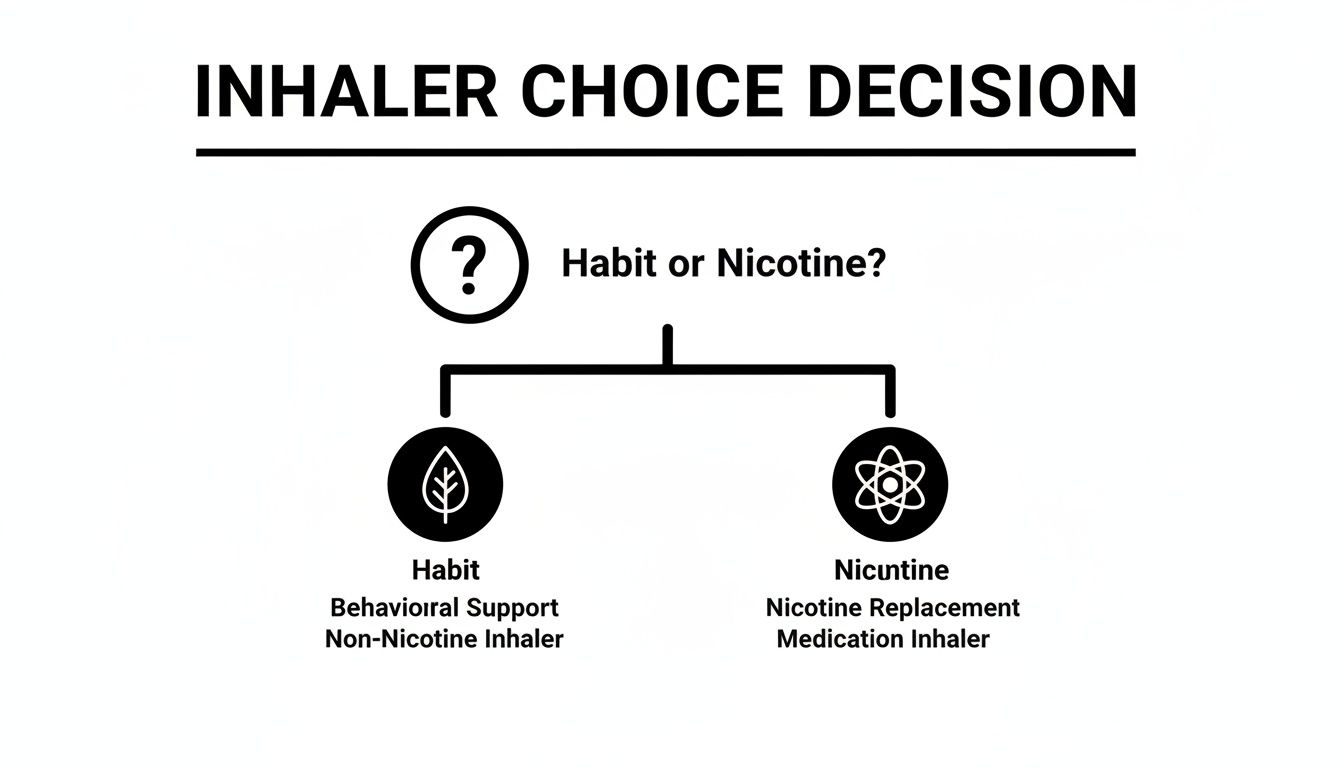
This visual guide breaks it down nicely: tackle the physical nicotine addiction first with NRT, or go straight to addressing the psychological habit with a sensory alternative.
Finding the right approach is key to feeling in control. To help you weigh your options, here's a quick comparison of the two main types of inhalers.
Comparing Nicotine vs Nicotine-Free Inhalers
| Attribute | Nicotine Inhalator | Nicotine-Free Inhaler |
|---|---|---|
| Primary Mechanism | Delivers a controlled dose of nicotine to the body to reduce physical withdrawal symptoms. | Simulates the physical act of smoking (hand-to-mouth ritual) without any nicotine or chemicals. |
| Main Purpose | To manage intense physical cravings and gradually wean the body off its nicotine dependence. | To satisfy the psychological and behavioural habits tied to smoking, such as oral fixation. |
| Best For | Heavy, long-term smokers with strong physical withdrawal symptoms (irritability, anxiety, etc.). | Light or social smokers who are more attached to the ritual and routine than the nicotine itself. |
| Cost | Typically more expensive due to being a medicated product. Ongoing cost for cartridges. | Often a one-time purchase or lower ongoing cost for flavour refills, making it more affordable long-term. |
| Availability | Available over-the-counter at pharmacies and some supermarkets. | Available online directly from brands like AuraFlow and in some health stores. |
Each path offers a different kind of support, so choosing the one that aligns with your personal struggle is the best way to set yourself up for success.
A Hybrid Approach for a Complete Strategy
It's also really important to remember that this doesn't have to be an either/or decision. For many people, the most effective journey actually involves a two-stage approach.
A successful quit plan is adaptable. You might start with an NRT inhalator to conquer the initial, intense physical withdrawal. Once your body is no longer crying out for nicotine, you can transition to a nicotine-free sensory inhaler to tackle the lingering behavioural habits for good.
This hybrid strategy tackles both sides of the addiction in a logical order—first, you calm the physical storm, and then you rebuild your daily rituals without the cigarette. It’s a powerful way to structure your quit plan for lasting success. For a deeper look into different quitting methods, our guide on choosing the right stop smoking aid offers more valuable insights.
Ultimately, the best inhaler is the one that directly targets your biggest quitting obstacle. By honestly assessing your needs, you can choose a tool that empowers you, making the path to a smoke-free life feel not just possible, but completely achievable.
Integrating an Inhaler into Your Quit Plan
Choosing one of the available smoking inhalers to quit smoking is a brilliant first step, but the device itself is just one piece of the puzzle. To really succeed, you need to build a solid strategy around it.
An inhaler works best when it’s part of a structured, thoughtful plan that prepares you for the challenges ahead. Think of it as turning a hopeful quit attempt into a long-term success story.
Your inhaler is your primary tool, sure, but a successful project needs a full toolkit and a clear blueprint. Your quit plan is that blueprint. It’s about setting clear goals, getting to know your personal smoking patterns inside out, and building a reliable support network to lean on when things get tough. A well-organised plan gives you direction and makes the whole journey feel far less overwhelming.
Setting Your Quit Date and Identifying Triggers
The first practical step is to set a firm quit date. Pick a day within the next couple of weeks—not so far off that you lose steam, but with enough time to get your head in the game. Mark it on your calendar, tell people about it, and treat it like a serious commitment.
Next, you need to become a detective of your own habits. For a few days before your quit date, keep a simple journal. Note down every single time you light up and what you’re doing or feeling in that moment.
- Is it always with your morning coffee?
- Is it during that mid-morning work break?
- Is it a reaction to feeling stressed or bored?
- Is it just what you do when you’re socialising with friends?
Pinpointing these personal smoking triggers is absolutely crucial. Once you know what they are, you can start using your inhaler proactively. If you know you always crave a cigarette at 10 AM with your tea, have your inhaler ready a few minutes beforehand to head that craving off before it even starts.
Building Your Support System
Quitting smoking can feel isolating, but you don't have to go it alone. In fact, building a support system is one of the most powerful things you can do.
Let your friends and family know your quit date and explain how they can help. This might mean asking them not to smoke around you, or just being there for a chat when you’re having a tough day.
Professional support can also make a huge difference. In the UK, brilliant resources like NHS Stop Smoking Services offer free, expert advice and encouragement. Combining a tool like an inhaler with professional guidance really boosts your chances of success. As you bring an inhaler into your plan, managing the stress and withdrawal is vital. For extra support, you can explore effective strategies to cope with anxiety for calmer days.
While smoking prevalence in England has steadily declined to 10.4%, significant disparities remain. For instance, individuals in routine and manual occupations still show a smoking rate of 19.2%, highlighting the need for tailored support systems. Discover more insights about these UK smoking statistics on gov.uk.
Creating a Phased Quit Timeline
Your journey doesn't have to be an all-or-nothing battle from day one. Breaking it down into phases can make the whole process feel much more manageable. Here’s a potential timeline that uses different types of inhalers for a complete strategy:
- Phase 1 (Weeks 1-4) Managing Physical Withdrawal: Start with a nicotine inhalator. Use it to navigate the initial, intense physical cravings as your body adjusts to being without nicotine from cigarettes. Understanding what to expect is key, and you can prepare by reading our detailed smoking cessation and withdrawal timeline.
- Phase 2 (Weeks 5-12) Breaking the Habit: As your physical dependence lessens, you can gradually reduce your use of the nicotine inhalator. At the same time, bring in a nicotine-free sensory inhaler like AuraFlow to tackle the behavioural side of things—the hand-to-mouth habit.
- Phase 3 (Beyond 12 Weeks) Maintaining a Smoke-Free Life: Now, you can transition fully to the nicotine-free inhaler. Your focus is all on reinforcing new, healthier habits and using the sensory tool to manage any lingering situational urges, completely free from nicotine.
This structured approach systematically dismantles both the physical addiction and the psychological habit, creating a sustainable and complete path to a smoke-free life.
Your Questions About Smoking Inhalers, Answered
It's completely natural to have a few questions when you're thinking about using an inhaler to help you quit. In fact, getting clear on the details is a huge part of building the confidence you need to succeed. We get it.
So, let's tackle the most common queries we hear. From safety concerns to how long you might need one, this is the essential information you need to move forward, free from any lingering doubts.
Are Smoking Inhalers Safe to Use?
This is usually the first question on everyone's mind, and for good reason. The short answer is yes, both nicotine replacement and nicotine-free inhalers are considered far, far safer than continuing to smoke cigarettes.
NRT inhalators are approved medical devices. They work by cutting out the thousands of toxic chemicals, tar, and carbon monoxide that you get from tobacco smoke. They give you a clean, measured dose of nicotine, which—while addictive—isn't the ingredient responsible for causing smoking-related diseases.
Nicotine-free sensory inhalers are even simpler. Because they contain no nicotine or active chemicals and produce no vapour, they're widely seen as a completely safe way to tackle the behavioural side of smoking without putting any harmful substances into your body.
What Are the Potential Side Effects?
Like any product, you might notice a few mild side effects, especially when you’re just starting out.
- Nicotine Inhalators: The most common issues are usually mild and don't last long. You might feel a bit of irritation in your throat or mouth, maybe a bit of a cough, or a runny nose as your body gets used to it. These things typically fade within the first week.
- Nicotine-Free Inhalers: Side effects here are very rare since there are no active ingredients. Some people might find a particularly strong flavour, like an intense mint, a bit much at first, but that’s easily solved by choosing a different flavour or just using the device more gently.
It's worth remembering that the side effects from NRT are tiny compared to the well-known, severe health risks of smoking, which include conditions like chronic obstructive pulmonary disease (COPD) and a whole list of other serious illnesses.
How Long Should I Use an Inhaler For?
This really comes down to your own personal journey and which type of inhaler you go for.
With NRT inhalators, a typical plan lasts for about 12 weeks. The idea is to use it to get through that initial, intense phase of withdrawal. After that, you'll gradually reduce how much you use it as your cravings start to ease off. Your GP or a local pharmacist can help you create a personalised plan to taper off successfully.
Nicotine-free inhalers are a different story—there's no set timeline. You can use them for as long as you need to feel secure in your new smoke-free habits. Many people find them incredibly helpful long-term for getting through those occasional tricky moments, like stressful days or social events, giving them a reliable tool to prevent a relapse.
Ready to tackle the habit without the nicotine? AuraFlow offers a simple, sensory approach to quitting. Our nicotine-free inhaler uses natural flavours to satisfy the hand-to-mouth ritual, giving you a calming way to manage cravings.