
So, you’ve decided to find a healthier way forward, away from cigarettes. That's a huge first step, and probably the most important one you'll take. But once you start looking, the sheer number of alternatives to smoking cigarettes can feel a bit much. From medical options like patches and vaping to newer, nicotine-free approaches that tackle the habit itself, where do you even begin? This guide is your roadmap.
Your Path Away from Smoking Starts Here
Making the decision to quit is one thing; navigating the "how" is another. It’s easy to feel overwhelmed by all the choices out there. Our goal here is to cut through that noise and give you a clear, honest look at the landscape of smoking alternatives available today. We want to help you move from feeling stuck to feeling empowered.
Think of it like planning a trip. There are several different routes to your destination, each with its own scenery and challenges. Some paths are direct, well-trodden, and medically guided. Others offer a gentler, more scenic route that focuses on leaving the entire ritual behind.
Finding Your Best Route
We’ll explore the full spectrum of options to help you find the one that actually fits your life and your personal goals. Generally, these alternatives fall into a few main categories:
- Medically Proven Aids: This is the traditional route, including Nicotine Replacement Therapy (NRT) like patches and gum, as well as prescription medications.
- Popular Harm Reduction Tools: Vaping is a common choice for many, offering a familiar hand-to-mouth action without the most dangerous parts of tobacco smoke.
- Nicotine-Free Methods: These options are all about breaking the psychological and physical habit—the ritual of smoking—using tools like herbal inhalers or mindful breathing aids.
Finding the right product is only half the battle; support is just as crucial. In England, local stop smoking services have an incredible track record. Recent figures show that people who use them are three times more likely to quit successfully. In just one year, these services helped 128,000 people quit for good, a 23% increase from the year before. It goes to show that the right combination of tools and support really works.
The real goal isn’t just to stop using cigarettes. It’s about building a new, healthier way of life from the ground up, and that includes creating an environment that supports your well-being.
As you start this journey, it's worth thinking about your whole environment. A healthier home can make a world of difference, and you might find a practical guide to improve home air quality a helpful place to start.
Exploring Medically Proven Smoking Alternatives

When you decide to quit smoking, you're not just kicking a habit—you're up against a powerful physical dependency on nicotine. The good news? You don’t have to go it alone. Medically proven alternatives are designed to ease this battle, handling the chemical side of the addiction so you can pour your energy into changing your behaviours.
These aren't just random suggestions; they're methods backed by years of clinical research and recommended by health professionals, including the NHS. Think of them as a solid support system, giving you a stable foundation to build a smoke-free life. They work by taking the edge off your body's withdrawal symptoms, which are often the toughest hurdle in those first few days.
Getting to Grips with Nicotine Replacement Therapy
Nicotine Replacement Therapy, or NRT, is probably one of the most familiar and trusted routes. The logic behind it is refreshingly simple: give your body the nicotine it’s craving, but without the thousands of harmful chemicals packed into cigarette smoke, like tar and carbon monoxide. This helps dial down those awful withdrawal symptoms—the irritability, the anxiety, and the intense urges to smoke.
NRT is a brilliant stepping stone. It cleverly separates the chemical addiction from the behavioural one. While your body gets a clean, controlled dose of nicotine, you get the mental space to work on breaking that powerful hand-to-mouth habit and untangling the rituals tied to smoking, like that classic morning coffee and cigarette.
There are a few different types of NRT, each designed to fit different lifestyles and needs:
- Nicotine Patches: You just stick one on your skin, and it provides a steady, slow release of nicotine all day. This is great for keeping those background cravings from creeping up on you.
- Fast-Acting Options: Things like nicotine gum, lozenges, inhalators, and nasal or mouth sprays get to work much faster. They are perfect for tackling those sudden, overwhelming cravings that hit you out of nowhere.
- Combination Therapy: Many people find real success by using both. A patch provides all-day support, while a fast-acting product is there for any breakthrough urges. In fact, studies show this combination approach can be far more effective than just using one product.
These products are easy to find over the counter in pharmacies and supermarkets. You can also get them through an NHS prescription, which makes them a really accessible and budget-friendly choice. For those looking to tackle the habit from another angle, it's also worth learning about other healthy cigarette alternatives that focus on the behavioural side of things.
Prescription Medications That Can Help You Quit
For some people, NRT just doesn't quite cut it. If that’s the case, your GP can prescribe medications created specifically to help you stop smoking. These work very differently from NRT because they don’t contain any nicotine at all. Instead, they interact with your brain chemistry to make the whole quitting process more manageable.
In the UK, there are two main prescription medications available: Varenicline (brand name Champix) and Bupropion (brand name Zyban). They offer a different kind of support, targeting the very same receptors in your brain that nicotine latches onto.
By changing how your brain responds to nicotine, these medications do two crucial things: they dial down the intensity of cravings and withdrawal, and they can actually block the satisfying buzz you get from smoking, making a cigarette feel much less enjoyable if you do have a slip-up.
This dual-action approach makes them powerful allies in your corner. Let’s break down how each one works.
How Varenicline and Bupropion Work
Varenicline (Champix) works by binding to the nicotine receptors in your brain. It gently stimulates them, which helps to take the edge off withdrawal symptoms. At the same time, it acts as a blocker, preventing nicotine from attaching to those same receptors. This means if you do smoke, you won’t get that usual hit of pleasure, making the act of smoking far less rewarding.
Bupropion (Zyban) is actually an antidepressant that was found to be surprisingly effective for quitting smoking. We don't know the exact mechanism, but it’s thought to influence brain chemicals like dopamine and noradrenaline, which are tangled up in nicotine addiction and withdrawal. This helps to reduce your cravings and other withdrawal symptoms.
Both medications require a prescription, so you’ll need to have a chat with your GP to make sure they’re right for you. You typically start taking them a week or two before your quit day. This gives the medicine time to build up in your system, making the transition on the big day feel much smoother and arming you with a powerful, science-backed tool for your journey.
Understanding Vaping as a Cigarette Alternative
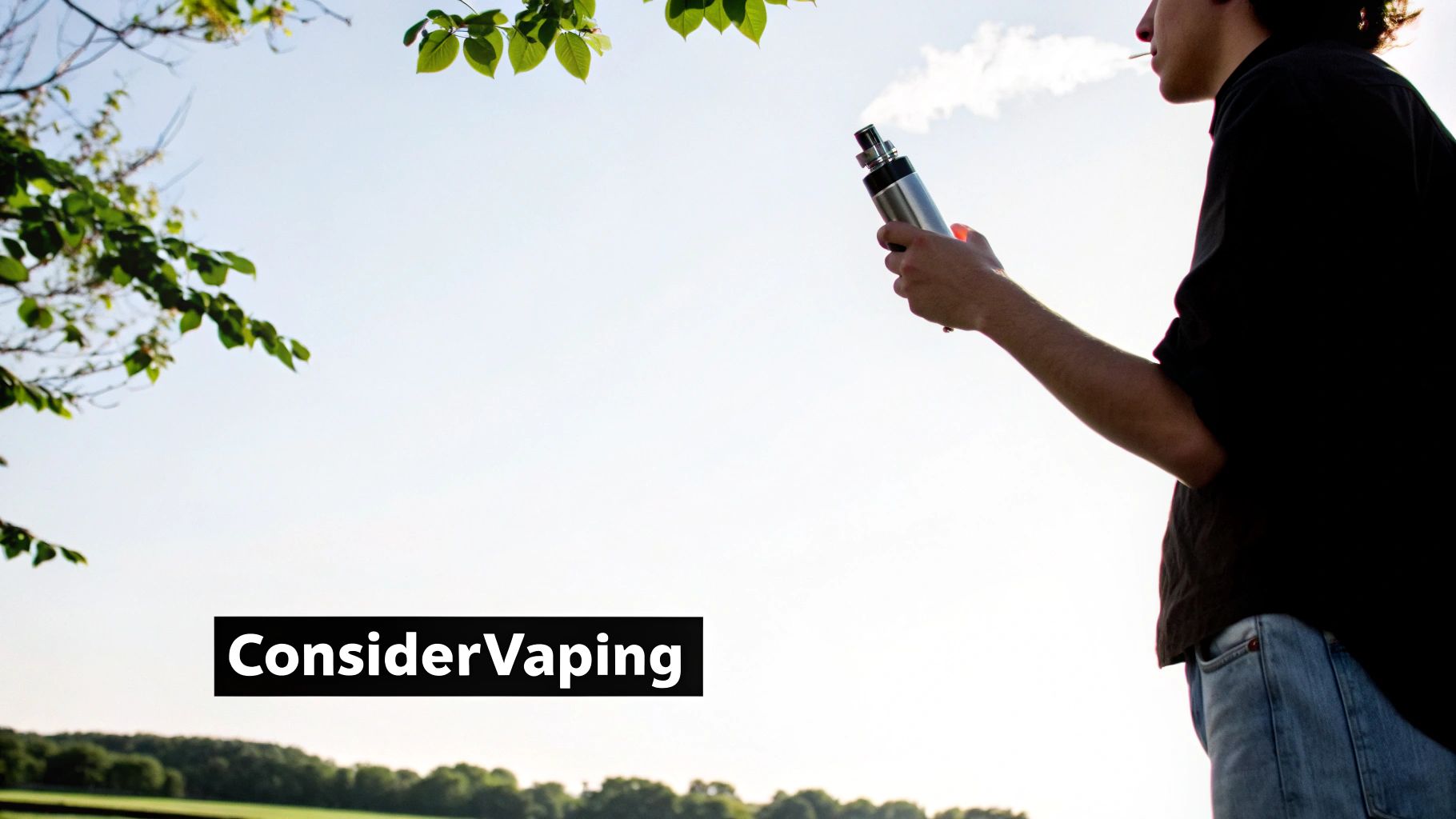
Walk down any high street and you’ll see it: vaping has exploded in popularity, quickly becoming one of the most talked-about alternatives to smoking cigarettes. But how does it actually work? In short, a vape (or e-cigarette) heats up a liquid—often called e-liquid or vape juice—to create a vapour that you inhale.
This simple difference, heating instead of burning, is absolutely crucial. When you burn tobacco, you create thousands of toxic chemicals. Vaping cuts out the two biggest villains: tar and carbon monoxide. These are the primary culprits behind smoking-related cancers and heart disease, which is why health bodies like the NHS agree that vaping is substantially less harmful than smoking.
This "harm reduction" approach is what makes vaping such a popular quitting tool. It tackles both the chemical craving for nicotine and the deep-seated behavioural habit of smoking at the same time.
The Practical Advantages of Vaping
Let's be honest, one of the hardest parts of quitting is breaking that ingrained physical ritual. Vaping mimics the hand-to-mouth action perfectly—the feeling of holding the device, inhaling, and seeing something come out when you exhale. For many, this makes the transition away from cigarettes feel far less abrupt than using patches or gum.
Another huge plus is the control it gives you over your nicotine intake. E-liquids come in a whole spectrum of strengths, from high doses for heavy smokers right down to zero. This means you can gradually taper down your nicotine consumption on your own terms, eventually breaking free from the chemical dependency without giving up the comfort of the ritual just yet.
And of course, there's the variety. From small, discreet pod vapes to more advanced setups, and from classic tobacco flavours to countless others, there's an option for everyone. This level of choice can make the switch feel less like a sacrifice and more like a positive change.
In England, e-cigarettes have become the leading tool for people trying to quit. They were used in 40.2% of quit attempts and were linked to the highest odds of success. When both usage and effectiveness were factored in, vaping had the greatest positive impact on helping people stop smoking. You can find more details in this comprehensive study on quit methods.
Navigating the Concerns and Staying Safe
While it’s a powerful quitting aid, vaping isn't completely risk-free, and it's important to be aware of the ongoing conversation. The main concern centres on the potential long-term health effects of inhaling e-liquid ingredients, which we don't fully understand yet simply because the technology is still relatively new.
This is why health experts are crystal clear on one thing: if you don’t smoke, you shouldn’t start vaping. Vaping is a tool for harm reduction for existing smokers, not a new hobby for non-smokers.
To stay safe, it's vital that you only buy regulated products from reputable UK shops. Anything sold legally has to meet strict quality and safety standards, which limit nicotine strength and ban certain dodgy ingredients. Steering clear of illicit or unregulated vapes is the single best thing you can do to vape more safely. If you'd rather bypass these concerns entirely, our guide to smokeless e-cigarettes and nicotine-free alternatives is a great place to start.
Making the Right Choice for You
Decided vaping might be the right path for you? It can seem a bit overwhelming at first, but it doesn't have to be. Here’s a simple guide to getting started:
- Choose Your Device: Most beginners get on best with a simple pod system or vape pen. They’re easy to use, don't require much fiddling, and are designed to feel like drawing on a cigarette.
- Select Your E-Liquid Strength: Match your nicotine strength to your smoking habit. If you were a heavy smoker (20+ a day), you might start with 18-20mg/mL. A lighter smoker could begin with 6-12mg/mL. Starting too low can leave you unsatisfied and tempted to go back to cigarettes.
- Find Your Flavour: This is more important than you might think. Finding a flavour you genuinely enjoy—whether it's tobacco, menthol, fruit, or something else—can make all the difference in sticking with it.
Ultimately, vaping is a proven tool that has helped millions of people in the UK leave smoking behind for good. By understanding the pros and cons and making smart choices, it can be a powerful stepping stone on your journey to becoming smoke-free.
Choosing Nicotine-Free Alternatives
What if you could tackle the habit without wrestling with the addiction? Nicotine-free alternatives to smoking operate on this simple but powerful idea. They’re designed to help you separate the physical habit from the chemical dependency—a crucial step for anyone looking to quit for good.
For so many people, the hardest part of quitting isn’t just the nicotine withdrawal. It's breaking those deep-seated rituals: the hand-to-mouth motion, the deep inhale, the little punctuation mark it provides to a coffee break or a stressful moment. These actions are ingrained through sheer repetition, becoming almost automatic.
Nicotine-free options offer a way to satisfy these physical urges without any addictive substances. They act as a stand-in, a prop that lets you go through the motions of smoking while your body clears itself of nicotine. This approach makes the psychological side of quitting feel a whole lot less jarring.
Untangling the Habit from the Addiction
Think of quitting smoking as a two-front battle. On one side, you have the chemical addiction to nicotine. On the other, you have the psychological habit—those automatic, conditioned behaviours built up over years. Nicotine-free tools focus entirely on that second front.
By using a substitute that mimics the physical sensation of smoking, you can give yourself the time and space to unlearn these behaviours gently. It's a way to soothe the part of your brain that still craves the ritual, even after the nicotine cravings have started to fade.
This is why these alternatives are often seen as the final step-down tool on the path to becoming completely smoke-free. They bridge the gap between relying on a nicotine product and relying on nothing at all, making the final leap feel more like a small, manageable step.
The core principle is harm elimination, not just harm reduction. By removing nicotine entirely, you address the root of the addiction while still having a tool to manage the behavioural triggers that can lead to a relapse.
These tools aren't just one single thing, either. They're a diverse group of products designed to meet different needs and preferences.
Exploring Your Nicotine-Free Options
When you take nicotine out of the equation, a few key types of products pop up, each with its own unique way of satisfying that smoking ritual.
- Herbal Cigarettes and Smokes: These look and feel just like traditional cigarettes but are filled with a blend of herbs instead of tobacco. They can be a really useful transitional tool if you find the visual and tactile experience of a cigarette hard to give up. It’s important to remember, though, that burning and inhaling any plant matter produces tar and carbon monoxide, so they aren't a long-term risk-free solution. For a deeper dive, you can learn more about how a herbal tobacco substitute can fit into a quitting plan.
- Nicotine-Free Vapes: These are identical to regular e-cigarettes but use e-liquid that contains 0% nicotine. They provide the same hand-to-mouth action, the feeling of inhaling, and the visual cue of exhaling a cloud of vapour. This satisfies multiple sensory triggers tied to the act of smoking.
- Aroma or Air Inhalers: These devices are perhaps the simplest and gentlest option of all. They don't heat anything or produce any vapour. Instead, you simply inhale through the device to draw in air infused with natural flavours. This provides a clean, satisfying draw that mimics the deep breath of a cigarette, offering a moment of calm without any chemicals, electronics, or combustion.
Choosing between these really depends on what part of the smoking ritual you find hardest to let go of. Is it the feel of the cigarette in your hand? The sight of the smoke? Or just the simple act of taking a deliberate, deep breath? Answering that question will point you toward the most effective alternative for your personal journey, empowering you to finally break the cycle and embrace a truly smoke-free life.
Building Your Support System to Quit for Good
Choosing the right alternative to smoking is a massive first step, but it’s only one piece of the puzzle. Quitting is as much a mental game as it is a physical one. Often, the toughest moments have nothing to do with nicotine cravings and everything to do with psychological triggers. This is where a strong support system becomes your greatest asset.
Think of it like learning any difficult new skill. You could try to figure it all out on your own, but having a coach, a team, and the right tools makes you far more likely to succeed. The same principle applies here; when you combine a physical quit aid with solid emotional support, your chances of staying smoke-free for good go up dramatically.
Tapping into Professional NHS Support
The brilliant thing is, you don’t have to do this alone. The UK is home to some of the best free resources in the world, designed specifically to help people stop smoking. At the top of that list are the local NHS Stop Smoking Services – a powerful, evidence-based ally to have in your corner.
These services offer a mix of expert advice, one-on-one counselling, and group support sessions. It’s an incredibly effective combination because it tackles both the "why" and the "how" of quitting. A trained advisor can help you pinpoint your personal smoking triggers and come up with strategies to manage them, while group sessions give you a sense of community. You realise you're not the only one.
Research shows again and again that smokers who use these services are up to three times more likely to quit successfully than people who try to go it alone. That’s not a small difference; it’s proof of how powerful structured, professional support can be.
Getting this help is straightforward. Just ask your GP for a referral or find your local service directly through the NHS website. They provide a supportive environment that helps keep you accountable and celebrates your progress every step of the way.
Leveraging the Power of Digital Tools
On top of professional services, a whole world of digital support is sitting right in your pocket. Technology has given us new ways to stay motivated, track our progress, and connect with others, all from our phones. These tools are a fantastic addition to any quitting method.
Many people find huge success with apps designed specifically for quitting smoking. These digital companions offer features that can make a real difference, especially on those really tough days.
Most quit-smoking apps include things like:
- Progress Trackers: Seeing exactly how long you’ve been smoke-free, down to the minute, can be a surprisingly powerful motivator.
- Health Milestones: Getting notifications about how your body is recovering – from better lung function to a reduced risk of heart disease – makes the benefits feel real.
- Savings Calculators: Watching the money you would have spent on cigarettes add up gives you a tangible reward for all your hard work.
- Craving Busters: Many apps have built-in games, breathing exercises, or quick tips to distract you the moment a craving hits.
Finding Your Community and Staying Motivated
Beyond apps, online communities and forums offer priceless peer support. There’s a powerful sense of solidarity that comes from connecting with people who are on the exact same journey. You can share your struggles, celebrate your wins, and get advice from others who genuinely get what you’re going through.
Building a proper support network is all about creating a safety net for yourself. By combining professional guidance from the NHS, daily motivation from digital tools, and the encouragement of a community, you surround yourself with positivity. This multi-layered approach ensures that whether you're facing a physical craving or a psychological wobble, you have somewhere to turn, helping you build the resilience you need to quit for good.
Creating Your Personal Plan to Stop Smoking
Knowing the options is one thing, but turning that knowledge into real-world action is where the magic happens. This is the moment you build a personal plan that moves you from thinking about quitting to actually doing it. Forget one-size-fits-all solutions; this is about crafting a strategy that fits your unique life, your triggers, and your reasons for wanting to change.
Start with a bit of honest self-reflection. When and why do you find yourself reaching for a cigarette? Is it the stress of a deadline, a pint with friends, or just sheer boredom? Getting to know your personal triggers is the first, most powerful step toward managing them. Think about what has or hasn't worked for you before, too. That insight is your best tool.
Matching Your Needs to the Right Alternative
Once you have a clearer picture of your habits, you can start pairing them with the right kind of support. What works for a heavy social smoker is probably going to be different from what helps someone who smokes alone to manage anxiety.
- If you smoke mainly in social settings: A tool like a nicotine-free inhaler or a low-strength vape can satisfy that hand-to-mouth habit without flooding your system with nicotine when you don't need it.
- If you smoke because of stress or anxiety: Combining a slow-release patch with a mindful alternative like an aroma inhaler can be a game-changer. You get steady nicotine support while actively building healthier ways to cope with stress.
- If you're a heavy, routine smoker: Combination NRT (like a patch plus gum) or a prescription medication from your GP might offer the robust support needed to get through severe physical withdrawal.
Here's a simple way to visualise which support systems might be the best fit for you.
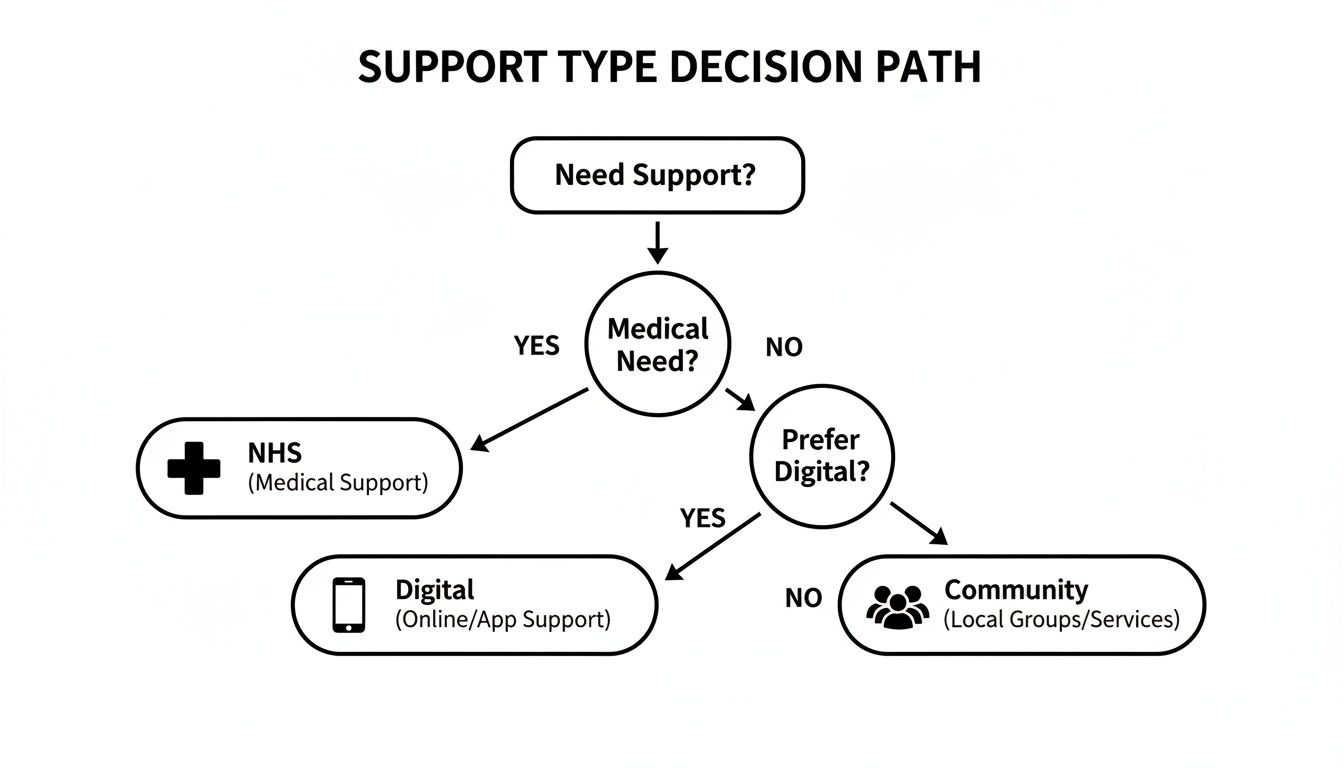
As you can see, your path is yours to tailor, whether you prefer structured medical guidance, the convenience of digital tools, or the encouragement of a real-life community.
Building Your Transition Framework
With an approach chosen, it’s time to map out the steps. A clear framework doesn't just add structure; it gives you the confidence to see it through.
- Set a Quit Date: Pick a specific day within the next few weeks. This makes your goal feel real and gives you time to get everything in place.
- Prepare for Withdrawal: Have your chosen alternative ready to go before your quit date. Stock up on healthy snacks, plan some distractions, and get ready for those first few tricky days.
- Manage Your Triggers: This is huge. Tell your friends and family what you're doing and ask for their support. Consciously change the routines that used to revolve around smoking.
Beyond the external help, cultivating mental toughness is an inner resource that will strengthen your resolve more than you can imagine. This journey takes resilience, and building that inner strength is just as crucial as any physical aid you choose. With a thoughtful plan, the right tools, and a supportive mindset, you're ready to begin.
Got Questions? We've Got Answers.
Stepping into the world of smoking alternatives can feel a bit like learning a new language. Let's clear up some of the most common questions to help you feel confident on your path to a smoke-free life.
Are Alternatives Like Vaping Really Safer Than Cigarettes?
Yes, absolutely. Leading UK health bodies, including the NHS and Public Health England, are clear on this: vaping is significantly less harmful than smoking.
While it's not totally risk-free, the key difference is that e-cigarettes don't contain tobacco. That means they don't produce the tar and carbon monoxide that do the most damage when you smoke. For this reason, they're widely recommended as a proven tool to help adult smokers quit for good.
Can I Get Financial Help For Smoking Alternatives?
You can. Here in the UK, you can often get NRT products and some prescription medications directly through the NHS.
Your GP or a local NHS Stop Smoking Service can sort you out with a prescription, which makes these options far more affordable. It's also worth checking with your local council, as many run ‘swap to stop’ schemes that can provide eligible smokers with a free starter vape kit to get them going.
How Do I Break the Hand-To-Mouth Habit?
This is the big one, isn't it? Breaking that physical, almost automatic, ritual is a huge hurdle for so many people. It's exactly where nicotine-free alternatives come into their own. Things like herbal inhalers, aroma sticks, or nicotine-free vapes are designed perfectly for this part of the journey.
They let you mimic the physical act of smoking without any of the addictive stuff. This means you can tackle the behavioural habit after you've already beaten the chemical addiction, making that final step feel much more natural.
This approach is all about satisfying that psychological need for the ritual itself. It gives you a gentle way to transition away from those ingrained physical motions, letting you build new, healthier habits at a pace that works for you.
Ready to embrace a nicotine-free ritual that’s both calming and satisfying? Discover how AuraFlow can help you find your moment of clarity. Explore our starter kits and begin your journey with a gentle breath at https://aura-flow.co.uk.