
So, you've decided to quit smoking. That's a massive step, and probably one of the best decisions you'll ever make for your health. But what happens next?
It’s less of a single event and more of a process. The toughest physical withdrawal pangs tend to hit their peak within 72 hours and then start to fade over the next 2-4 weeks. But the real journey—your body healing and your mind rewiring itself—takes a bit longer.
Your Body's Recovery Timeline After Quitting
The moment you put out that last cigarette, something incredible starts to happen. Your body begins to repair itself, and this isn't some far-off, wishy-washy goal. We're talking about real, measurable changes that kick in within minutes.
Think of it like this: your body has been working under a constant strain, and quitting is like finally giving it a break. It immediately gets to work, flushing out the bad stuff and patching things up. Knowing this timeline can be a huge motivator, turning the vague idea of "getting healthy" into a series of small, concrete wins you can celebrate along the way.
The First Few Days of Freedom
Those initial 48 hours are where you'll see some of the most dramatic and immediate payoffs. Your cardiovascular system, which has been under the cosh for so long, finally gets a chance to breathe and recalibrate.
You don't have to wait weeks to feel the benefits. They start right away.
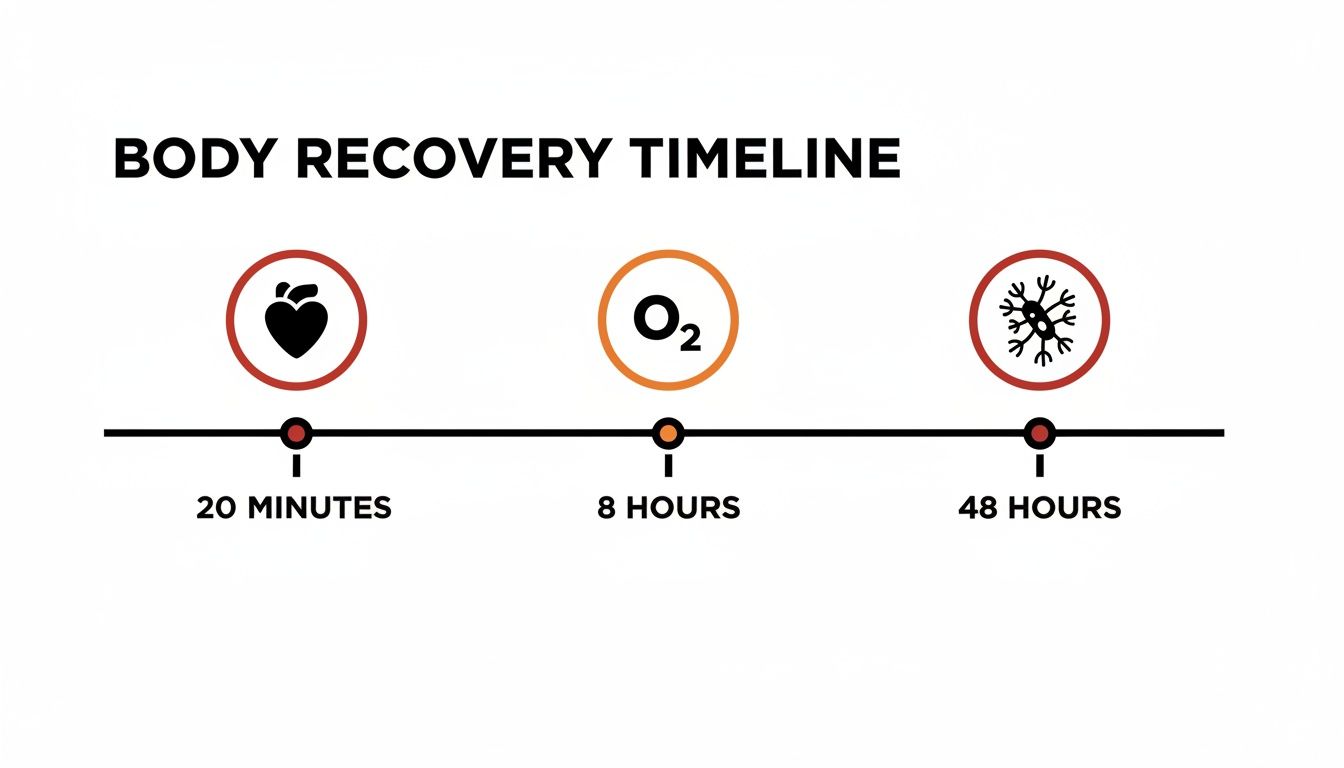
As you can see, your body wastes absolutely no time. Just 20 minutes after you stop, your heart rate starts to return to normal. It’s proof that your efforts are paying off from the very first minute.
Milestones in Your Healing Journey
The real magic happens as you rack up more smoke-free hours, days, and weeks. To give you a clearer picture of what to expect, here’s a breakdown of the key milestones your body will hit.
Your Body's Recovery Timeline After Your Last Cigarette
| Time Since Quitting | What's Happening in Your Body | Common Feelings and Symptoms | Practical Tip |
|---|---|---|---|
| 20 Minutes | Heart rate & blood pressure drop. Hands and feet warm up. | A sense of relief, but maybe the first pangs of a craving. | Drink a big glass of water and take a few deep, slow breaths. |
| 12 Hours | Carbon monoxide levels in your blood return to normal. | You might feel a bit restless or have trouble sleeping. | Try a calming, caffeine-free tea before bed. |
| 24 Hours | Your risk of a heart attack already starts to decrease. | Cravings may intensify. You could feel irritable or anxious. | Go for a brisk walk to clear your head and boost your mood. |
| 48 Hours | Nerve endings begin to regrow. Your sense of smell and taste improve. | Headaches and brain fog are common as your body adjusts. | Keep your AuraFlow handy for those moments you need a sensory distraction. |
| 2 Weeks - 3 Months | Circulation and lung function improve. Breathing gets easier. | Coughing might increase temporarily—this is a good sign! Your lungs are clearing out. | Stay hydrated and do some light exercise to help your lungs along. |
| 1 - 9 Months | Cilia (the tiny hairs in your lungs) are back on the job, cleaning out mucus. | Coughing and shortness of breath decrease significantly. | Celebrate this milestone! You’re breathing easier and feeling more energetic. |
| 1 Year | Your risk of coronary heart disease is now half that of a smoker. | You feel more in control and the habit feels more distant. | Put the money you've saved towards something you really want. |
| 5 Years | Your stroke risk is reduced to that of a non-smoker. | Most physical cravings are long gone; psychological triggers are the main hurdle. | Reflect on how far you've come and what your motivations are for staying quit. |
| 10 Years | Your risk of dying from lung cancer is about half that of a current smoker. | You see yourself as a non-smoker, not an ex-smoker. | Share your story with someone who's just starting their own journey. |
| 15 Years | Your risk of coronary heart disease is now the same as a non-smoker's. | The thought of smoking might barely cross your mind anymore. | Enjoy the profound, long-term health benefits you’ve given yourself. |
As you can see, the rewards are both immediate and incredibly long-lasting. Each milestone you pass is a testament to your body's amazing ability to heal itself once you give it the chance.
One of the very first things to get better is your circulation. As your body starts healing, learning how to improve blood circulation can give your recovery an extra boost, helping you feel warmer and more energetic even in those early days.
Navigating the First 72 Hours of Nicotine Withdrawal

This is it. The first few days after your last cigarette are often the most intense part of the journey. Think of it as a brief but powerful storm your body has to get through to reach calm seas on the other side. During these crucial first three days, your system is working overtime to flush out the last traces of nicotine, and your brain is really starting to notice it's gone.
This process is completely normal. Nicotine has spent a long time rewiring your brain's reward pathways, and now, those pathways are having to reset themselves. This sudden change is what kicks off the most common and uncomfortable withdrawal symptoms.
Understanding the Withdrawal Peak
The first 72 hours are when physical withdrawal symptoms usually hit their peak. Why? Because by this point, all the nicotine has left your bloodstream, and your body is in full recalibration mode. The intensity is actually a good sign—it means your body is already starting to heal.
You’ll likely feel a mix of physical and emotional symptoms as your body adjusts. Trust me, it’s not just "in your head"; there are very real physiological changes happening.
Your body is unlearning a dependence it has relied on for a long time. The discomfort you feel is the sound of your health being rebuilt, one hour at a time. This is a temporary state, not a permanent one.
The symptoms you might face during this period are well-known and have been felt by millions of people who have successfully quit before you. Recognising them for what they are is the first step to managing them.
- Intense Cravings: These urges can feel all-consuming and often pop up during routine activities like your morning coffee or after a meal.
- Irritability and Mood Swings: It's common to feel short-tempered or emotionally sensitive as your brain chemistry finds its new normal.
- Anxiety and Restlessness: Many people describe a feeling of being on edge or unable to settle down.
- Fatigue and Brain Fog: Feeling tired and finding it hard to concentrate is completely normal. Your body is using a ton of energy to heal.
These feelings are temporary signals that you're in recovery. For a more detailed look at what to expect week by week, you can explore our full smoking cessation withdrawal timeline. Having a plan for this storm is crucial, so you can emerge stronger on the other side.
Practical Strategies for the First Three Days
Knowing what's coming is half the battle; having a plan to deal with it is the other half. The trick is to have strategies ready before the cravings hit, so you can act thoughtfully instead of instinctively. Your goal right now is to distract, delay, and find a new ritual.
Instead of trying to fight the urge head-on—which can feel exhausting—find ways to redirect your energy and focus. This is where you start laying the groundwork for new, healthier habits, even in these early, tough moments.
Create a Supportive Environment
Your surroundings can make a massive difference. You need to set yourself up for success by making a few simple tweaks to your environment:
- Remove All Triggers: Get rid of any leftover cigarettes, lighters, and ashtrays from your home, car, and workplace. Out of sight, out of mind.
- Inform Your Support System: Let friends and family know your quit date. They can offer encouragement and will be more understanding if you're a bit irritable.
- Stock Up on Healthy Distractions: Have things like crunchy carrots, sugar-free gum, or a big bottle of water on hand to keep your mouth and hands busy.
Replace the Habit Without Nicotine
The physical hand-to-mouth action of smoking is a deeply ingrained habit, a ritual you've repeated thousands of times. Finding a nicotine-free replacement is vital to satisfy that muscle memory without prolonging your physical dependence.
This is where a sensory tool like AuraFlow can provide immediate support. It lets you mimic the hand-to-mouth motion and the feeling of inhalation but with calming, natural flavours instead of harmful chemicals. It’s a comforting ritual that helps break the cycle, giving your hands and mind something to do when a craving strikes and keeping you firmly on track.
Winning the Mental Game in the First Month
So, you’ve made it through the initial physical storm of nicotine withdrawal. That’s a huge win. But now, the focus starts to shift. Welcome to the mental game.
In the first few weeks, the challenge moves from overpowering physical cravings to the subtle, powerful pull of psychological triggers. These are the moments woven into your daily life—that first coffee in the morning, a stressful work call, or the five-minute break you always spent with a cigarette.
This phase is all about consciously spotting and rewiring those deeply ingrained habits. It’s less about brute force and more about smart strategy. The physical need for nicotine is fading, but the mental association is still going strong.
Identifying Your Personal Triggers
Think of your smoking habit like a simple, powerful loop: a trigger (like finishing a meal) leads to a routine (lighting up), which delivers a reward (a moment of perceived relief). To break that chain, you have to understand your unique triggers first.
They usually fall into a few key categories. For some, it's emotional; stress or boredom sends you reaching for that familiar comfort. For others, it’s situational—driving, talking on the phone, or socialising with friends who smoke.
Grab a notebook or use an app. For the next few days, just make a quick note every time you feel a strong urge to smoke. What were you doing? Who were you with? How were you feeling? This simple act of observation is your first real step towards taking back control.
Building New and Healthier Responses
Once you know your triggers, you can start building new routines to replace the old ones. The goal is to create a new trigger-routine-reward loop that actually serves your smoke-free life.
This process is absolutely central to long-term success. If you're looking for a deeper dive, learning about the science of bad and good habits can give you a better grasp on how to make these new behaviours stick.
Here are a few practical strategies to get you started:
- Morning Coffee Trigger: If your first coffee feels empty without a cigarette, change things up. Drink it in a different room, listen to a podcast while you sip, or even switch to a flavourful herbal tea for a week.
- Stressful Meeting Trigger: Instead of a smoke break after a tough meeting, take a brisk five-minute walk around the block. The movement and fresh air will do far more to clear your head.
- Post-Meal Trigger: The moment you finish eating, get up from the table. Brush your teeth, do the washing-up, or call a friend. Create a new, immediate action that shatters the old association.
The key is not to fight the trigger but to change your response. You are actively teaching your brain a new way to handle old cues, weakening the old connection one successful attempt at a time.
The Power of a Sensory Replacement
In these moments of high temptation, having a simple, portable tool can make all the difference. The hand-to-mouth action is a massive part of the smoking ritual, and your brain still craves that familiar motion.
This is where a device like AuraFlow can be incredibly effective. Instead of reaching for a cigarette, you can take a mindful breath, satisfying the physical habit without any of the bad stuff. The pleasant, natural flavour provides a new sensory reward, creating a moment of pause that helps break the old loop for good.
It’s not about replacing one addiction with another. It’s about using a supportive aid to manage the behavioural side of smoking while your mind catches up with your body's amazing progress.
As you navigate this mental game, you’ll also start noticing a very real reward—the money piling up in your bank account. Take a moment each week to calculate how much you’ve saved. Turning the high cost of cigarettes into newfound cash is a powerful motivator that reinforces your decision and rewards your hard work in a way you can see and feel.
Solidifying Your New Smoke-Free Identity
That first month is intense, but once you’re through it, something shifts. You're no longer in the moment-to-moment battle of ‘quitting’; you're now building a new life as a non-smoker. This is where you make that new identity stick for good.
The worst of the physical cravings have likely faded, and a real sense of confidence is starting to bubble up. You’re noticing tangible rewards now—breathing feels easier, that annoying cough might finally be gone, and you’ve got more energy. This is what all that hard work was for.
But there’s a new challenge to watch out for: complacency. As the struggle eases, a sneaky little trick your mind plays called 'euphoric recall' can pop up. You might start daydreaming about the 'good old days' of smoking, conveniently forgetting the coughing fits, the cost, and the constant worry.
Staying Grounded in Your Progress
The best way to fight this romanticised memory is to stay grounded in the reality of your success. It’s about celebrating how far you’ve come and actively noticing the good things happening in your life right now.
Keeping track of your progress is a brilliant way to do this. Consider exploring the best habit tracking apps to watch your smoke-free days stack up and your savings grow. Seeing that concrete proof makes it so much harder for false nostalgia to creep in.
You are not depriving yourself of anything; you are freeing yourself from a dependence that held you back. Each day smoke-free is an act of self-care and a step towards a healthier future.
This isn’t just about getting through the first few weeks. It’s about building a sustainable, smoke-free life that becomes your new normal. You're part of a massive positive shift—smoking rates in the UK have plummeted from 51% of adults in 1960 to just 11.9% in 2023. That journey shows that quitting is a marathon, not a sprint, where small, smart swaps lead to huge personal victories.
Evolving Your Tools for a New Lifestyle
As your needs change, your strategies should too. The tools that were your lifeline during the initial withdrawal can now be adapted to support a new, healthier routine. This isn't about crisis management anymore; it's about building positive rituals.
Your AuraFlow, for example, can shift from being an emergency craving-buster to a tool for creating mindful pauses in your day.
- Mindful Moments: Instead of a smoke break, take a three-minute AuraFlow break. Use a calming flavour to recentre yourself.
- Stress Management: When life gets overwhelming, that familiar hand-to-mouth ritual can be used to take a few deep, steadying breaths, helping you manage stress without reaching for nicotine.
- Ritual Reinforcement: Keep using it during old trigger moments. Not out of desperation, but as a deliberate choice to reinforce the healthier, smoke-free lifestyle you’ve worked so hard to build.
The Long-Term Rewards of a Smoke-Free Life
You’ve battled through the first few weeks, and that’s a massive achievement. But this is where the real magic happens. This is the part of the journey where your hard work truly starts to pay off, and you begin to feel the profound, life-altering rewards of staying smoke-free. The improvements you’ve noticed so far? They’re just a warm-up.
Hitting the one-year mark is a huge milestone. By the time you blow out that candle on your first smoke-free anniversary cake, your risk of coronary heart disease will have literally been cut in half. Think about that. Your risk is half that of a smoker. This isn't just some abstract number; it's a real, physical change in your body's strength, earned one smoke-free day at a time.
A Future of Better Health
The longer you stay away from cigarettes, the more your body rewinds the clock. Your personal risk profile starts to look more and more like someone who has never smoked. For years to come, this quiet healing process will continue in the background, systematically undoing the damage and rebuilding your health from the inside out.
The historical data is incredibly motivating. UK lung cancer statistics, for instance, show just how powerful quitting can be at any age. A landmark study revealed that for men who quit smoking at age 60, the cumulative risk of developing lung cancer by age 75 plummets to 10%. If you quit at 50, it drops to 6%, and quitting at 30 brings it down to a tiny 2%. Every single year you add to your smoke-free life makes a difference.
Here are a few more powerful health milestones to look forward to:
- After 5 Years: Your risk of having a stroke drops to the same level as a non-smoker. Your body has effectively reversed this specific risk.
- After 10 Years: Your risk of dying from lung cancer is now about half that of someone who is still smoking. A decade of freedom has given you a powerful new defence.
- After 15 Years: Your risk of coronary heart disease is finally back to that of a lifelong non-smoker. You've closed the circle.
Each of these markers represents a future with more energy, more resilience, and far less risk—a gift you give yourself every single day. For a more detailed look at the timeline, check out our guide on the health benefits of quitting smoking.
Visualising Your Financial Freedom
Beyond the incredible health gains, the money you’ll save is just as life-changing. Smoking is an expensive habit, one that quietly eats away at your finances. When you finally break free, you unlock a kind of financial freedom you may not have realised was possible.
The cost of a single pack might not seem like much on its own, but when you add it all up, the numbers are staggering. By choosing a simple, low-cost support like AuraFlow, you’re not just making a smart choice for your health—you're freeing up thousands of pounds for things that actually bring you joy. A dream holiday, a new car, or just the simple peace of mind that comes with a healthier bank balance.
Every pack of cigarettes you don't buy is a direct deposit into your future. You are trading a costly habit for financial empowerment and a healthier life.
Let's actually run the numbers. The table below shows just how much you could save by switching from a moderate smoking habit to using AuraFlow as a supportive tool.
Your Financial Freedom The Cost of Smoking vs AuraFlow
| Time Period | Estimated Cost of Smoking* | Estimated Cost of AuraFlow | Total Savings |
|---|---|---|---|
| 1 Year | £2,737.50 | Less than £300 | Over £2,437 |
| 5 Years | £13,687.50 | Less than £1,500 | Over £12,187 |
| 10 Years | £27,375.00 | Less than £3,000 | Over £24,375 |
Based on an average of 10 cigarettes per day at £15.00 per pack of 20.
The figures really do speak for themselves. This isn't just about saving money; it's about reclaiming it. Every day you stay smoke-free, you're making a direct investment in a longer, healthier, and much, much wealthier future.
Got Questions About Quitting? We've Got Answers
As you walk the path to a life without cigarettes, it’s completely normal for questions and worries to pop up. Think of it as part of the process. Getting clear, supportive answers can make all the difference, helping you navigate the bumps in the road with a bit more confidence.
Whether you're concerned about weight gain or wondering what to do if you have a momentary slip-up, we've got you covered. These answers are designed to give you practical advice that keeps you moving forward, reinforcing the strategies we've already talked about.
Will I Gain Weight When I Quit Smoking?
This is easily one of the biggest worries we hear, but gaining weight isn’t a given. It's true that nicotine gives your metabolism a little nudge, and when you stop, you might find yourself feeling hungrier than usual.
But the real culprit is often the hand-to-mouth habit. So many people start snacking simply to replace the physical act of smoking. This is where a sensory tool can be an absolute game-changer.
Instead of reaching for crisps, you can satisfy that ingrained ritual with a calming breath of natural flavour. An AuraFlow, for instance, gives you a calorie-free way to manage the habit. By focusing on healthy snacks when you’re genuinely hungry, staying hydrated, and adding a bit of light exercise to your day, you can keep your weight in check while your body heals. It’s all about being mindful of why you’re reaching for something.
What Should I Do If I Slip Up and Have a Cigarette?
First things first: take a deep breath. A slip-up is a learning moment, not a total failure. The most important thing is to stop that one cigarette from turning back into a full-blown habit. A single lapse doesn't undo all the amazing progress you’ve made.
Now, it's time to play detective.
- What was going on right before you smoked?
- Were you stressed, at a party, or feeling a certain way?
- Who were you with?
Understanding the "why" behind the slip is your most powerful tool. It helps you build a stronger defence for next time. Forgive yourself, right now, and get straight back to your smoke-free goal. Think of it as taking a wrong turn on a long road trip—you just get back on the main road.
A slip is not a slide. It's a single event you can learn from. Use it as data to strengthen your resolve and fine-tune your coping strategies for the future.
This is why having a support plan is so critical. Keeping an AuraFlow handy gives you an immediate, nicotine-free alternative for those high-risk moments, helping you ride out the craving without derailing your journey.
How Is AuraFlow Different From Vaping?
That's a fantastic question, and the difference really boils down to purpose and simplicity. Vapes and e-cigarettes are electronic devices that heat up nicotine-laced e-liquids. While they're sometimes positioned as quit aids, they can keep the nicotine addiction going and often contain a cocktail of chemicals. Plus, they need charging, refilling, and general upkeep.
AuraFlow is in a completely different category. It’s a non-electronic, nicotine-free wellness device designed purely as a behavioural aid to help you quit smoking. There are no batteries, no liquids, and no artificial additives—just natural essential oil flavours.
Its sole purpose is to help you manage the physical, hand-to-mouth ritual through a mindful action. It supports your goal of becoming free from both smoking and nicotine dependency, helping you break the cycle for good rather than just switching your nicotine source.
How Can I Best Support Someone Who Is Quitting?
Your support can be an incredible superpower for someone on their quitting journey. The most vital thing you can do is be patient, positive, and understanding. Try to avoid judgment, especially if they’re struggling or have a slip-up.
Instead, be their cheerleader. Celebrate their milestones, whether it's 24 hours or a full year smoke-free. Every single achievement is a victory worth shouting about. Your encouragement can have a massive impact on how long they manage to quit smoking for good.
Here are a few practical ways to show you care:
- Ask How You Can Help: Don't just assume. They might need a distraction during a craving, someone to vent to, or a hand in avoiding trigger situations like the pub.
- Plan Smoke-Free Outings: Suggest a walk, a trip to the cinema, or visiting a place where smoking isn't allowed. This helps them create new, positive memories.
- Offer Practical Support: Gifting something thoughtful like an AuraFlow Starter Kit shows you’re actively invested in their success. It gives them a real strategy to use when things get tough.
Remember, it’s their journey, but your unwavering support can be the rock they lean on.
Ready to start your own journey with a tool designed for support and simplicity? The AuraFlow Starter Kit provides a natural, nicotine-free way to manage cravings and build new, healthier habits. Discover how AuraFlow can support you at aura-flow.co.uk.