
Finding a good substitute for liquid smoke is all about having delicious, smoky options right at your fingertips. The best alternatives are probably already in your cupboard: things like smoked paprika, chipotle powder, or even a clever infusion using Lapsang Souchong tea.
These pantry staples deliver a genuinely smoky flavour without any weird additives, making them perfect for sprucing up marinades, rubs, and sauces.
Why You Need a Good Liquid Smoke Substitute
Let's be honest, that deep, smoky flavour can make or break a dish. But what happens when you’ve run out of liquid smoke halfway through a recipe, or you just fancy something a bit more natural? That's where this guide comes in.
Having a go-to liquid smoke substitute is a total game-changer for any home cook. Think of it as your secret weapon for incredible barbecue, savoury marinades, and next-level vegan meals. Finding an alternative isn’t about compromise; it’s about unlocking new layers of flavour and taking creative control of your cooking.
Expanding Your Culinary Toolkit
Relying on a single ingredient can really limit your creativity. Once you learn how to create smoky notes from other sources, you become a much more adaptable and resourceful cook.
You might discover that the earthy heat of chipotle powder is actually far better in your chilli, or that the subtle fragrance of smoked salt is the perfect way to finish off roasted vegetables. It’s all about having the right tool for the job.
This shift towards versatile, flavour-enhancing products is becoming more and more common. In fact, the UK liquid smoke market alone was valued at USD 9.17 million and is projected to grow significantly. This trend reflects a wider interest in health-conscious cooking and clean-label foods, particularly in cities like London and Manchester. If you're curious about the market dynamics, you can read more about the UK's growing interest in flavour alternatives.
The best reason to find a substitute is control. You decide the intensity, the nuance, and the ingredients, turning a simple recipe into something that is uniquely yours.
Common Reasons to Look for an Alternative
Many cooks start looking for substitutes for all sorts of practical reasons. Figuring out your 'why' can help you choose the best option for your kitchen.
- You've Run Out Mid-Recipe: It’s a classic kitchen nightmare. A reliable substitute saves a last-minute trip to the shops.
- Avoiding Additives: Some commercial liquid smoke products contain preservatives or colourings you might prefer to skip.
- Allergies or Sensitivities: A homemade substitute means you know exactly what’s in your food, no questions asked.
- Flavour Exploration: Sometimes, you're just curious! It's fun to create different smoky profiles, from subtly woody to intensely charred.
Unlocking Smoky Flavours from Your Spice Rack
When you need a hit of smoky flavour in a hurry, your best bet is often hiding in plain sight. Forget complicated infusions or fancy equipment; the fastest way to get that deep, woody essence is to reach right into your spice rack. It’s the secret to immediate satisfaction and gives you incredible control over the final taste of your dish.
The undisputed champion of the smoky spice world is smoked paprika. Made from peppers that are slowly dried over oak fires, it brings a rich, authentic smokiness that’s both complex and wonderfully aromatic. It’s a staple for a reason and my first port of call whenever a recipe needs that proper barbecue-style depth.
Choosing Your Smoked Paprika
Not all smoked paprika is created equal, and knowing the difference is key to matching the flavour to what you’re cooking.
- Sweet (Pimentón Dulce): This is the one you’ll see most often. It delivers a mild, sweet smokiness without any heat, making it incredibly versatile for everything from dry rubs to rich stews.
- Bittersweet (Pimentón Agridulce): Offering a more medium-bodied flavour, this type has a subtle complexity that sits right between sweet and hot. It’s fantastic for adding a bit of nuance.
- Hot (Pimentón Picante): This version is made with spicy peppers, adding a noticeable kick alongside its smoky notes. It's perfect for chilli, spicy marinades, or any dish where you want both heat and smoke.
For a general liquid smoke substitute, I always suggest starting with sweet smoked paprika. A good rule of thumb is 1.5 teaspoons of smoked paprika for every 1 teaspoon of liquid smoke a recipe calls for. You can always dial it up or down from there to suit your taste.
One of my favourite tricks is to create a quick 'smoked paprika oil'. Just warm a little neutral oil in a pan over a low heat, stir in your paprika, and let it 'bloom' for about 30 seconds until it smells amazing. This simple step helps the flavour disperse much more evenly, mimicking a liquid perfectly.
Expanding Your Smoky Spice Arsenal
While smoked paprika is a hero, other spices can bring their own unique smoky qualities to the party. Chipotle powder, made from smoked and dried jalapeños, packs a powerful one-two punch of smoky depth and fiery heat. It’s an absolute game-changer for Tex-Mex dishes or any recipe that benefits from a spicy edge.
Similarly, ground cumin offers an earthy, slightly smoky character that complements other flavours beautifully. While it’s not intensely smoky on its own, it adds a foundational warmth that really enhances the overall perception of smokiness. These kinds of flavours are easier to find than ever. In fact, major supermarkets and hypermarkets capture over 47.4% of liquid smoke sales globally, showing just how accessible these profiles have become. You can read more about how mainstream retail drives culinary trends at Market.us.
Quick Guide to Spice-Based Substitutes
To make things even simpler, here’s a quick-reference table to help you choose the right spice for the job.
| Substitute | Flavor Profile | Best For | Substitution Ratio (per 1 tsp Liquid Smoke) |
|---|---|---|---|
| Smoked Paprika | Rich, sweet, and deeply smoky | BBQ rubs, stews, roasted vegetables, marinades | 1.5 teaspoons |
| Chipotle Powder | Smoky with a distinctive, medium-to-hot spicy kick | Chilli, tacos, spicy sauces, Tex-Mex dishes | 0.5 - 1 teaspoon (adjust for heat) |
| Ground Cumin | Earthy, warm, with a subtle smoky undertone | Soups, lentils, meat rubs (often combined with paprika) | 1 teaspoon (for a mild, earthy base) |
Think of this as your starting point. The real magic happens when you start experimenting and combining them to create a flavour that’s all your own.
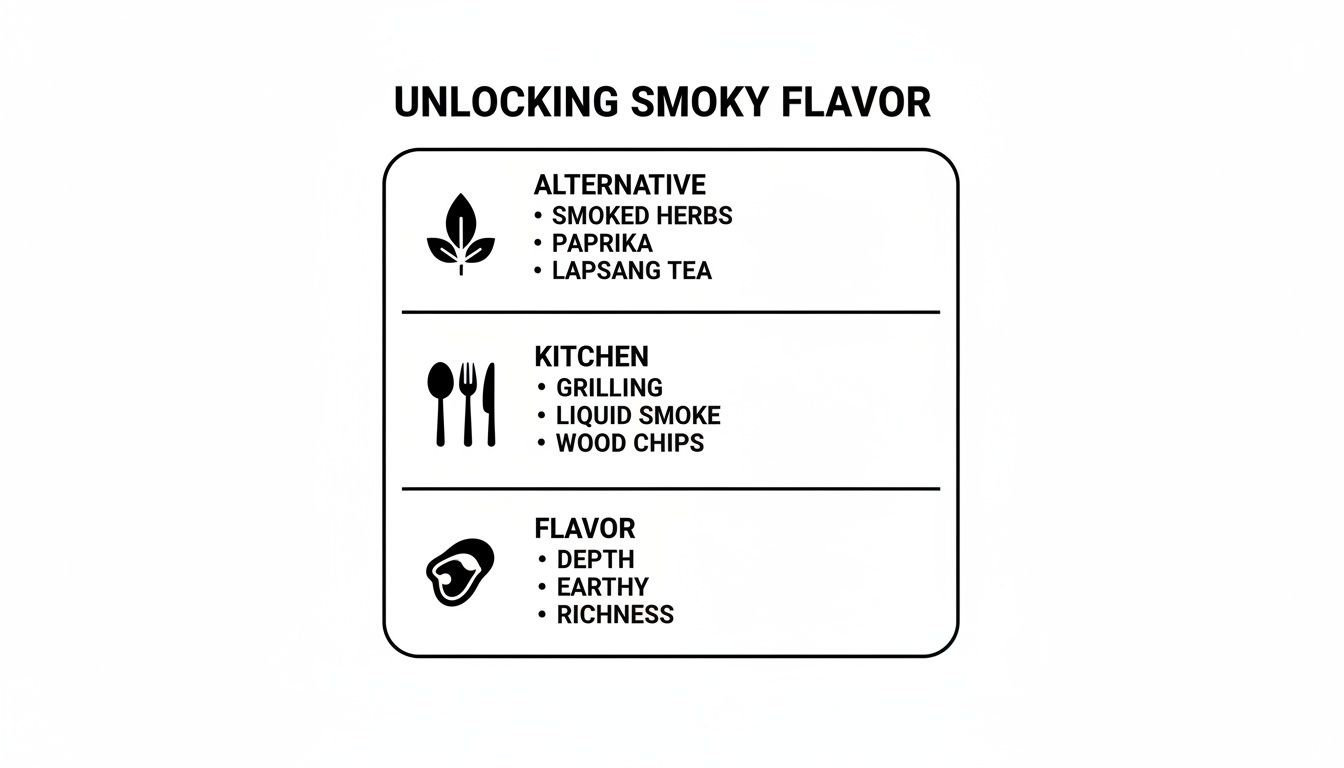
As you can see, achieving a great smoky taste is all about exploring these natural alternatives and using simple kitchen techniques to build up layers of complex flavour.
Creating Your Own Smoky Concentrate at Home
If you really want to get a grip on smoky flavours in your cooking, there's nothing quite like making your own liquid smoke substitute from scratch. Stepping beyond the spice rack lets you craft a liquid concentrate that slips perfectly into marinades, sauces, and soups. It's a brilliant way to capture a pure, clean smoke essence without any weird additives.
The whole process is surprisingly straightforward. We're essentially capturing flavour through infusion—not, I repeat, not trying to create actual smoke indoors (which is very dangerous!). Instead, we're pulling the smoky compounds out of ingredients that have already been smoked or charred. What you're left with is a potent, bespoke liquid you can keep in the fridge for whenever a recipe needs that signature barbecue kick.
Method One: The Smoked Tea Infusion
One of the most elegant and surprisingly effective ways to create a smoky liquid is by using Lapsang Souchong tea. This incredible black tea from China's Fujian province is smoke-dried over pine fires, which gives it a powerful, almost resinous smoky aroma. It creates a concentrate with a wonderfully complex, woody flavour that works wonders in vegetarian dishes or with delicate proteins like chicken and fish.
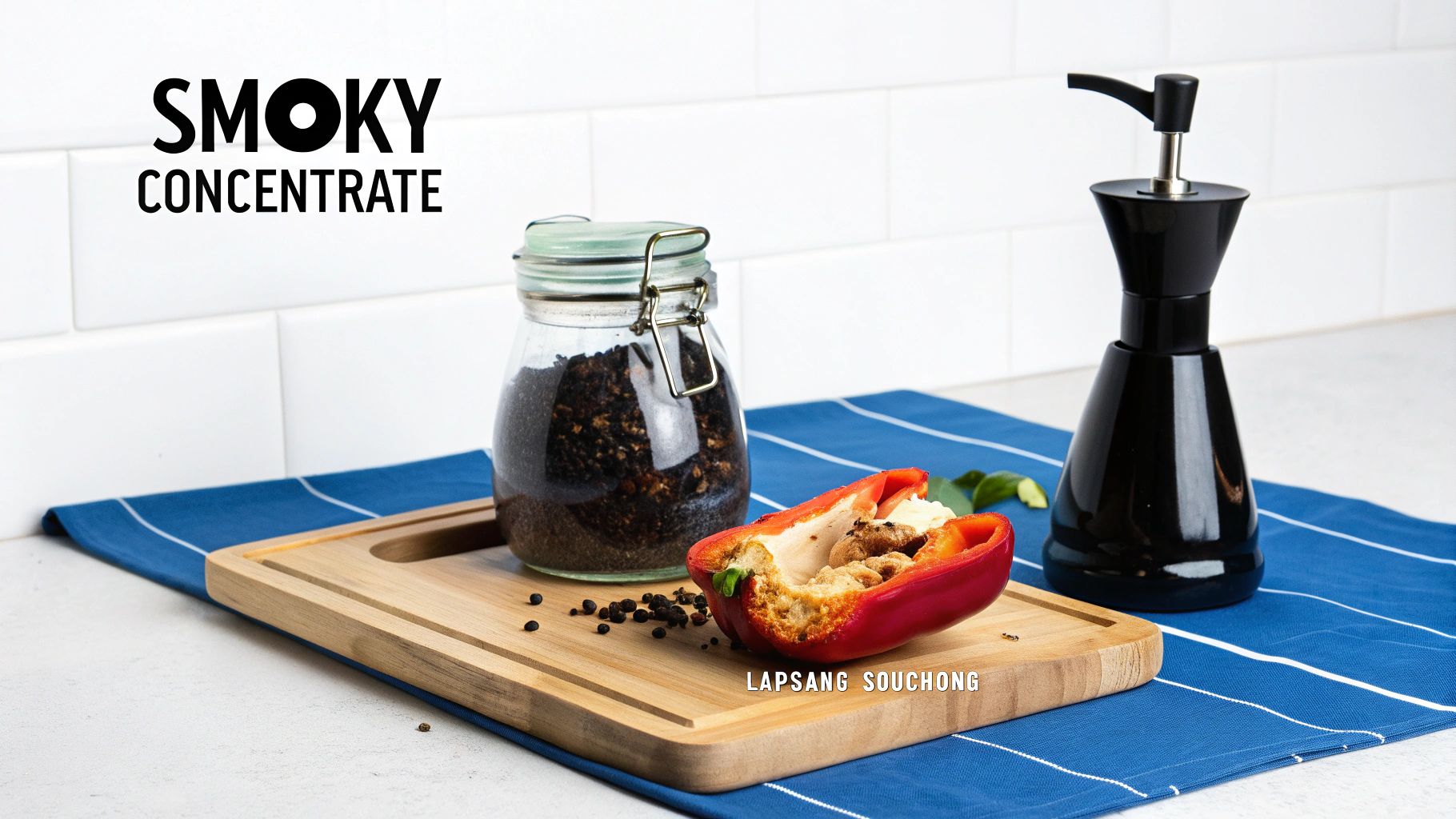
You only need two things to get started.
- 1 tablespoon of loose-leaf Lapsang Souchong tea
- 120 ml (about ½ cup) of boiling water
The ratio is the most important part here. It's the key to getting a potent concentrate without it becoming bitter, which is exactly what happens if you let the tea steep for too long.
Just pop the tea leaves in a heatproof jar or mug and pour the boiling water over them. Let the mixture steep for no longer than 10 minutes. Any more than that, and you'll start pulling out tannins that create a nasty, astringent taste nobody wants.
Once the time is up, immediately strain the liquid through a fine-mesh sieve or even a coffee filter to get rid of all the leaves. Let this dark, aromatic liquid cool down completely before you pour it into a clean, airtight glass jar. This homemade substitute will keep happily in the fridge for up to two weeks. Playing with infusions is a fascinating area of cooking, much like discovering how different essential oils can be used for unique flavours in other culinary creations.
Method Two: The Charred Vegetable Essence
For a deeper, more savoury, and slightly sweeter smoke profile, my personal go-to is a charred vegetable essence. This technique works by intensely charring vegetables like onions, bell peppers, or leeks to capture the incredible flavour that comes from the Maillard reaction and caramelisation. The liquid you end up with has a robust, straight-off-the-grill character that’s perfect for heartier dishes like stews, chilli, or marinades for red meat.
Your best tools for this are a gas hob flame or a very hot grill in your oven. Safety is a big deal here, so make sure your kitchen is well-ventilated—open a window or switch on your extractor fan before you begin.
Pro Tip: When you're charring the vegetables, don't be shy. You want them to get properly black on the outside. This blackened exterior is precisely where all that concentrated smoky flavour is hiding. The inside will just steam and soften, creating a beautiful contrast.
Here’s a quick rundown using a large onion.
First, cut a large yellow onion in half, but leave the skin on for extra flavour.
Place the onion halves, cut-side down, directly onto the grate of a gas hob over a medium-high flame, or stick them under a hot oven grill. You’ll want to let them char for about 5-7 minutes, until the surfaces are deeply blackened and blistered.
Next, carefully move the hot onion halves to a small saucepan and add just enough water to barely cover them—around 250 ml (about 1 cup). Bring the water to a gentle simmer, then pop a lid on the pan, reduce the heat to low, and let it infuse for 20 minutes.
Finally, strain the liquid, and be sure to press down on the onion pieces to squeeze out every last drop of that flavourful juice.
Once it has cooled, this essence can be stored in the fridge in an airtight container for up to a week. It makes a fantastic savoury base and a seriously convincing liquid smoke substitute for so many recipes.
Getting the Most Flavour From Your Substitute
This is where the real fun begins. Mastering your chosen liquid smoke substitute isn’t just about swapping one bottle for another; it’s about understanding how to weave these new, complex notes into your cooking to create something truly memorable. The two things to keep in your mind are application and intensity.
Unlike a standardised shop-bought product, your homemade concoction will have its own unique personality. A smoked tea infusion can be incredibly potent and aromatic, while a paprika oil might offer a much gentler warmth. This is why you should always, always adopt a 'start low and go slow' mentality.
Begin by adding just half of what you think you'll need. Give it a taste, let the flavours mingle for a moment, and then decide if it needs a little more. You can always add another drop, but you can’t take one away once it’s in the pot.
Practical Tips for Application
How you add your smoky substitute is just as important as how much you add. Different dishes call for different approaches to get that perfect, balanced result.
- Marinades and Wet Rubs: This is the time to go all in from the start. Stir your liquid directly into the other ingredients. For big cuts like pulled pork or a brisket-style tri-tip, this gives the smoky essence time to penetrate deep into the meat, building a foundational layer of flavour that cooks right through.
- Glazes and Sauces: Here, you want to hold back and add it towards the end of the cooking process. When you’re glazing roasted carrots or finishing off a homemade barbecue sauce, adding the smoke at the last minute preserves all those bright, aromatic top notes that would otherwise get lost over a long simmer.
- Soups and Stews: Just a few drops stirred in during the final 15 minutes of cooking can introduce a wonderful, complex depth without steamrolling the other ingredients.
The demand for these clever flavour hacks is growing fast. The global liquid smoke market is expected to hit USD 1,14,266.2 thousand by 2028, which tells you just how much people are craving that innovative smoky taste in their home cooking.
A Guide to Flavour Pairing
Pairing your smoky base with complementary ingredients is the secret to creating a truly harmonious dish. The right combination won't just enhance the smokiness; it'll add a whole new dimension of flavour.
Think of your substitute as one instrument in an orchestra. Its flavour is amplified and made more beautiful when it harmonises with others. A smoky note paired with sweetness, acidity, or umami creates a much richer experience.
Consider these tried-and-true pairings:
- Maple Syrup: That pure sweetness is the perfect counterpoint to a deep smoke. It’s ideal for glazes on salmon or for creating bacon-style marinades for tempeh and tofu.
- Soy Sauce or Tamari: This brings a savoury, umami character that grounds the smokiness, making it a brilliant partner in beef marinades or earthy mushroom dishes.
- Balsamic Vinegar: The sharp acidity cuts through any richness and really brightens up the smoke. It works beautifully in salad dressings or as a finishing drizzle over grilled vegetables.
Beyond just picking ingredients, exploring more advanced seasoning techniques to impart smoky flavor without a smoker can give you even more control. In the same way, understanding the properties of concentrated essences, like when using food-grade peppermint oil, offers great insight into how potent flavours behave in a recipe.
Smart Store-Bought Smoky Alternatives
While getting creative in the kitchen is one of life’s great joys, sometimes you just need a quick, reliable, and delicious solution straight from the shelf. Let’s be honest, when you need that smoky flavour now, the supermarket has some fantastic tricks up its sleeve that go way beyond bog-standard liquid smoke.
Choosing a well-made store-bought product can be a brilliant move, especially when consistency and time are your top priorities. It means you can get that complex, layered smokiness in minutes, without any of the faff. From smoked salts to infused oils, these products are designed to deliver a predictable, punchy flavour every single time.
How to Spot the Good Stuff
When you're browsing the aisles, the key is to become a savvy label-reader. Not all smoky products are created equal, and a little bit of knowledge can help you dodge the artificial-tasting options and hidden nasties.
You’re looking for products that get their flavour from an actual smoking process. You want to see phrases like “naturally smoked” or ingredients lists that are simple and recognisable.
- Avoid "Smoke Flavouring": This vague term can sometimes be a red flag for artificial, lab-created compounds that leave a weird chemical aftertaste.
- Check for Hidden Sugars: Many barbecue sauces, a popular smoky alternative, are absolutely loaded with sugar or high-fructose corn syrup. Look for brands that put spices and natural ingredients front and centre, not sweetness.
- Opt for Natural Ingredients: The best products will have a short and sweet ingredients list: things like salt, oil, paprika, or peppers that have been genuinely smoked over real wood.
Here’s a good rule of thumb: if you can’t easily picture how the ingredients were made, it might be best to leave it on the shelf. The goal is to find something that tastes like real food because it’s made from real food.
Your Go-To Commercial Smoky Toolkit
Having a few key items in your pantry can completely transform your cooking. Think of these as your instant smoky flavour enhancers, ready to go at a moment's notice.
Smoked Salt: This is probably the most versatile tool in the kit. It’s made by slow-smoking sea salt over wood fires, infusing each crystal with a deep, aromatic flavour. A pinch can finish off roasted vegetables, season a steak before it hits the grill, or even give a simple tomato soup a surprising depth.
Smoked Olive Oil: Another brilliant choice, this oil is perfect for drizzling over dishes just before they hit the table. Use it to dress a salad, finish a pizza, or add a subtle smoky note to hummus. It adds a layer of flavour without completely taking over.
A High-Quality Barbecue Sauce: Don't underestimate a truly good BBQ sauce. Find one with a rich, complex flavour profile built from ingredients like smoked paprika, chipotle, and molasses. It’s an all-in-one solution for marinades, glazes, or just for dipping.
Ultimately, the choice between DIY and store-bought just comes down to what you need. For a quick weeknight meal or a perfectly consistent batch of your famous chilli, a high-quality commercial product is often the smartest, simplest choice.
Common Questions About Liquid smoke Alternatives
When you start venturing beyond the bottle, a few common questions always seem to surface. Getting them answered can be the difference between a good meal and a great one, giving you the confidence to get that smoky flavour just right.
Let's dive into some of the things people often ask.
How Strong Are These Substitutes?
One of the first things people wonder is whether a DIY alternative can really pack the same punch as the commercial stuff. The honest answer is: it varies, a lot.
A spice-based option like smoked paprika offers a gentler, more buildable warmth. On the other hand, a homemade concentrate using Lapsang Souchong tea can be incredibly powerful and aromatic. My personal rule of thumb is to always start with half the amount you think you’ll need, then taste and adjust as you go. Commercial liquid smoke is highly concentrated, so you'll usually find yourself using a bit more of a homemade substitute to hit that same level of intensity.
The real beauty of any liquid smoke substitute is the control it gives you. You're not stuck with one level of smokiness. You can fine-tune the depth of flavour to perfectly match your recipe, from a subtle whisper to a full-on, straight-off-the-grill blast.
Can I Use These for Curing Meats?
This is a really important safety point. When it comes to curing meats like bacon or making jerky, the answer is a firm no. These DIY and spice-based substitutes are brilliant for adding flavour to things like marinades, barbecue sauces, or stews. They bring the taste, but they absolutely lack the preservative qualities needed to cure meat safely.
Traditional curing methods depend on a very specific combination of salts and a proper smoking process for food preservation. It's best to stick to using these clever alternatives purely for their flavouring power.
Are There Any Substitutes I Should Avoid?
Yes, definitely. The biggest risk is trying to create actual smoke inside by burning wood chips without professional-grade ventilation and equipment. This is a serious fire hazard and creates significant health risks from smoke inhalation.
I'd also be cautious with generic "smoke-flavoured" products you might find, as they can sometimes have a synthetic, chemical aftertaste. For the most authentic and satisfying results, stick with natural ingredients like spices, teas, and charred vegetables. The flavour is just cleaner and far more enjoyable. It's amazing how aromas from natural sources create powerful sensory experiences; you can learn more about a different kind of aromatic effect by seeing how vapour can be used with essential oils.
How Long Will a Homemade Substitute Last?
Shelf life is another key thing to consider. Because these homemade versions don't have any preservatives, their lifespan is much shorter than their shop-bought cousins.
- A smoked paprika oil infusion should be kept in an airtight container in the fridge and is best used within one week.
- A brewed smoked tea concentrate will keep for up to two weeks when refrigerated in a sealed jar.
Always give your homemade substitute a quick look and a sniff before you use it, just to make sure it’s still fresh and good to go.
At AuraFlow, we believe in finding natural, satisfying alternatives that support your well-being. If you're looking for a gentle, nicotine-free way to replace a smoking ritual with mindful moments of flavour, explore our starter kits at https://aura-flow.co.uk.