
Let's get straight to it: why do people smoke? It’s never just one simple reason. Instead, smoking is a tangled web of three powerful forces working together: a biological hook, a set of psychological triggers, and a whole lot of social pressure. This complex mix is precisely what makes it such a tough habit to kick.
Understanding Why People Smoke
Think of a smoking habit like a stubborn old tree. The biological addiction to nicotine is the deep taproot, anchoring the habit firmly in your brain's chemistry. At the same time, the psychological routines and social influences are like a sprawling network of smaller roots, holding it tight in the soil of your daily life. To really get why people smoke, we have to look at each of these roots, big and small.
This guide will break down every part of that system, from the chemical reactions in the brain to the simple comfort of a daily ritual. By untangling this complex web, we can get a much clearer picture of the challenges smokers face and find better, more effective ways to quit for good.
The Three Pillars of Smoking
The reasons people smoke really boil down to three main categories. Each one plays its own part, but they all overlap to keep the habit going.
- Biological Drivers: This is all about nicotine's powerfully addictive nature. It quickly gets its hooks into the brain's reward system, creating a physical dependency that’s incredibly hard to ignore.
- Psychological Triggers: Smoking gets woven into the fabric of daily life and emotions. It becomes a go-to tool for managing stress, a reward after a meal, or just something to do when you're bored.
- Social and Cultural Influences: Let’s face it, peer pressure is real. Family habits and even how smoking is shown in films can make it seem normal. It often starts as a social thing, a way to fit in or feel a bit rebellious.
This diagram helps to visualise how these three core pillars of the smoking habit work together.
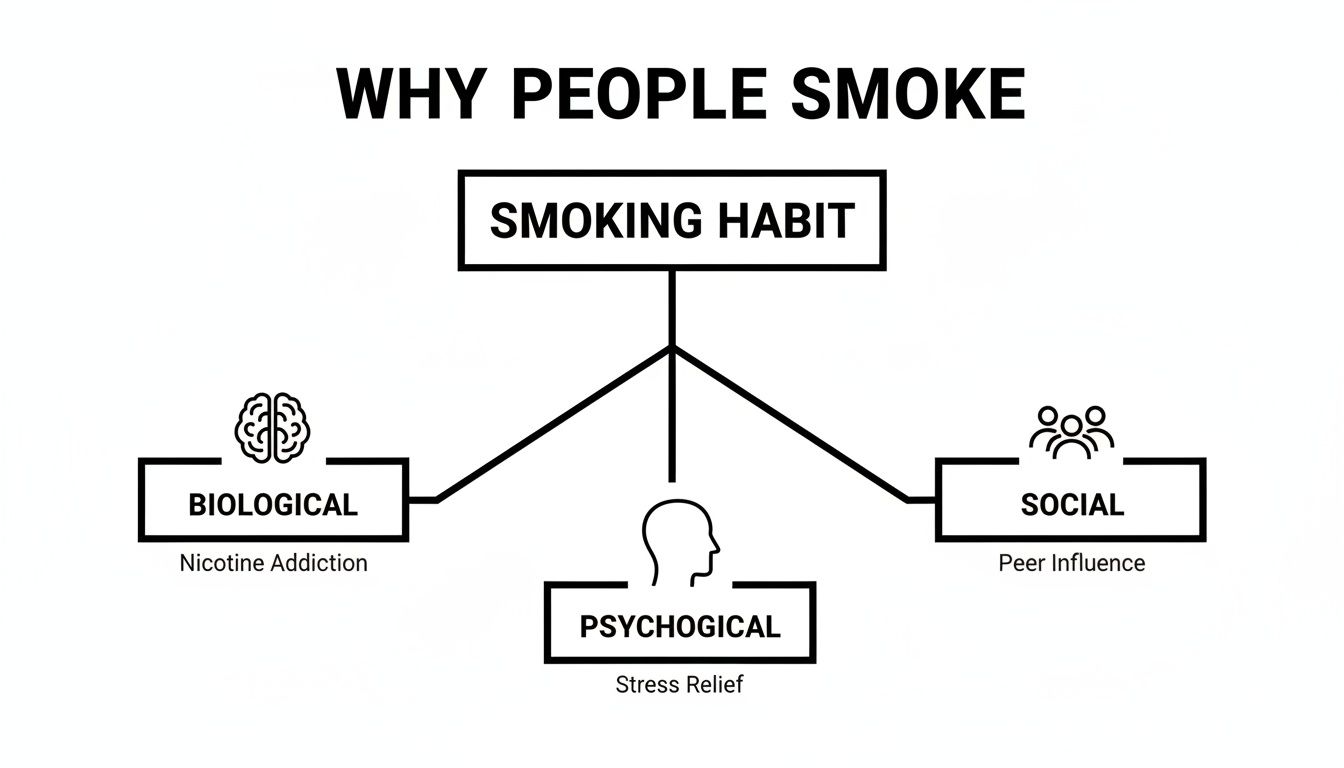
As you can see, these forces don't work in isolation. They feed off each other, creating a powerful cycle that makes the behaviour feel almost automatic.
To give you a quick overview, this table summarises the main drivers we've discussed.
Key Drivers of Smoking at a Glance
| Driver Category | Primary Mechanism | Common Examples |
|---|---|---|
| Biological | Nicotine Addiction & Brain Chemistry | Dopamine rush, physical withdrawal symptoms, intense cravings. |
| Psychological | Habit, Routine & Emotional Coping | Morning coffee cigarette, post-meal smoke, stress relief. |
| Social & Cultural | Peer Influence & Normalisation | Smoking with friends, family members who smoke, media portrayals. |
This table shows just how intertwined these factors are, creating a habit that is much more than just a simple choice.
Someone might start smoking to fit in with friends, but they continue because of the psychological comfort and the physical addiction that quickly follows. It’s this powerful combination that explains why simply "deciding to quit" often isn't enough without a proper plan that tackles all three areas.
Grasping this framework is the first crucial step. It helps us move away from seeing addiction as a simple lack of willpower and towards a more realistic and compassionate understanding. This mindset opens the door to modern solutions that don't just fight the nicotine cravings, but also address the behavioural patterns left behind—like using nicotine-free alternatives such as AuraFlow to satisfy that deep-seated ritualistic urge.
The Biological Hook of Nicotine Addiction
To really get to the bottom of why people smoke, we need to look inside the brain. This isn't a story about a lack of willpower; it’s about a powerful chemical hijacking that begins with a single puff. The main character in this story is nicotine, a substance that acts like a master key inside our neural pathways.
When you inhale, nicotine zips from the lungs to the brain in just a few seconds—even faster than many drugs injected directly into the bloodstream. Once it arrives, it perfectly mimics a natural neurotransmitter called acetylcholine, slotting into specific receptors and unlocking the brain's entire reward system.
The result? An artificial flood of a chemical called dopamine, often nicknamed the "feel-good" molecule. This sudden surge creates a temporary wave of pleasure, calm, and focus. Your brain immediately registers this feeling as something incredibly important, something worth doing again. And again.
The Dopamine Cycle Explained
Think of your brain's reward circuit as a system designed to encourage survival behaviours, like eating a good meal or connecting with friends. When you do these things, it releases a small, healthy dose of dopamine, gently nudging you with a message: "That was good, let's repeat that."
Nicotine doesn't just nudge; it shoves. It short-circuits this finely tuned system, unleashing a dopamine hit that's far more intense and rapid than anything you'd get from natural rewards. It effectively teaches the brain that smoking is one of the most vital things it can do to feel good.
This process of chemical reinforcement is the very foundation of physical addiction. The brain forges a powerful link between the act of smoking and an immediate, intense reward, creating a compelling loop that's incredibly tough to escape.
This repeated cycle quickly leads to physical dependency, as the brain adapts and starts to see this constant stream of nicotine as the new normal.
Tolerance: The Never-Ending Chase
At first, maybe one cigarette is all it takes to get that hit of calm or pleasure. But the brain is smart and highly adaptable. With repeated exposure, the nicotine receptors become less sensitive. This process is known as tolerance.
This means the same amount of nicotine no longer cuts it. To get that original dopamine rush, a person has to smoke more often or switch to stronger tobacco. What began as a single cigarette after dinner can quickly snowball into two, then a whole pack a day. It’s a classic case of chasing a high that keeps moving further and further away.
This escalating need is a core reason why a casual act can intensify over time, turning into a constant, gnawing necessity.
Withdrawal: The Brain's Cry for Nicotine
So, once the brain has rewired itself to expect a steady supply of nicotine, what happens when you take it away? This is where withdrawal kicks in, and it's a brutal experience.
When a regular smoker goes too long without a cigarette, their dopamine levels don't just return to normal; they plummet. The brain, now utterly dependent on nicotine to function, sounds the alarm. It sends out urgent signals that something is seriously wrong, triggering a host of deeply unpleasant physical and psychological symptoms.
Common withdrawal symptoms include:
- Intense Cravings: An overwhelming, almost primal urge to smoke.
- Irritability and Anxiety: Feeling on edge, short-tempered, and completely stressed out.
- Difficulty Concentrating: A thick mental fog that makes it impossible to focus.
- Restlessness and Insomnia: An inability to relax or get a decent night's sleep.
These symptoms aren't just "in your head." They are real, physical responses from a brain screaming for a chemical it has come to rely on. The quickest way to silence that alarm is to have another cigarette, which sends dopamine levels soaring back up and locks the entire addictive cycle firmly back in place.
Understanding this biological mechanism is crucial. It shows that quitting isn't just about breaking a bad habit; it's about giving your brain the time it needs to heal and recalibrate its own chemistry. If you're facing this challenge, it can be a massive help to understand how long cravings last and what to expect. The biological hook is powerful, but with the right knowledge, it is possible to unlatch it for good.
Psychological Triggers and The Comfort of Ritual
While nicotine certainly creates a powerful chemical hook, the reasons people smoke run much deeper than brain chemistry. The habit quickly weaves itself into the fabric of your day, turning the simple act of lighting up into a deeply ingrained psychological ritual.
It’s this mental side of the habit that often makes quitting feel so impossible.

Beyond the physical addiction, a cigarette becomes a trusted companion—a reliable tool for navigating life's ups and downs. It offers a moment of pause, a predictable pattern in an often chaotic world, forging a psychological bond that can feel just as strong as the physical one.
The Power of Conditioning and Daily Routines
Much of smoking’s psychological grip comes down to a simple but powerful process called classical conditioning. This is just a fancy way of saying your brain learns to connect smoking with specific activities, feelings, or times of day. Over time, these cues become automatic triggers that spark a craving out of nowhere.
Think of it like this: every morning, you have a coffee and a cigarette together. Your brain builds a strong connection between the two. Soon enough, just the smell of coffee is enough to make you desperate for a smoke, even if your body doesn't physically need nicotine at that moment. The cue itself has become the trigger.
This process links smoking to countless moments in your day, turning ordinary routines into a series of automated prompts to light up.
Common Psychological Triggers for Smoking
These conditioned responses create a landscape of triggers that are unique to each person but usually fall into a few common categories. Spotting your own is the first step toward breaking the cycle.
- Emotional Triggers: Many people smoke to manage their feelings. A cigarette might become a go-to coping mechanism for stress, a way to numb anxiety, or a companion during moments of sadness or boredom.
- Routine Triggers: This is the most common one. It includes smoking with your morning coffee, right after a meal, during a break at work, or while driving. These acts become so intertwined that doing one without the other just feels wrong.
- Social Triggers: Being around other smokers, going to a party, or even having a drink at the pub can create a powerful urge to smoke. The environment itself becomes the cue, tied to all the past times you've smoked in a similar situation.
This network of triggers ensures that the desire to smoke isn't just a random craving; it's a predictable, automated response to living your life, making the habit feel essential for getting through the day.
The ritual of smoking provides a sense of structure and control. Taking a five-minute smoke break isn’t just about nicotine; it’s about stepping away, taking a deep breath, and having a moment of guaranteed personal time. This predictable pause can be incredibly comforting.
The Comfort of the Physical Act Itself
Beyond the triggers, the sheer physical act of smoking provides its own unique comfort. That repetitive hand-to-mouth motion is a soothing, familiar behaviour that can ease tension and give you something to focus on during stressful moments.
This is closely related to what psychologists call an oral fixation, where the mouth becomes a source of comfort and stress relief. For many smokers, this ritual is a huge part of the addiction. It’s the feeling of the cigarette in their fingers, the act of lighting it, and the sensation of inhaling and exhaling.
If you’re curious about the psychology behind this, our guide on what is an oral fixation explains exactly how this powerful behaviour works.
This is why so many people who quit find themselves missing the act of smoking just as much as the nicotine, if not more. They need something to do with their hands, a way to replicate that familiar, calming ritual. Breaking this psychological dependency means finding new ways to manage stress, fill those routine gaps, and satisfy that deep-seated need for a comforting, repetitive action.
Social Circles and Cultural Influence
While brain chemistry and personal habits are huge drivers, they don't paint the full picture of why people smoke. Let's be honest: smoking is rarely a solo act. More often than not, it starts—and stays—within our social worlds. Our connections with friends, family, and colleagues can be a powerful force that either introduces us to smoking or keeps the habit firmly locked in place.
Think back to when most people first try a cigarette. It’s usually during those teenage years or early adulthood, a time when fitting in feels like everything. The urge to belong, to look a bit older, or even just to see what all the fuss is about, is a potent mix. That first cigarette is often less about a real craving and more about a social handshake.
For many, smoking becomes a kind of membership card to a social club. It's a reason to gather, a shared ritual that breaks the ice, and a way to build a quick sense of camaraderie. This social reinforcement makes the habit feel normal, even desirable, especially when you're young.
The Power of Peer Groups and Normalisation
When smoking is common within your circle of friends or family, it just becomes… normal. The health risks seem a million miles away when the people you look up to or hang out with are all doing it. This is social normalisation in action—where a behaviour, despite its known dangers, gets accepted as just part of the group's life.
It's not always about obvious peer pressure, like someone daring you to light up. It’s often much more subtle. It’s seeing your mates step outside for a smoke break and not wanting to be left out of the conversation. It’s the unspoken feeling that to be part of the crew, you take part in its rituals.
And this dynamic doesn’t just stop in your teens. It carries right on into adulthood, especially in certain environments.
- Workplace Culture: The "smokers' corner" outside the office is a classic example. It's a place where colleagues from different teams connect, share gossip, and build relationships. Missing out on that informal networking can make you feel a bit excluded.
- Nightlife and Social Events: In pubs, clubs, or at parties, smoking can feel like a natural part of the atmosphere. That link between having a drink and having a cigarette is a powerful social cue that prompts you to light up.
- Family Influence: If you grew up in a house where your parents or older siblings smoked, the habit can easily seem like a normal part of being an adult. The behaviour is modelled from a young age, making it far more likely that you'll start smoking yourself.
From Hollywood Glamour to Modern Influences
Beyond our immediate circles, wider cultural messages have long shaped how we see smoking. For decades, films and TV glamorised cigarettes, presenting them as symbols of sophistication, rebellion, or effortless cool.
Just picture that classic detective lighting up in a moody alleyway, or the elegant film star with a cigarette holder. These images wove smoking into our cultural fabric, tying it to traits we found desirable. While today's advertising is heavily restricted, the echoes of that legacy still linger.
Now, that influence has shifted. In the UK, while smoking rates are dropping overall, social dynamics still keep the habit alive in specific groups. One of the main reasons people still smoke cigarettes is its high prevalence among young adults aged 25 to 34, who had the highest smoking proportion at 14.0% in 2023. This trend is often fuelled by social pressures, career stress, and smoking being normalised in nightlife scenes. You can find out more about these smoking trends in Great Britain from the Office for National Statistics.
For so many people, the social side of smoking is the toughest barrier to quitting. The fear of losing those connections, of feeling awkward in social situations, or being cut off from your core group of friends can be more daunting than facing the physical withdrawal itself.
Ultimately, this social web adds another deeply human layer to the question of "why do people smoke cigarettes?". It shows that the decision to smoke—and the struggle to quit—is tangled up in our fundamental need to connect and belong.
The Impact of Economics and Environment
It's easy to think of smoking as a personal choice, but if we zoom out, a much bigger picture comes into view. The reality is, your postcode can influence your likelihood of smoking just as much as your personal psychology. Smoking isn't an equal-opportunity habit; it hits communities facing financial hardship and systemic disadvantages the hardest.
This isn’t a coincidence. It’s a direct result of stress, accessibility, and decades of targeted marketing.
For many, a cigarette becomes a tool to manage the chronic, grinding stress of economic instability. When you’re worried about paying the rent, finding secure work, or dealing with poor housing, the immediate, calming hit from nicotine can feel like a necessary crutch. It’s a small, predictable moment of relief in an otherwise unpredictable life—a coping mechanism born from circumstances, not a simple lack of willpower.
This powerful link between financial strain and smoking is a major public health challenge.
The Geography of Smoking
You can literally map the correlation between deprivation and smoking across the UK, where certain regions consistently show higher rates. These are often the same areas grappling with greater levels of poverty, unemployment, and limited opportunities, creating a perfect storm where smoking becomes deeply entrenched in daily life.
In the UK, social and economic hardship is a huge driver. Just look at regions like the North East of England and Scotland, which have struggled with stubbornly high rates for years. While the national average has fallen to 11.9% of UK adults smoking in 2023, progress in deprived areas lags far behind.
The North East, for example, has seen an impressive 48.2% drop since 2011, yet its rate remains stubbornly above the national average. Statistics from 2022 show a similar story, with prevalence at 14.1% in Wales, 14.0% in Northern Ireland, and 13.9% in Scotland. This data shows how lower-income groups often turn to nicotine to cope with the immense pressures of their environment. You can dig into the numbers yourself in this detailed breakdown from Action on Smoking and Health.
The data paints a clear picture: smoking is deeply tangled up with societal inequality. You simply can't separate the issue from the broader economic health of a community.
This context is crucial. It shifts the conversation from blaming individual smokers to recognising the powerful systemic pressures that foster and sustain the habit. When basic needs are a daily struggle, long-term health can easily take a backseat to short-term survival.
An Uneven Playing Field
Economic factors don't just influence if people smoke, but also what they smoke. In areas with less disposable income, cheaper options like hand-rolled tobacco are far more common. This ensures that cost, while a barrier, doesn't stop people from smoking entirely—it just pushes them toward more affordable, but equally harmful, alternatives.
Let’s not forget, the tobacco industry has a long, well-documented history of targeting lower-income and vulnerable communities. By concentrating its marketing in these areas through point-of-sale ads and historical sponsorships, the industry successfully embedded its products into the cultural fabric of these neighbourhoods.
This strategic targeting creates an environment where smoking is not only normalised but constantly visible, making it that much harder for someone to quit or for a young person to avoid starting. The fight to stop smoking isn't just an internal battle; it's a fight against an environment saturated with triggers and economic stressors that make lighting up feel like the easiest choice.
Pathways To Quitting Smoking For Good

Knowing why you smoke is one thing; using that knowledge to finally stop is the real game-changer. Breaking free from cigarettes is a deeply personal journey, and there’s no single "right" way to go about it. The secret is to build a plan that works for you—one that tackles both the physical addiction and the deeply ingrained psychological habits we've explored.
Most people find success by combining a few different strategies. This multi-pronged approach works because you're not just fighting a chemical dependency. You're also rewiring years of learned behaviours and emotional triggers. It’s all about finding the right tools to get the job done.
Proven Strategies for Quitting
When it comes to the physical side of things, a few evidence-based methods have a strong track record of helping people quit for good. These are designed to take the edge off withdrawal symptoms, making it so much easier to focus on breaking those psychological ties.
- Nicotine Replacement Therapy (NRT): This is a very common starting point. Products like patches, gum, and lozenges give you a controlled dose of nicotine without the thousands of other harmful chemicals found in tobacco smoke. This helps ease the cravings while you work on changing your habits.
- Behavioural Support: This could mean working with a trained professional, either one-on-one or in a group setting. Counsellors can help you pinpoint your personal triggers and come up with practical ways to manage them when they pop up.
- Prescription Medications: Certain medications can also help by reducing cravings and making smoking less enjoyable if you do slip up. These are available through your GP and can be a powerful part of a quit plan.
Remember, quitting is a process of unlearning. Each time you resist a craving or use a new coping skill, you are actively weakening the old neural pathways and building new, healthier ones. The goal is progress, not perfection.
Addressing the Comfort of Ritual
For so many people, the biggest hurdle isn't the nicotine—it’s the loss of the ritual. That familiar hand-to-mouth motion, the structured break in your day, the deep breath you take. These actions provide a huge amount of psychological comfort. This is where modern, nicotine-free alternatives can play a vital role.
These tools are designed to satisfy those behavioural urges without delivering any harmful chemicals. They let you keep the familiar physical motion, providing a comforting bridge away from the old habit. By replicating the hand-to-mouth action, they help you decouple the ritual from the chemical reward, making the transition feel far less jarring. This can be a game-changing step, and you can explore more about alternatives to smoking cigarettes to see what might fit your lifestyle.
Quitting smoking is one of the most powerful things you can do to reduce cardiovascular risk and improve your overall health. For a deeper dive into how this affects your body, it's helpful to understand the causes and impact of high blood pressure. Ultimately, finding the right combination of support—from NRT to behavioural strategies and ritual replacements—is what empowers you to build a smoke-free life that feels both sustainable and genuinely rewarding.
A Few Common Questions
Digging into the reasons why we smoke can bring up a lot of questions. Let’s clear up a few of the most common ones, building on what we’ve already explored about this complicated habit.
Is Smoking Just a Physical Addiction to Nicotine?
Not at all. While nicotine’s physical hold is incredibly powerful, it's only one part of the story. Smoking is also a deeply ingrained psychological and social habit. We use cigarettes to manage stress, to mark the end of a meal, or to connect with colleagues during a break.
To successfully quit, you really have to tackle all three of these things: the physical cravings, the mental triggers that make you reach for a cigarette, and the social situations that normalise it. If you ignore one, the whole habit can stay standing.
Think of it like a three-legged stool. The physical, psychological, and social aspects all support the habit. If you only kick out one leg, the stool won't fall. That's why a whole-person approach to quitting is so much more effective.
Why Do People Start Smoking When They Know the Risks?
Most people light up their first cigarette during their teens or early twenties. This is a time when social pressure is at its peak and the part of the brain that weighs up long-term risks isn't fully developed yet. The immediate reward of fitting in or feeling grown-up often feels way more important than a distant health problem.
Once that starts, nicotine can hijack the brain’s reward system surprisingly fast. What begins as a social experiment can quickly spiral into a powerful physical and psychological dependency that becomes incredibly difficult to break.
How Can Nicotine-Free Alternatives Actually Help Someone Quit?
This is a great question. Nicotine-free alternatives are such a useful tool because they go straight for the behavioural and ritualistic side of the addiction. For so many of us, the simple physical act of raising something to our lips and inhaling provides a huge amount of comfort and structure to the day.
These kinds of products let you go through that familiar hand-to-mouth motion, satisfying the habit without any nicotine or harmful tobacco smoke. This helps to slowly break the link between the physical action and the chemical reward, making it easier to manage cravings and transition towards a completely smoke-free life.
Ready to break the cycle of ritual and find a calmer way forward? AuraFlow offers a nicotine-free, natural alternative designed to satisfy the hand-to-mouth habit with gentle, pleasant flavours. Discover a new ritual and begin your smoke-free journey at https://aura-flow.co.uk.